


Large vasodilatations in skeletal muscle of resting conscious dogs and their contribution to blood pressure variability
- PMID: 10990545
- PMCID: PMC2270085
- DOI: 10.1111/j.1469-7793.2000.t01-1-00611.x
Large vasodilatations in skeletal muscle of resting conscious dogs and their contribution to blood pressure variability
Abstract
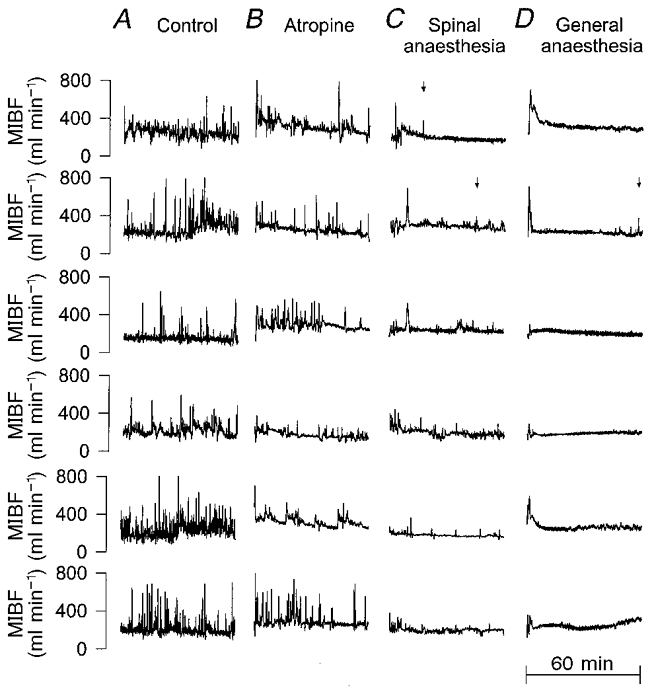
Large (up to +400 %) transient ( approximately 20 s) increases of blood flow were observed in the external iliac arteries of resting conscious dogs (n = 10) in the absence of major alerting or muscular activity. At the same time arterial pressure (AP) fell slightly while heart rate (HR) rose. The vasodilatations were resistant to atropine, ganglionic, beta-adrenergic and NO-synthase inhibition, but were suppressed by spinal or general anaesthesia. Vasodilatations of similar appearance were elicited by an alerting sound; these were abolished by atropine. The spontaneous vasodilatations occurred simultaneously and their magnitudes were well correlated between both legs, but were not correlated to the amount of concomitant activation of the surface electromyogram. The duration of this activation almost never outlasted 10 s. The reactive hyperaemia observed after a total occlusion of the artery even for 16 s was not large enough to explain the size of the spontaneous vasodilatations. Occlusion during peak flow of the vasodilatations did not affect the size of the reactive hyperaemia. Spectral analysis made separately for data segments with and without vasodilatation revealed that the vasodilatations substantially enhanced the variability of AP and HR at frequencies below approximately 0.1 Hz. In conclusion, large coordinated skeletal muscle vasodilatations were identified in resting conscious dogs, which are initiated neurally, but not by sympathetic-cholinergic or nitroxidergic fibres and which do not show any clear correlation to muscular contraction. The vasodilatations substantially affect the regulation of skeletal muscle blood flow and explain a significant portion of AP and HR variability.
Figures




References
-
- Bendat JS, Piersol AG. Random Data: Analysis and Measurement Procedures. New York: Wiley; 1986.
-
- Bigger JTJ, Fleiss JL, Rolnitzky LM, Steinman RC. The ability of several short-term measures of RR variability to predict mortality after myocardial infarction. Circulation. 1993;88:927–934. - PubMed
-
- Camm AJ, Malik M, Bigger JT, Breithardt G, Cerutti S, Cohen RJ, Coumel P, Fallen EL, Kennedy HL, Kleiger RE, Lombardi F, Malliani A, Moss AJ, Rottman JN, Schmidt G, Schwartz PJ, Singer DH. Heart rate variability – standards of measurement, physiological interpretation, and clinical use (Task force of the European Society of Cardiology and the North American Society of Electrophysiology) Circulation. 1996;93:1043–1065. - PubMed
-
- Caraffa-Braga E, Granata L, Pinotti O. Changes in blood flow distribution during acute emotional stress in dogs. Pflügers Archiv. 1973;339:203–316. - PubMed
Publication types
MeSH terms
Substances
LinkOut - more resources
Full Text Sources
