


Sequencing of the rpoB gene in Legionella pneumophila and characterization of mutations associated with rifampin resistance in the Legionellaceae
- PMID: 10991843
- PMCID: PMC90134
- DOI: 10.1128/AAC.44.10.2679-2683.2000
Sequencing of the rpoB gene in Legionella pneumophila and characterization of mutations associated with rifampin resistance in the Legionellaceae
Abstract
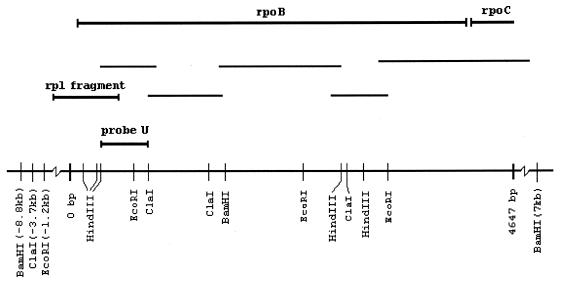
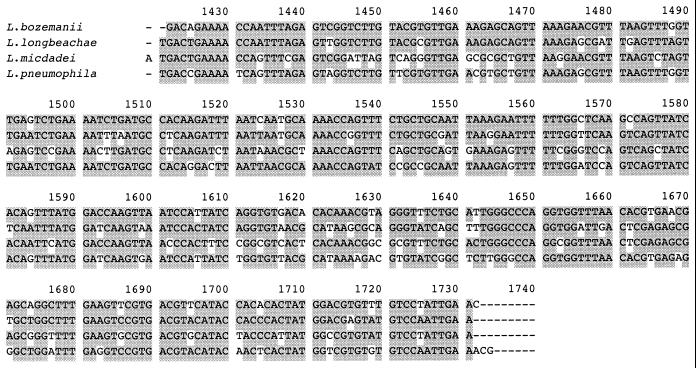
Rifampin in combination with erythromycin is a recommended treatment for severe cases of legionellosis. Mutations in the rpoB gene are known to cause rifampin resistance in Escherichia coli and Mycobacterium tuberculosis, and the purpose of the present study was to investigate a possible similar resistance mechanism within the members of the family Legionellaceae. Since the RNA polymerase genes of this genus have never been characterized, the DNA sequence of the Legionella pneumophila rpoB gene was determined by the Vectorette technique for genome walking. A 4,647-bp DNA sequence that contained the open reading frame (ORF) of the rpoB gene (4,104 bp) and an ORF of 384 bp representing part of the rpoC gene was obtained. A 316-bp DNA fragment in the center of the L. pneumophila rpoB gene, corresponding to a previously described site for mutations leading to rifampin resistance in M. tuberculosis, was sequenced from 18 rifampin-resistant Legionella isolates representing four species (L. bozemanii, L. longbeachae, L. micdadei, and L. pneumophila), and the sequences were compared to the sequences of the fragments from the parent (rifampin-sensitive) strains. Six single-base mutations which led to amino acid substitutions at five different positions were identified. A single strain did not contain any mutations in the 316-bp fragment. This study represents the characterization of a hitherto undescribed resistance mechanism within the family Legionellaceae.
Figures

Comment in
-
Update on rifampin resistance in the Legionellaceae.Antimicrob Agents Chemother. 2001 Jul;45(7):2181-2. doi: 10.1128/AAC.45.7.2181-2182.2001. Antimicrob Agents Chemother. 2001. PMID: 11441826 Free PMC article. No abstract available.
References
-
- Aboshkiwa M, Al-Ani B, Coleman G, Rowland G. Cloning and physical mapping of the Staphylococcus aureus rplL, rpoB and rpoC genes, encoding ribosomal protein L7/L12 and RNA polymerase subunits beta and beta′. J Gen Microbiol. 1992;138:1875–1880. - PubMed
-
- Al-Ani B, Aboshkiwa M, Glass R E, Coleman G. The patterns of extracellular protein formation by spontaneously-occurring rifampicin-resistant mutants of Staphylococcus aureus. FEMS Microbiol Lett. 1990;70:91–94. - PubMed
-
- Arnold C, Hodgson I J. Vectorette PCR: a novel approach to genomic walking. PCR Methods Appl. 1991;1:39–42. - PubMed
-
- Bangsborg J M, Hindersson P, Shand G, Høiby N. The Legionella micdadei flagellin: expression in Escherichia coli and DNA sequence of the gene. APMIS. 1995;103:869–877. - PubMed
MeSH terms
Substances
Associated data
- Actions
- Actions
- Actions
- Actions
- Actions
- Actions
- Actions
LinkOut - more resources
Full Text Sources
