Upregulation of ERG genes in Candida species by azoles and other sterol biosynthesis inhibitors
- PMID: 10991846
- PMCID: PMC90137
- DOI: 10.1128/AAC.44.10.2693-2700.2000
Upregulation of ERG genes in Candida species by azoles and other sterol biosynthesis inhibitors
Abstract
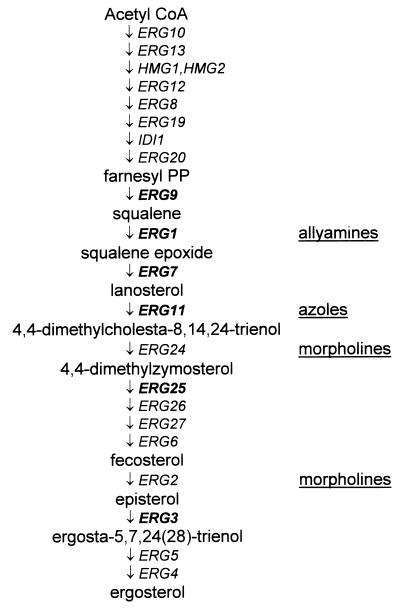
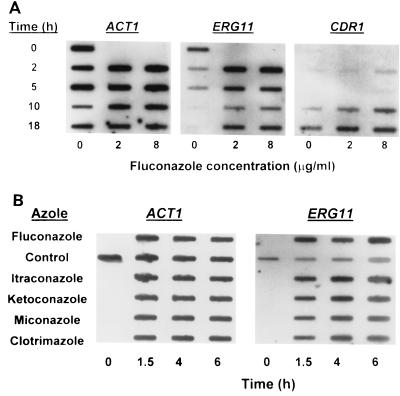
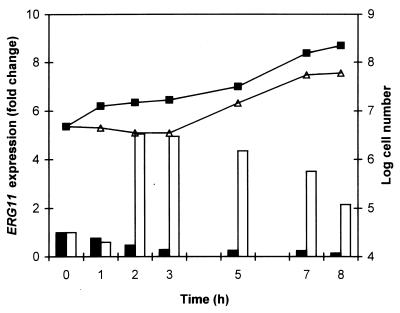
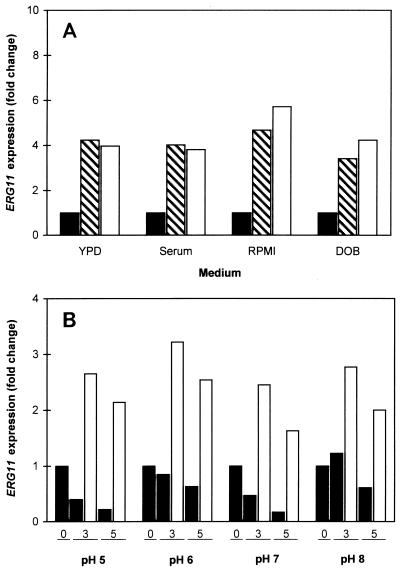
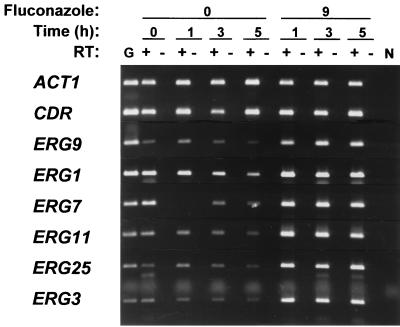
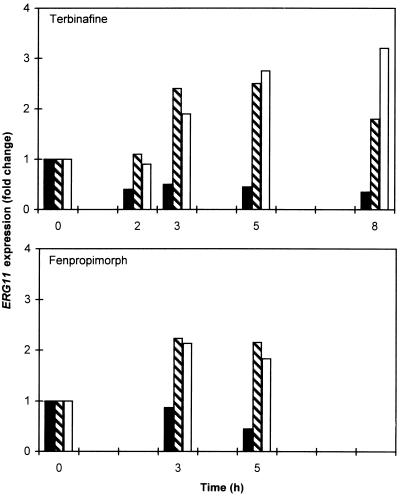
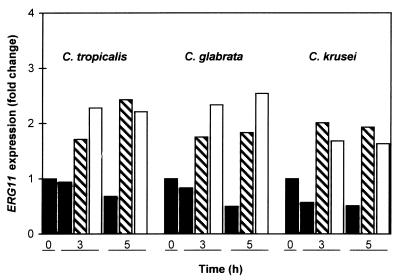
Infections due to Candida albicans are usually treated with azole antifungals such as fluconazole, but treatment failure is not uncommon especially in immunocompromised individuals. Relatedly, in vitro studies demonstrate that azoles are nonfungicidal, with continued growth at strain-dependent rates even at high azole concentrations. We hypothesized that upregulation of ERG11, which encodes the azole target enzyme lanosterol demethylase, contributes to this azole tolerance in Candida species. RNA analysis revealed that ERG11 expression in C. albicans is maximal during logarithmic-phase growth and decreases as the cells approach stationary phase. Incubation with fluconazole, however, resulted in a two- to fivefold increase in ERG11 RNA levels within 2 to 3 h, and this increase was followed by resumption of culture growth. ERG11 upregulation also occurred following treatment with other azoles (itraconazole, ketoconazole, clotrimazole, and miconazole) and was not dependent on the specific medium or pH. Within 1 h of drug removal ERG11 upregulation was reversed. Azole-dependent upregulation was not limited to ERG11: five of five ERG genes tested whose products function upstream and downstream of lanosterol demethylase in the sterol biosynthetic pathway were also upregulated. Similarly, ERG11 upregulation occurred following treatment of C. albicans cultures with terbinafine and fenpropimorph, which target other enzymes in the pathway. These data suggest a common mechanism for global ERG upregulation, e.g., in response to ergosterol depletion. Finally, azole-dependent ERG11 upregulation was demonstrated in three additional Candida species (C. tropicalis, C. glabrata, and C. krusei), indicating a conserved response to sterol biosynthesis inhibitors in opportunistic yeasts.
Figures
References
-
- Alarco A M, Balan I, Talibi D, Mainville N, Raymond M. AP1-mediated multidrug resistance in Saccharomyces cerevisiae requires FLR1 encoding a transporter of the major facilitator superfamily. J Biol Chem. 1997;272:19304–19313. - PubMed
-
- Arthington-Skaggs B A, Crowell D N, Yang H, Sturley S L, Bard M. Positive and negative regulation of a sterol biosynthetic gene (ERG3) in the post-squalene portion of the yeast ergosterol pathway. FEBS Lett. 1996;392:161–165. - PubMed
-
- Cannon R D, Kerridge D. Correlation between the sterol composition of membranes and morphology in Candida albicans. J Med Vet Mycol. 1988;26:57–65. - PubMed
Publication types
MeSH terms
Substances
Grants and funding
LinkOut - more resources
Full Text Sources
Other Literature Sources