. 2000 Oct;68(10):5567-74.
doi: 10.1128/IAI.68.10.5567-5574.2000.

Salmonella enterica serovar typhimurium-dependent regulation of inducible nitric oxide synthase expression in macrophages by invasins SipB, SipC, and SipD and effector SopE2

Affiliations

Salmonella enterica serovar typhimurium-dependent regulation of inducible nitric oxide synthase expression in macrophages by invasins SipB, SipC, and SipD and effector SopE2

B J Cherayil et al. Infect Immun. 2000 Oct.

Abstract

When Salmonella enterica invades mammalian cells, it activates signals leading to increased expression of inflammatory mediators. One such mediator is nitric oxide (NO), which is produced under control of the enzyme inducible NO synthase (iNOS). Induction of iNOS in response to Salmonella infection has been demonstrated, but the bacterial effector molecules that regulate expression of the enzyme have not been identified. In the study reported here, an analysis of Salmonella-dependent iNOS expression in macrophages was carried out. Wild-type Salmonella strains increased the levels of both iNOS protein and mRNA in murine macrophage cell lines in an invasion-independent fashion. Mutant strains lacking a functional pathogenicity island 1-encoded type III secretion system, as well as strains lacking the invasins SipB, SipC, and SipD, were impaired in iNOS induction. Complementation experiments indicated that all three of the invasins were required for induction of iNOS expression. These results suggested that an effector protein, translocated into macrophages via the type III secretion system in a SipB-, SipC-, and SipD-dependent manner, might be the ultimate mediator of iNOS induction. In keeping with this idea, a mutant strain deficient in SopE2, a recently described homolog of SopE, was found to be impaired in the induction of iNOS expression. These observations suggest that iNOS expression is regulated by signals activated by SopE2 (and possibly SopE) and that the role of SipB, SipC, and SipD in this process is to facilitate translocation of the relevant effector.


Figures
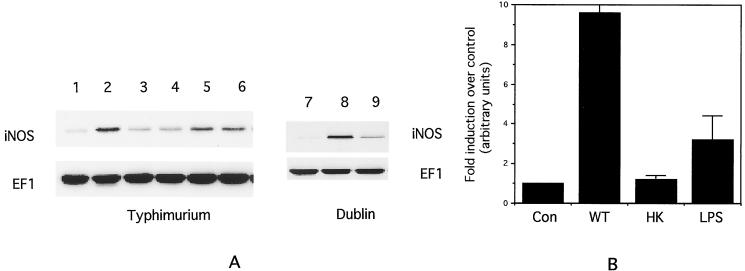
FIG. 1
FIG. 1
(A) Western blot of iNOS and EF1 expression in RAW264.7 cells infected with Salmonella. Lane 1, control; lane 2, SL1344; lane 3, heat-killed SL1344; lane 4, formaldehyde-fixed SL1344; lane 5, 100 ng of LPS per ml; lane 6, heated LPS; lane 7, control; lane 8, 2229; lane 9, chloramphenicol-treated 2229. (B) Quantitation of mean iNOS band intensities from three separate experiments similar to that shown in panel A. Con, control; WT, wild-type Salmonella; HK, heat-killed Salmonella; LPS, 100 ng of LPS per ml. Error bars indicate the standard deviations.
FIG. 2
FIG. 2
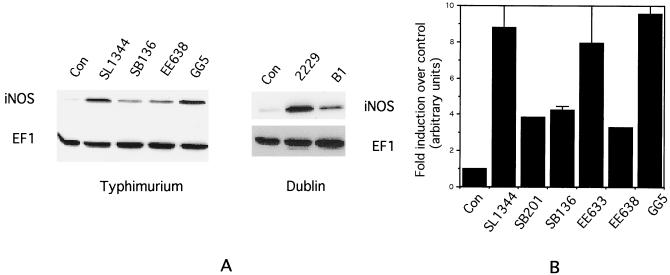
(A) Western blot of iNOS and EF1 expression in RAW264.7 cells infected with different strains of Salmonella. Strain designations are indicated above the lanes. (B) Quantitation of mean iNOS band intensities from five separate experiments similar to that shown in panel A. Strain designations are indicated below the columns. Error bars indicate the standard deviations.
FIG. 3
FIG. 3
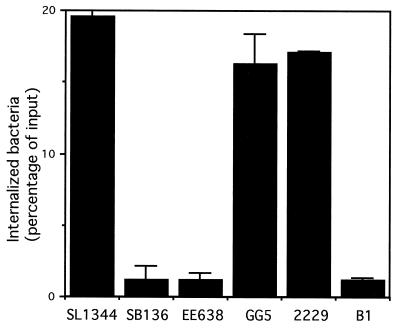
Invasiveness of different Salmonella strains based on the mean numbers of internalized bacteria (percent input) 2 h after infection of RAW264.7 cells. Error bars indicate the standard deviations.
FIG. 4
FIG. 4
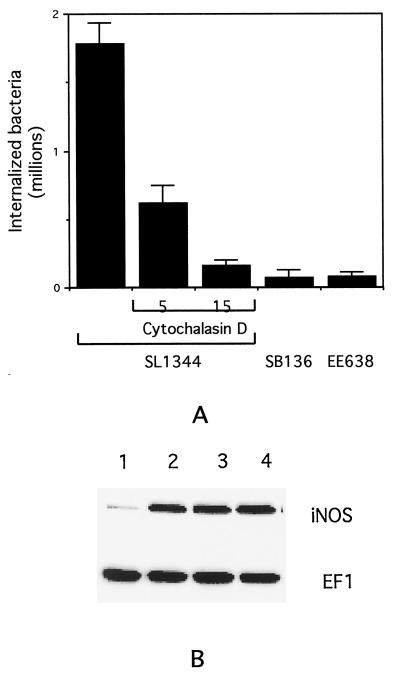
(A) Effect of cytochalasin D (at 5 or 15 μg/ml) on internalization of wild-type Salmonella (SL1344) into RAW264.7 cells compared to the number of internalized SB136 and EE638 mutant strains. Error bars indicate the standard deviations. (B) Western blot indicating the effect of cytochalasin D treatment on iNOS and EF1 expression in RAW264.7 cells. Lane 1, uninfected cells; lane 2, untreated cells infected with SL1344; lane 3, cytochalasin D-treated (5 μg/ml) cells infected with SL1344; lane 4, cytochalasin D-treated (15 μg/ml) cells infected with SL1344.
FIG. 5
FIG. 5
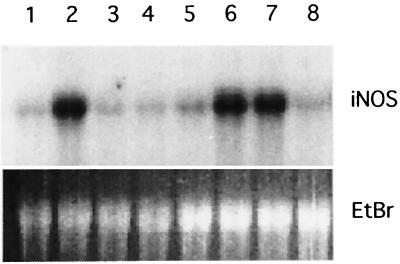
Northern blot of iNOS mRNA expression in RAW264.7 cells 18 h after infection with different strains of Salmonella. Lane 1, control; lane 2, SL1344; lane 3, SB201; lane 4, SB136; lane 5, EE638; lane 6, GG5; lane 7, cytochalasin D-treated (15 μg/ml) cells infected with SL1344; lane 8, cytochalasin D-treated (15 μg/ml) cells. The ethidium bromide-stained 28S rRNA band (EtBr) is shown to indicate the loading of lanes.
FIG. 6
FIG. 6
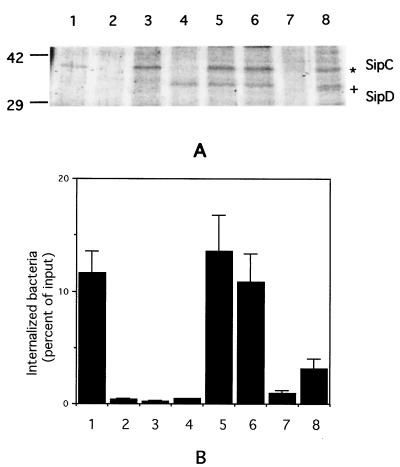
(A) Expression of Sips C and D in wild-type, mutant, and transformed strains of Salmonella. Lane 1, SL1344; lane 2, EE638; lane 3, EE638/C; lane 4, EE638/D; lane 5, EE638/CD; lane 6, EE638/CD, no IPTG; lane 7, B1; lane 8, B1/CD. The numbers to the left of the gel indicate molecular mass in kilodaltons. (B) Invasiveness of wild-type, mutant, and transformed strains of Salmonella. The column numbers refer to the same strains and conditions as the lane numbers in panel A. Error bars indicate the standard deviations.
FIG. 7
FIG. 7
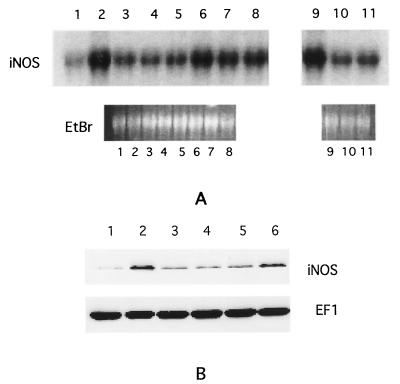
(A) Northern blot of iNOS expression in RAW264.7 cells infected with wild-type, mutant, and transformed strains of Salmonella. Lane 1, uninfected cells; lane 2, SL1344; lane 3, EE638; lane 4, EE638/C; lane 5, EE638/D; lane 6, EE638/CD; lane 7, EE638/CD, cells treated with 15 μg of cytochalsin D per ml; lane 8, EE638/CD, no IPTG; lane 9, 2229; lane 10, B1; lane 11, B1/CD. EtBr, ethidium bromide-stained 28S rRNA band. (B) Western blot of iNOS and EF1 expression in RAW264.7 cells infected with wild-type, mutant, and transformed strains of Salmonella. Lane 1, uninfected cells; lane 2, SL1344; lane 3, EE638; lane 4, EE638/C; lane 5, EE638/D; lane 6, EE638/CD.
FIG. 8
FIG. 8
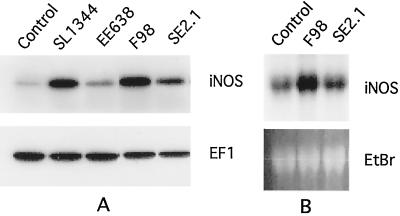
(A) Western blot of iNOS and EF1 expression in RAW264.7 cells infected with wild-type and mutant strains of Salmonella. (B) Northern blot of iNOS expression in RAW264.7 cells infected with wild-type and mutant strains of Salmonella. EtBr, ethidium bromide-stained 28S rRNA band. Strain designations are indicated above the lanes.

References

    1. Amin A R, Attur M, Abramson S B. Nitric oxide synthase and cyclooxygenases: distribution, regulation and intervention in arthritis. Curr Opin Rheumatol. 1999;11:202–209. - PubMed
    1. Bakshi C S, Singh V P, Wood M W, Jones P W, Wallis T S, Galyov E E. Identification of SopE2, a Salmonella secreted protein which is highly homologous to SopE and involved in bacterial invasion of epithelial cells. J Bacteriol. 2000;182:2341–2344. - PMC - PubMed
    1. Chaudhuri A, Orme S, Vo T, Wang W, Cherayil B J. CD40-mediated signals inhibit the binding of TRAF2 to the CD40 cytoplasmic domain. J Immunol. 1997;159:4244–4251. - PubMed
    1. Collazo C M, Galan J E. The invasion-associated type III secretion system of Salmonella typhimurium directs the translocation of Sip proteins into the host cell. Mol Microbiol. 1997;24:747–756. - PubMed
    1. Darji A, Guzman C A, Gerstel B, Wachholz P, Timmis K N, Wehland J, Chakraborty T, Weiss S. Oral somatic transgene vaccination using attenuated S. typhimurium. Cell. 1997;91:765–775. - PubMed

Publication types

MeSH terms

LinkOut - more resources