. 2000 Oct;68(10):5673-8.
doi: 10.1128/IAI.68.10.5673-5678.2000.

alpha(v)beta(3) integrin and bacterial lipopolysaccharide are involved in Coxiella burnetii-stimulated production of tumor necrosis factor by human monocytes

Affiliations

alpha(v)beta(3) integrin and bacterial lipopolysaccharide are involved in Coxiella burnetii-stimulated production of tumor necrosis factor by human monocytes

J Dellacasagrande et al. Infect Immun. 2000 Oct.

Expression of concern in

Abstract

Coxiella burnetii, the agent of Q fever, enters human monocytes through alpha(v)beta(3) integrin and survives inside host cells. In addition, C. burnetii stimulates the synthesis of inflammatory cytokines including tumor necrosis factor (TNF) by monocytes. We studied the role of the interaction of C. burnetii with THP-1 monocytes in TNF production. TNF transcripts and TNF release reached maximum values within 4 h. Almost all monocytes bound C. burnetii after 4 h, while the percentage of phagocytosing monocytes did not exceed 20%. Cytochalasin D, which prevented the uptake of C. burnetii without interfering with its binding, did not affect the expression of TNF mRNA. Thus, bacterial adherence, but not phagocytosis, is necessary for TNF production by monocytes. The monocyte alpha(v)beta(3) integrin was involved in TNF synthesis since peptides containing RGD sequences and blocking antibodies against alpha(v)beta(3) integrin inhibited TNF transcripts induced by C. burnetii. Nevertheless, the cross-linking of alpha(v)beta(3) integrin by specific antibodies was not sufficient to induce TNF synthesis. The signal delivered by C. burnetii was triggered by bacterial lipopolysaccharide (LPS). Polymyxin B inhibited the TNF production stimulated by C. burnetii, and soluble LPS isolated from C. burnetii largely mimicked viable bacteria. On the other hand, avirulent variants of C. burnetii induced TNF production through an increased binding to monocytes rather than through the potency of their LPS. We suggest that the adherence of C. burnetii to monocytes via alpha(v)beta(3) integrin enables surface LPS to stimulate TNF production in THP-1 monocytes.


Figures
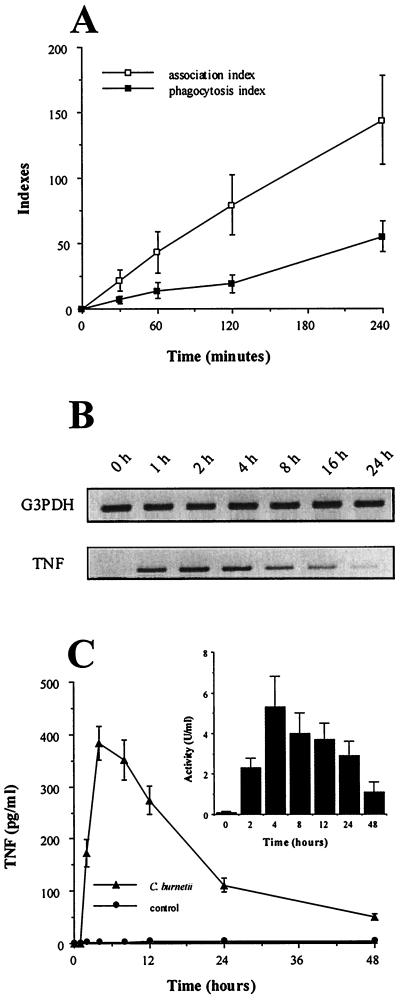
FIG. 1
FIG. 1
C. burnetii-monocyte interaction and TNF production. (A) THP-1 monocytes were incubated with C. burnetii at a bacterium-to-cell ratio of 100:1 for different periods of time. Cells were then washed, cytocentrifuged, and permeabilized by LPC or not permeabilized. Bacteria were revealed by indirect immunofluorescence. The results are means ± standard errors (SE) of four different experiments. (B) Total RNA was extracted and transcribed in cDNA. After amplification, PCR products for TNF and G3PDH, used as an internal control, were analyzed by agarose gel electrophoresis and ethidium bromide staining. The data are representative of four different experiments. (C) Monocyte supernatants were assayed for the presence of TNF by immunoassay. Results are means ± SE of five experiments. (Inset) The same supernatants were assayed for TNF bioactivity. Results are means ± SE.
FIG. 2
FIG. 2
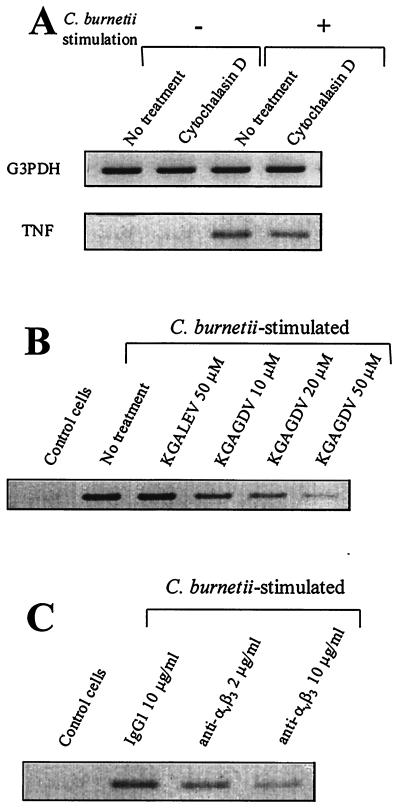
Effect of C. burnetii binding on TNF synthesis. Monocytes were pretreated with 1 μg of cytochalasin D/ml (A), KGALEV or KGAGDV peptides (B), or blocking anti-αvβ3 integrin MAb or control IgG1 (C) for 15 min and then stimulated with C. burnetii for 2 h. Total RNA was extracted and transcribed in cDNA. PCR products were analyzed by agarose gel electrophoresis and ethidium bromide staining. The figure is representative of three different experiments.
FIG. 3
FIG. 3
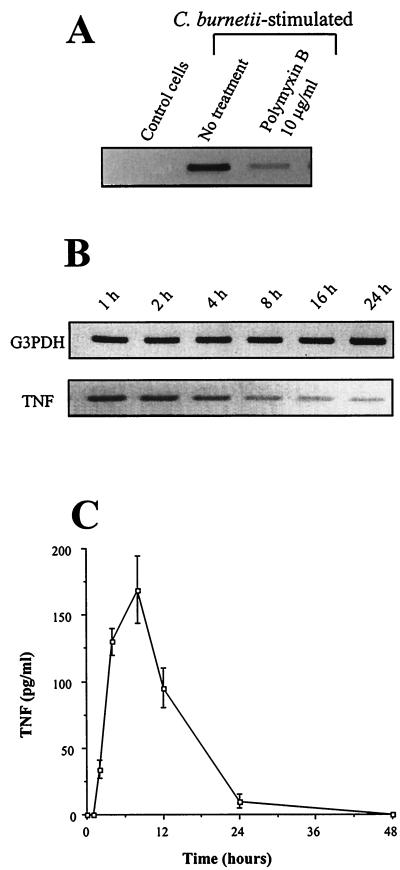
TNF production induced by C. burnetii S-LPS. (A) Monocytes were incubated with or without polymyxin B (10 μg/ml) for 15 min and then stimulated by C. burnetii for 2 h. (B) Monocytes were incubated with 2 μg of C. burnetii S-LPS/ml for different periods of time. Total RNA was extracted and transcribed in cDNA. PCR products were analyzed by agarose gel electrophoresis and ethidium bromide staining. The data are representative of three different experiments. (C) Monocytes were incubated with 2 μg of C. burnetii S-LPS/ml for different periods of time. Cell supernatants were then assayed for the presence of TNF using an enzyme immunoassay. Results are means ± standard errors representing the averages of three experiments.
FIG. 4
FIG. 4
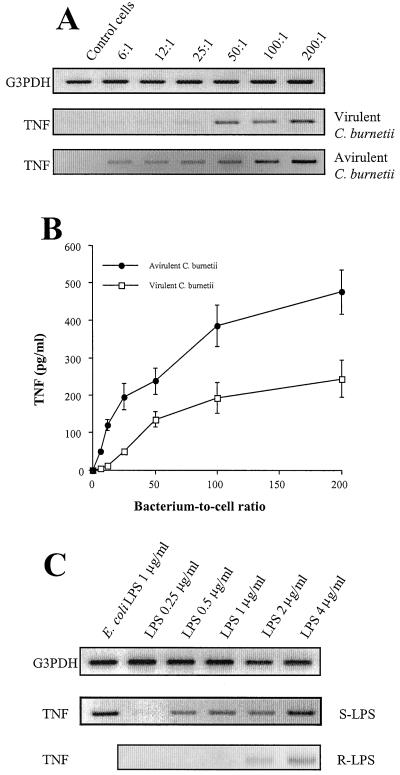
TNF production induced by avirulent C. burnetii and R-LPS. Monocytes were incubated with different concentrations of virulent or avirulent C. burnetii for 2 (A) or 8 h (B). (A) Total RNA was extracted and transcribed in cDNA. PCR products were analyzed as described for Fig. 1. The data are representative of three different experiments. (B) Monocyte supernatants were assayed for the presence of TNF by immunoassay. Results are means ± standard errors of four experiments. (C) Monocytes were incubated with different concentrations of S-LPS and R-LPS for 2 h. The expression of TNF mRNA was assessed as described for panel A. The data are representative of three different experiments.

References

    1. Amano K L, Williams J C, Missler V, Reinhold N. Structure and biological relationship of C. burnetii lipopolysaccharides. J Biol Chem. 1987;262:4740–4747. - PubMed
    1. Bermudez L E, Kaplan G. Recombinant cytokines for controlling mycobacterial infections. Trends Microbiol. 1995;3:22–27. - PubMed
    1. Beuscher H V, Rodel F, Forsberg A, Rollinghoff M. Bacterial evasion of host immune defense: Yersinia enterocolitica encodes a suppressor for tumor necrosis factor alpha expression. Infect Immun. 1994;62:4804–4810. - PMC - PubMed
    1. Brown E, Hooper L, Ho T, Gresham H. Integrin-associated protein: a 50 kD plasma membrane antigen physically and functionally associated with integrins. J Cell Biol. 1990;111:2785–2794. - PMC - PubMed
    1. Capo C, Zugun F, Stein A, Tardei G, Lepidi H, Raoult D, Mege J L. Upregulation of tumor necrosis factor alpha and interleukin-1β in Q fever endocarditis. Infect Immun. 1996;64:1638–1642. - PMC - PubMed

Substances

LinkOut - more resources