The relationship between virological characteristics of hepatitis C virus (HCV) and reactivity to the regional specific proteins of HCV
- PMID: 10992722
- PMCID: PMC4531759
- DOI: 10.3904/kjim.2000.15.2.109
The relationship between virological characteristics of hepatitis C virus (HCV) and reactivity to the regional specific proteins of HCV
Abstract
Background: Although the polyproteins of hepatitis C virus(HCV) are processed and formed in nearly equimolar amounts, individual functional proteins have a discrepancy in their time of appearance following HCV infection and eliciting immune response. This study was conducted to compare the reactivity toward regional specific HCV protein in relation to virological characteristics, including HCV genotype and HCV replication.
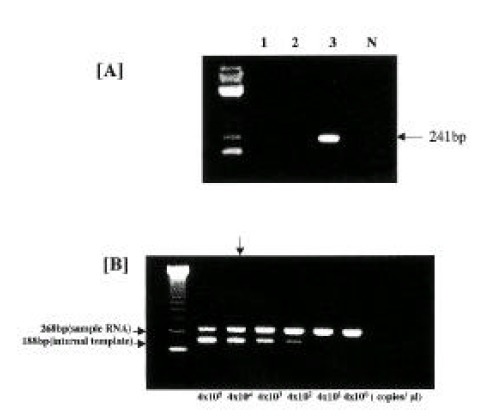
Methods: Sera from forty-five patients with chronic HCV infection were analyzed through the experiments of the recombinant immunoblot assay(RIBA-2), HCV genotyping and HCV RNA quantitation.
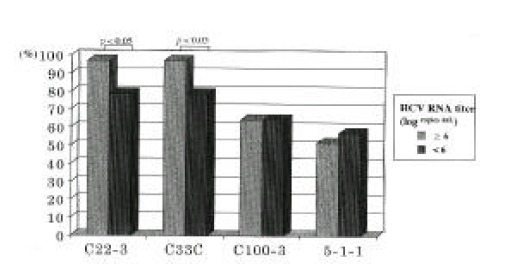
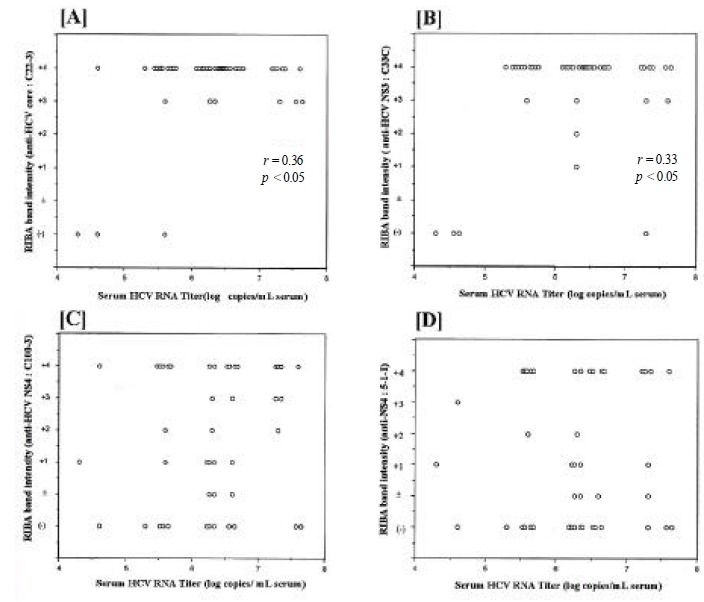
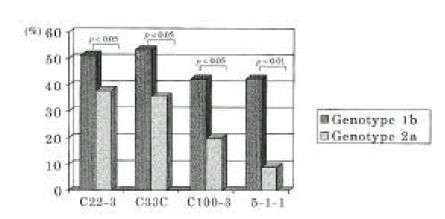
Results: The frequencies of seropositivity to C22-3, C33C, C100-3 and 5-1-1 proteins were 91.1%, 91.1%, 64.4% and 53.3%, respectively, of all the patients, and thus the antibodies to C22-3 and C33C proteins were found more frequently (p < 0.05). The antibody responses between core or NS3 proteins and NS4 proteins showed more discrepancy in the HCC group than that in the CH group, implying a possibility of oncogenic potential of core or NS3 gene in hepatocarcinogenesis. The detection rate of antibodies to C22-3 and C33C, in accordance with serum HCV RNA levels, was significantly higher in highly viremic patients than that in low viremic patients (p < 0.05). Antibodies to C22-3, C33C, C100-3 and 5-1-1 were also found more frequently in patients with HCV genotype 1b, compared to those with HCV genotype 2a (p < 0.05).
Conclusion: These results suggest that antibody detection of HCV may depend on the virological characteristics of HCV, the levels of HCV replication and HCV genotype and, therefore, HCV RNA detection using RT-PCR technique is essential for confirmatory diagnosis for HCV infection. Furthermore, the HCV core or NS3 Protein may play important role in hepatocarcinogenesis.
Figures
References
-
- Choo QL, Kuo G, Weiner AJ, Overby LR, Bradley DW, Houghton M. Isolation of a cDNA clone derived from a blood borne non-A, non-B viral hepatitis genome. Science. 1989;244:359–362. - PubMed
-
- Khanna A, Poduri CD, Murugan P, Kumar S, Sugunan VS, Shenoy KT, Das MR. Analysis of human immune response to potential hepatitis C viral epitopes. Acta Virol. 1998;42:141–145. - PubMed
MeSH terms
Substances
LinkOut - more resources
Full Text Sources