


Elucidating the mechanism of familial amyloidosis- Finnish type: NMR studies of human gelsolin domain 2
- PMID: 10995458
- PMCID: PMC27087
- DOI: 10.1073/pnas.180310097
Elucidating the mechanism of familial amyloidosis- Finnish type: NMR studies of human gelsolin domain 2
Abstract
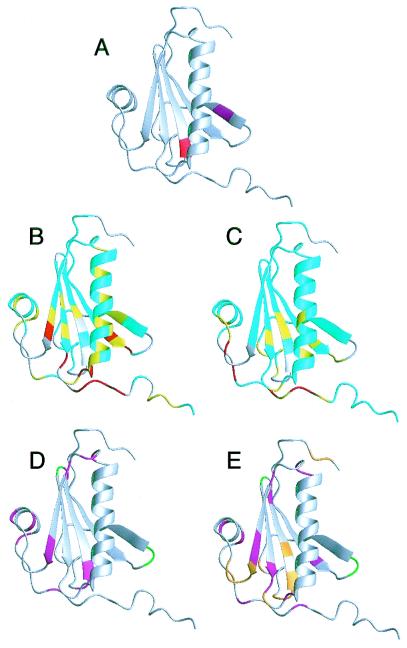
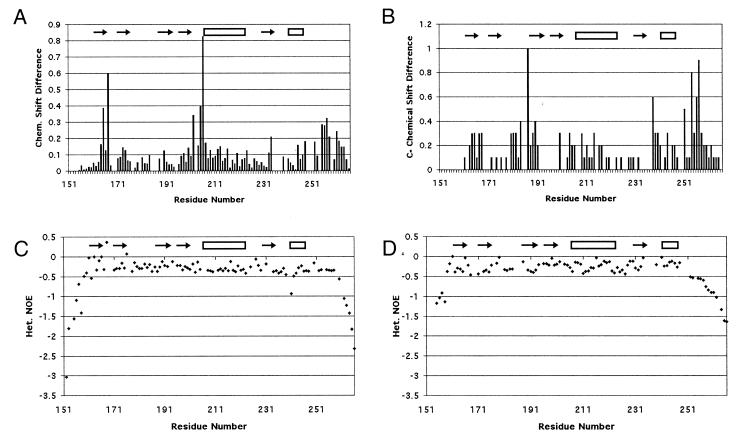
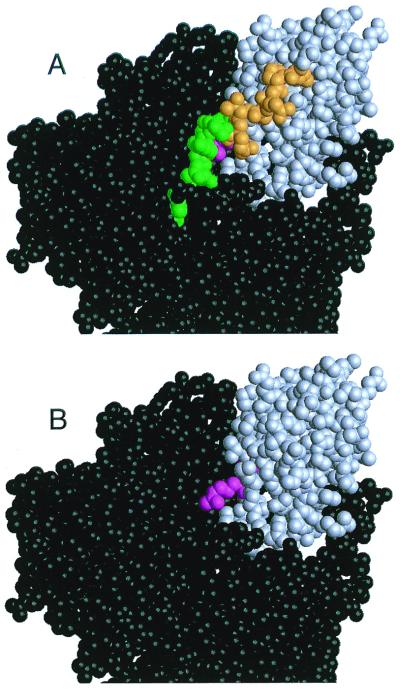
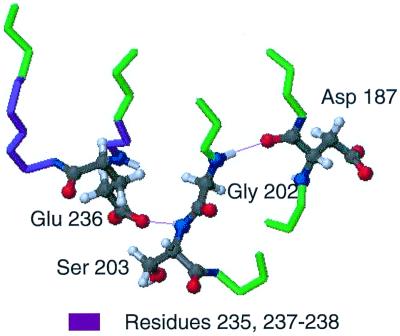
Familial amyloidosis-Finnish type (FAF) results from a single mutation at residue 187 (D187N or D187Y) within domain 2 of the actin-regulating protein gelsolin. The mutation somehow allows a masked cleavage site to be exposed, leading to the first step in the formation of an amyloidogenic fragment. We have performed NMR experiments investigating structural and dynamic changes between wild-type (WT) and D187N gelsolin domain 2 (D2). On mutation, no significant structural or dynamic changes occur at or near the cleavage site. Areas in conformational exchange are observed between beta-strand 4 and alpha-helix 1 and within the loop region following beta-strand 5. Chemical shift differences are noted along the face of alpha-helix 1 that packs onto the beta-sheet, suggesting an altered conformation. Conformational changes within these areas can have an effect on actin binding and may explain why D187N gelsolin is inactive. [(1)H-(15)N] nuclear Overhauser effect and chemical shift data suggest that the C-terminal tail of D187N gelsolin D2 is less structured than WT by up to six residues. In the crystal structure of equine gelsolin, the C-terminal tail of D2 lies across a large cleft between domains 1 and 2 where the masked cleavage site sits. We propose that the D187N mutation destabilizes the C-terminal tail of D2 resulting in a more exposed cleavage site leading to the first proteolysis step in the formation of the amyloidogenic fragment.
Figures
References
-
- Thomas P J, Qu B H, Pedersen P L. Trends Biochem Sci. 1995;20:456–459. - PubMed
-
- Kelly J W. Curr Opin Struct Biol. 1996;6:11–17. - PubMed
-
- Kelly J W. Structure (London) 1997;5:595–600. - PubMed
-
- Kelly J W. Curr Opin Struct Biol. 1998;8:101–106. - PubMed
-
- Blake C, Serpell L. Structure (London) 1996;4:989–998. - PubMed
Publication types
MeSH terms
Substances
Grants and funding
LinkOut - more resources
Full Text Sources
Research Materials
