. 2000 Sep 26;97(20):10972-7.
doi: 10.1073/pnas.200377097.

Regulation of vascular endothelial growth factor (VEGF) gene transcription by estrogen receptors alpha and beta

Affiliations

Regulation of vascular endothelial growth factor (VEGF) gene transcription by estrogen receptors alpha and beta

M D Mueller et al. Proc Natl Acad Sci U S A. .

Abstract

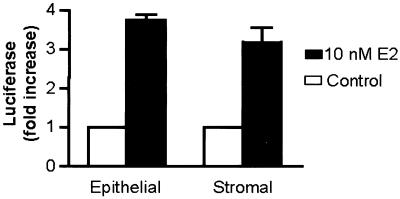
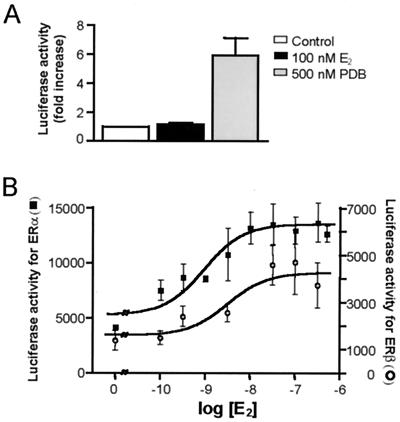
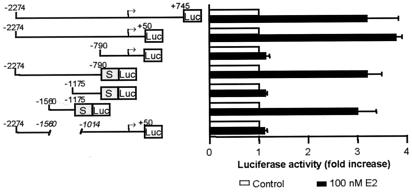
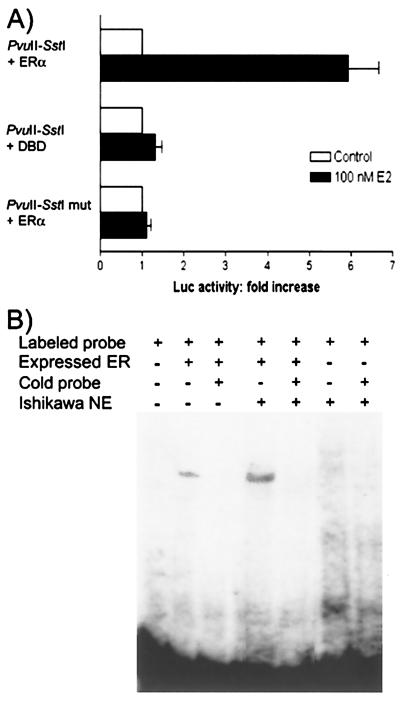
Vascular endothelial growth factor (VEGF) mediates angiogenic activity in a variety of estrogen target tissues. To determine whether estrogen has a direct transcriptional effect on VEGF gene expression, we developed a model system by transiently transfecting human VEGF promoter-luciferase reporter constructs into primary human endometrial cells and into Ishikawa cells, derived from a well-differentiated human endometrial adenocarcinoma. In primary endometrial epithelial cells, treatment with 17beta-estradiol (E(2)) resulted in a 3.8-fold increase in luciferase activity, whereas a 3. 2-fold induction was demonstrated for stromal cells. Our Ishikawa cells had less than 100 functional estrogen receptors (ER)/cell and were therefore cotransfected with expression vectors encoding either the alpha- or the beta-form of the human ER. In cells cotransfected with ERalpha, E(2) induced 3.2-fold induction in VEGF-promoter luciferase activity. A 2.3-fold increase was observed in cells cotransfected with ERbeta. Through specific deletions, the E(2) response was restricted to a single 385-bp PvuII-SstI fragment in the 5' flanking DNA. Cotransfection of this upstream region with a DNA binding domain ER mutant, or site-directed mutagenesis of a variant ERE within this fragment, resulted in the loss of the E(2) response. Electromobility shift assays demonstrated that this same ERE sequence specifically binds estradiol-ER complexes. These studies demonstrate that E(2)-regulated VEGF gene transcription requires a variant ERE located 1.5 kb upstream from the transcriptional start site. Site-directed mutagenesis of this ERE abrogated E(2)-induced VEGF gene expression.


Figures
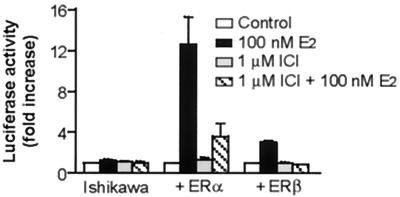
Figure 1
Figure 1
Ishikawa cells were transfected with ERE-TK luciferase vectors (3 μg per cuvette) with or without expression vectors for ERα or ERβ (1.5 μg per cuvette). The cells were treated for 20 h with 100 nM E2 and/or 1 μM ICI as indicated in the Inset. Error bars show standard deviations among triplicates.
Figure 2
Figure 2
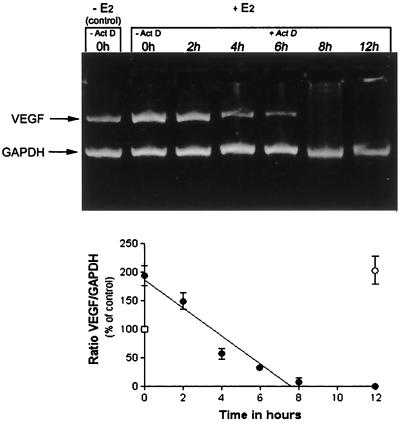
Ishikawa cells were transiently transfected with ERα. After recovery overnight, the cells were stimulated with ethanolic vehicle [−E2 (control)] or 100 nM E2 for 15 h without actinomycin D (−Act D) before the first time point [0 h; −E2 (□) and +E2 (●)]. Act D (5 μg/ml) was then added to the remaining cell cultures, and total RNA was extracted after an additional 2, 4, 6, 8, and 12 h (●). Control samples (without Act D) were assessed after 12 h (○). RT-PCR was performed as described and visualized on 4% agarose gels stained with ethidium bromide. Data of three independent experiments (±SD) were analyzed as ratio of VEGF:glyceraldehyde-3-phosphate dehydrogenase (GAPDH) and expressed as percentage of the control. VEGF mRNA half-life was calculated as 4 h.
Figure 3
Figure 3
Human endometrial epithelial and stromal cells were transiently transfected with luciferase fusion vectors containing 2.3 kb of 5′ flanking DNA relative to the VEGF transcriptional start site (VEGF −2274 to +50, KpnI–NheI). Epithelial cells were transfected by calcium phosphate precipitation. Effectene was used to transfect stromal cells. After transfection, the medium was changed to phenol-red-free DME-H21 with 2.5% dextran charcoal-filtered calf serum. The transfected cells were treated with ethanolic vehicle (control) or with E2 (10 nM) for 20 h. The cells were lysed, and luciferase activity was measured. Relative luciferase activity is expressed as -fold increase over the controls. Error bars represent standard deviations of three different cultures, each done in triplicate.
Figure 4
Figure 4
(A) Ishikawa cells were transiently transfected with luciferase fusion vectors containing 2.3 kb of 5′ flanking DNA relative to the VEGF transcriptional start site. After recovery overnight, the cells were treated with ethanolic vehicle (control), E2 (100 nM), or phorbol-12,13-dibutyrate (PDB, 500 nM) for 20 h. Error bars represent standard deviations from three different cultures. (B) Dose–response of E2 activation of the VEGF gene promoter in the presence of ERα and ERβ. Ishikawa cells were transfected with VEGF luciferase vectors and expression vectors encoding either ERα or ERβ. Transfected Ishikawa cells were treated with increasing E2 concentrations. The results obtained with ERα are plotted as light units on the left ordinate (■), those obtained with ERβ on the right ordinate (○). Error bars show standard deviations among quadruplicates from a single representative transfection.
Figure 5
Figure 5
Specific deletions of the 5′ UTR and 5′ flanking sequences of the human VEGF gene promoter were obtained by digestion with restriction enzymes and transiently transfected into Ishikawa cells with ERα expression vectors. Gene fragments were subcloned into pGL2-basic or pGL2-promoter vectors, where pGL2-promoter contains a minimal SV40 promoter sequence (S). The arrow indicates the transcriptional start site of the VEGF gene. Luciferase activity of each construct was normalized to that of the corresponding empty vector. Error bars represent standard deviations of three different cultures, each done in triplicate.
Figure 6
Figure 6
(A) Luciferase fusion vectors containing a PvuII-SstI genomic fragment (−1560 to −1175) of the human VEGF gene promoter were cotransfected with expression vectors encoding either ERα or ERα containing a DNA binding domain mutation (DBD). After mutation of a putative ERE within the targeted upstream region, the luciferase fusion vector was cotransfected with ERα. After recovery overnight, the cells were treated with ethanolic vehicle (control) or 100 nM E2 for 20 h. Error bars represent standard deviations in three different cultures. (B) Electrophoretic mobility-shift assay with oligonucleotides containing the putative ERE. ERs expressed in reticulocyte lysates and/or Ishikawa nuclear extracts (NE) were added to the labeled oligonucleotide probe (aatcagactgactggcctcagagccc). Binding competition was performed by adding cold probe at a 100-fold excess.

References

    1. Vincenti V, Cassano C, Rocchi M, Persico G. Circulation. 1996;93:1493–1495. - PubMed
    1. Tischer E, Mitchell R, Hartman T, Silva M, Gospodarowicz D, Fiddes J, Abraham J. J Biol Chem. 1991;266:11947–11954. - PubMed
    1. Houck K, Ferrara N, Winer J, Cachianes G, Li B, Leung D. Mol Endocrinol. 1991;5:1806–1814. - PubMed
    1. Charnock-Jones D, Sharkey A, Rajput-Williams J, Burch D, Schofield J, Fountain S, Boocock C, Smith S. Biol Reprod. 1993;48:1120–1128. - PubMed
    1. Ferrara N. Curr Top Microbiol Immunol. 1999;237:1–30. - PubMed

Publication types

LinkOut - more resources