


doi: 10.1172/JCI11144.
Hypoxia-induced pulmonary vascular remodeling: a model for what human disease?
Affiliations
- PMID: 10995781
- PMCID: PMC381402
- DOI: 10.1172/JCI11144
Item in Clipboard
Hypoxia-induced pulmonary vascular remodeling: a model for what human disease?
J Clin Invest.
2000 Sep.
No abstract available
Figures
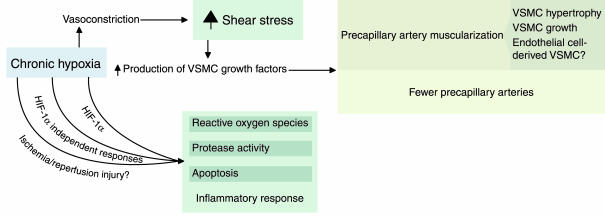
Mechanisms that may be involved in hypoxia-induced pulmonary vascular remodeling. Growth factors for VSMCs can be generated as consequences of elevated shear stress or of oxidant stress and may be dependent or independent of hypoxia-inducible factor 1α (HIF-1α). ROSs may also affect gene expression, activate proteinases, and trigger the production of cytokines.
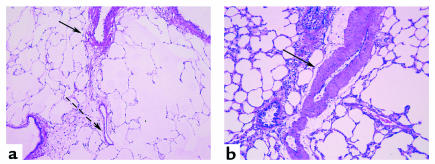
Pulmonary vascular morphology of vehicle-treated (a) or SU5416-treated (b) rats exposed to Denver altitude conditions for 3 weeks. Note the increase in medial thickness in the SU5416-treated rat lungs, which extends into preacinar vessels (arrow). On the other hand, normal pulmonary arteries have well defined medial muscular layer (arrow), which becomes progressively thinner (dashed arrow) in the preacinar region.
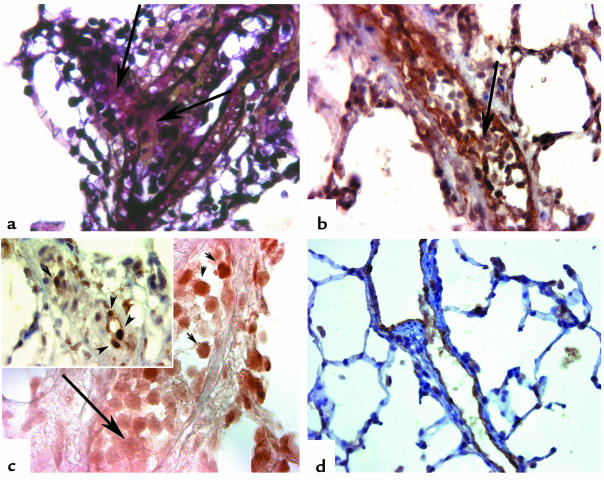
Lungs from chronically hypoxic rats treated with the VEGF-R2 inhibitor SU5416 for 3 weeks. (a) Intimal obliteration of precapillary pulmonary artery (arrows), resulting in almost-complete disappearance of vascular lumen; (b) the intimal obliteration is due to expansion of Factor VIII–related antigen–positive cells (arrow). (c) The intraluminal cluster of endothelial cells shows expression of the key apoptosis effector active caspase 3 (arrowhead), while endothelial cells in the center of the cluster (arrow) show evidence of proliferation with expression of proliferating cell nuclear antigen (inset, arrowheads). (d) Caspase inhibition with the broad spectrum caspase inhibitor Z-Asp-CH2, administered at the beginning of the chronic hypoxia and SU5416 treatment, results in a marked decrease in pulmonary artery pressures. The pulmonary arteries are lined by a monolayer of Factor VIII–related antigen–positive endothelial cells, with preservation of vascular lumen. (a: pentachrome staining, ×320; b: Factor VIII–related antigen immunostaining, ×300; c: active caspase 3 immunostaining, ×400; d: Factor VIII–related antigen immunostaining, ×200.)
References
-
- Will DH, Alexander AF, Reeves JT, Grover RF. High altitude-induced pulmonary hypertension in normal cattle. Circ Res. 1962;10:172–177. - PubMed
-
- Rabinovitch M, Gamble W, Nadas AS, Miettinen O, Reid L. Rat pulmonary circulation after chronic hypoxia: hemodynamic and structural features. Am J Physiol. 1979;236:H818–H827. - PubMed
-
- Stenmark K, et al. Severe pulmonary hypertension and arterial adventitial changes in newborn calves at 4300 m. J Appl Physiol. 1987;62:821–830. - PubMed
Publication types
MeSH terms
Substances
Grants and funding
LinkOut - more resources
Full Text Sources
Other Literature Sources
