. 2000 Sep 15;20(18):7017-23.
doi: 10.1523/JNEUROSCI.20-18-07017.2000.

The role of identified neurotransmitter systems in the response of insular cortex to unfamiliar taste: activation of ERK1-2 and formation of a memory trace

Affiliations

The role of identified neurotransmitter systems in the response of insular cortex to unfamiliar taste: activation of ERK1-2 and formation of a memory trace

D E Berman et al. J Neurosci. .

Abstract

In the behaving rat, the consumption of an unfamiliar taste activates the extracellular signal-regulated kinase 1-2 (ERK1-2) in the insular cortex, which contains the taste cortex. In contrast, consumption of a familiar taste has no effect. Furthermore, activation of ERK1-2, culminating in modulation of gene expression, is obligatory for the encoding of long-term, but not short-term, memory of the new taste (Berman et al., 1998). Which neurotransmitter and neuromodulatory systems are involved in the activation of ERK1-2 by the unfamiliar taste and in the long-term encoding of the new taste information? Here we show, by the use of local microinjections of pharmacological agents to the insular cortex in the behaving rat, that multiple neurotransmitters and neuromodulators are required for encoding of taste memory in cortex. However, these systems vary in the specificity of their role in memory acquisition and in their contribution to the activation of ERK1-2. NMDA receptors, metabotropic glutamate receptors, muscarinic, and beta-adrenergic and dopaminergic receptors, all contribute to the acquisition of the new taste memory but not to its retrieval. Among these, only NMDA and muscarinic receptors specifically mediate taste-dependent activation of ERK1-2, whereas the beta-adrenergic function is independent of ERK1-2, and dopaminergic receptors regulate also the basal level of ERK1-2 activation. The data are discussed in the context of postulated novelty detection circuits in the central taste system.


Figures
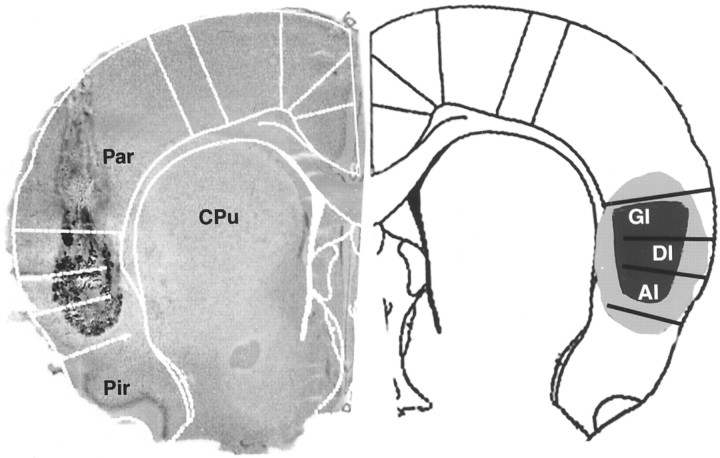
Fig. 1.
Fig. 1.
Left, A Nissl-stained frozen section of the rat brain [coronal cut, +1.2 mm relative to bregma (Paxinos and Watson; 1986)] depicting the sphere of diffusion of 1 μl of India ink microinjected into the insular cortex as detailed in Materials and Methods. Right, A scheme of the corresponding contralateral hemisphere depicting the superimposed sphere of diffusion in a group of 10 rats (gray) and the estimated “median” obtained by superimposing the five smallest dye diffusion spheres (black).GI, Granular insular cortex; DI, dysgranular insular cortex; AI, agranular insular cortex; CPu, caudate-putamen; Par, parietal cortex; Pir, piriform cortex.
Fig. 2.
Fig. 2.
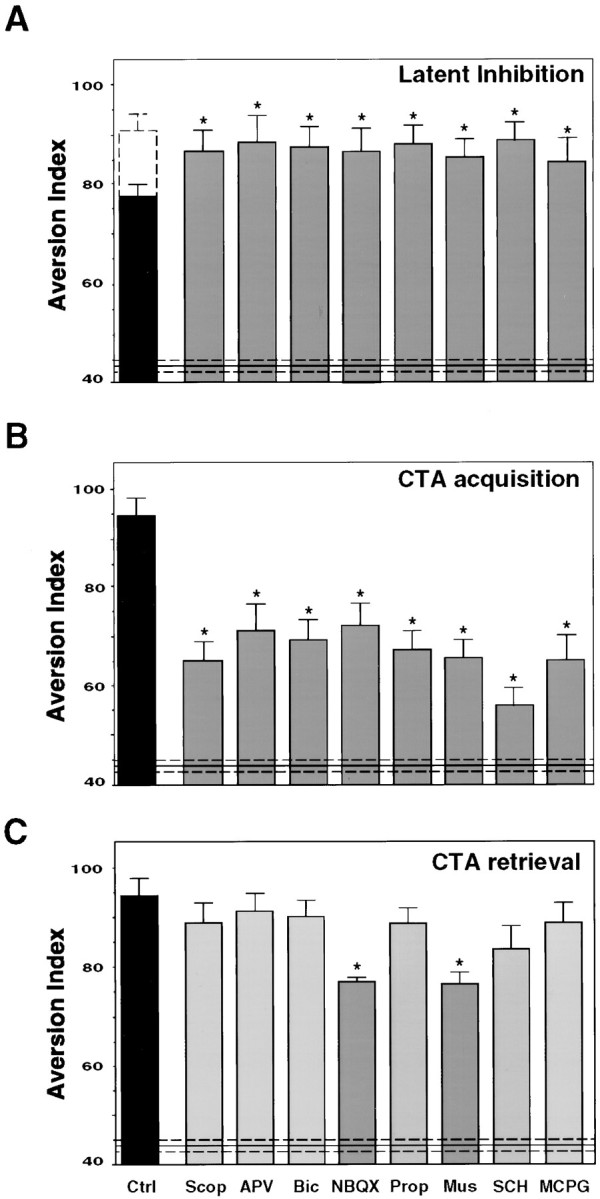
Behavioral effects of the different neurotransmitter ligands microinjected into the IC. A, Impairment of latent inhibition by local bilateral microinjection of the cholinergic antagonist scopolamine (Scop; 50 μg), the NMDA receptor antagonist APV (10 μg), the GABAergic antagonist bicuculline (Bic; 20 μg), the AMPA/kainate receptor antagonist NBQX (5 μg), the β-adrenergic receptor antagonist propranolol (Prop; 20 μg), the GABAergic agonist muscimol (Mus; 5 μg), the D1/D5 dopamine receptors antagonist SCH 23390 (SCH; 5 μg), and the metabotropic glutamate receptor antagonist MCPG (50 μg). Animals were trained and tested in the LI+CTA protocol as described in Materials and Methods. They were microinjected with the different ligands 20 min before the preexposure to the novel taste in the LI phase of the protocol (n = 6 per group; the control black bar indicates aversion index value for CTA+LI, and thedashed bar indicates CTA without LI). B, Effect of the ligands on CTA acquisition. Animals were microinjected 20 min before CTA training (n = 10) and tested as detailed in Materials and Methods in the CTA protocol.C, Effect of the ligands on CTA retrieval. Animals were trained and microinjected with the drugs 20 min before the test session in the CTA protocol, 3 d after the conditioning (n = 11). Aversion Index is defined as [milliliters of water/(milliliters of water + milliliters of saccharin) × 100]. Injection volume is 1 μl/hemisphere. An aversion index of 50 indicates equal-preference level.Ctrl, Control animals microinjected into the IC with vehicle only. Included for comparison is also the aversion index of sham-conditioned controls, i.e., rats injected in training with saline intraperitoneally instead of LiCl intraperitoneally, and microinjected into the IC with vehicle only (43 ± 3, horizontal solid line ± dashed lines).
Fig. 3.
Fig. 3.
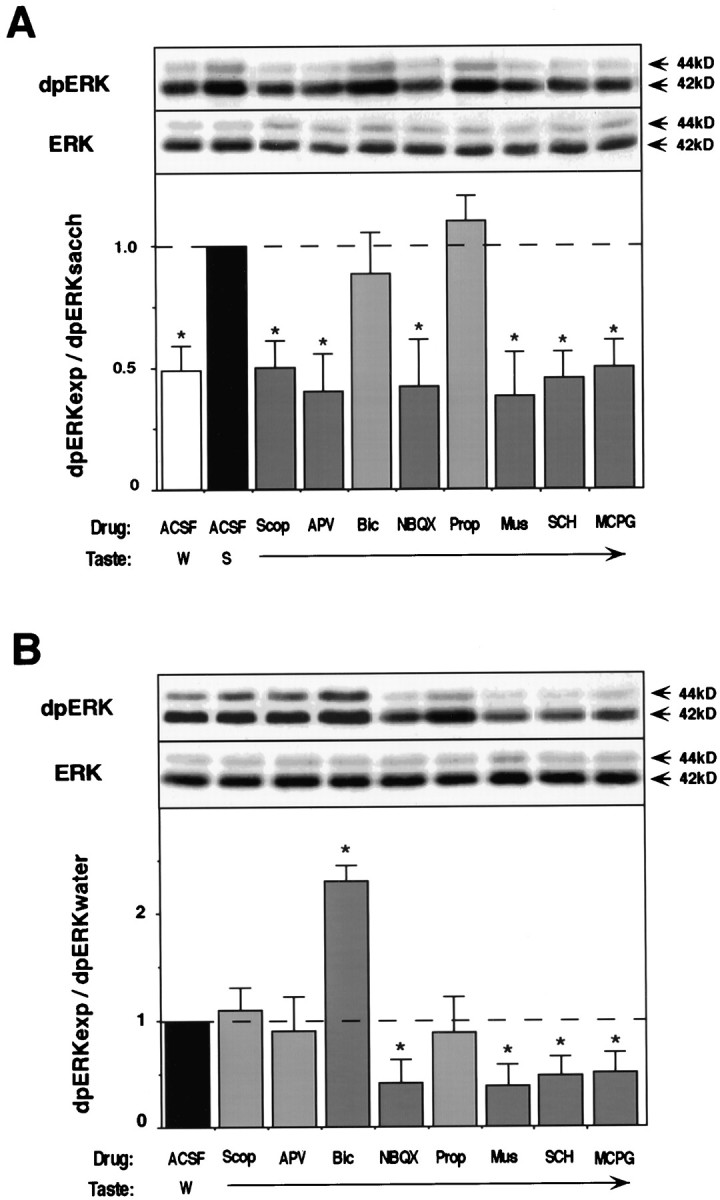
Effect of various ligands microinjected into the IC on ERK1–2 activation. A, Effect on taste-induced ERK1–2 activation. Top, representative blots of activated (dpERK1–2) and total ERK1–2 (ERK) from animals microinjected with the different neurotransmitter ligands 20 min before exposure to saccharin (black and gray bars) and water (white bar). Bottom, Quantification of the results from the blots (n = 10 per group). The level of dpERK1–2 in animals microinjected with ACSF and exposed to saccharin (black bar) is used as standard. Ratio of activation is presented as dpERK experimental/dpERK saccharin.B, Effect of the ligands on the basal level of ERK1–2 activation. Top, Representative blots of dpERK1–2 and ERK1–2 from animals microinjected with the ligands and exposed to water 20 min later. Bottom, Quantification of the results from the blots (n = 12). The level of dpERK1–2 in animals microinjected with ACSF and exposed to water (black bar) is used as standard. Ratio of activation is presented as dpERK experimental/dpERK water. W, Water; S, saccharin.
Fig. 4.
Fig. 4.
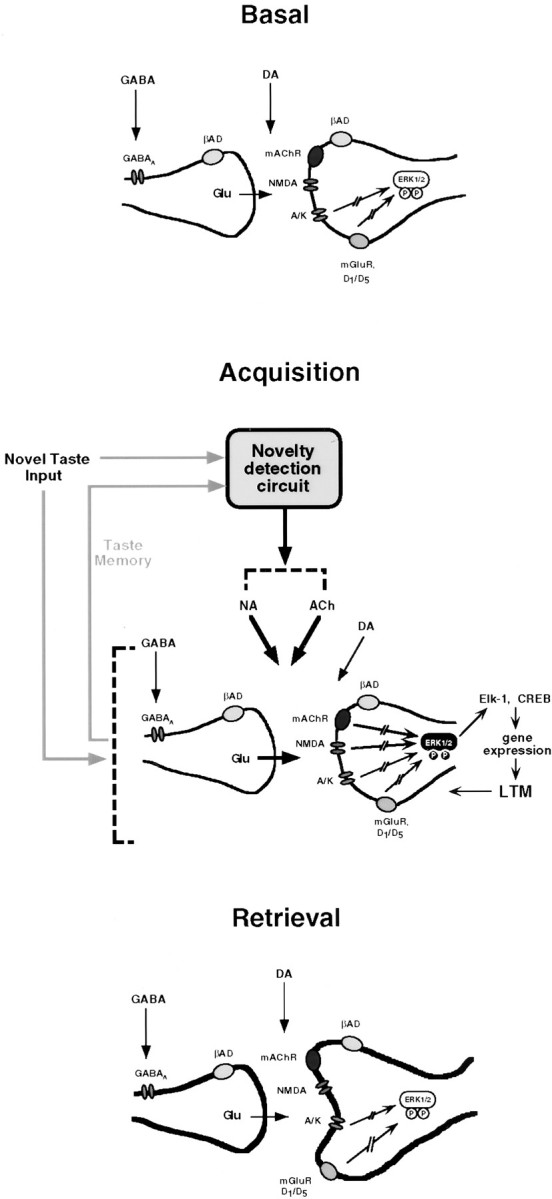
A highly simplified scheme of some elements in the processes that might subserve the encoding of taste memory in the IC. In the absence of taste input (Basal), the balance between the resting levels of glutamate (Glu; acting via AMPA/KR and mGluR), GABA, and dopamine (DA; via D1/D5 receptors) regulates the basal level of ERK1–2 activation. When a new taste is consumed, a hypothetical novelty detection system, e.g., thalamocortico-brainstem circuits (Ahissar et al., 1997, Ahissar, 1998), compares the on-line stimulus with taste representations in memory. According to this model, if a meaningful mismatch is detected, a signal is sent to the cholinergic and noradrenergic systems, resulting in release of acetylcholine and noradrenaline in the IC. Acquisition involves, in addition to glutamatergic transmission via the metabotropic and AMPA receptors, glutamatergic transmission via the NMDA receptor, as well as cholinergic and noradrenergic input. Acetylcholine activates ERK1–2, whereas noradrenaline functions in this system independent of ERK1–2. Activation of ERK1–2 culminates in modulation of gene expression and ultimately in long-term representational changes. The yet unidentified novelty detection circuit may overlap with the IC circuits, which are altered by taste experience, and may also involve brain areas not mentioned in the scheme, e.g., amygdala (Schafe and Bernstein, 1996;Escobar and Bermudez-Rattoni, 2000). In retrieval, glutamatergic transmission that is essential for activation of the memory circuits and expression of the recalled behavior is mediated in the now-modified synapse (bold contours) via the AMPA/KR, whereas the NMDA, muscarinic, and noradrenaline receptors are no more obligatory. ERK activation remains unaltered by the retrieved information; its resting activity level is still regulated as in Basal above. The scenario in which some of the effects of the indicated neurotransmitters and neuromodulators on MAPK are mediated via interneurons that ultimately use different transmitters is omitted for the sake of simplicity. For further details, see Results. A/K, AMPA/KR; βAD, β-adrenergic receptor; LTM, long-term memory; PP, biphosphorylated, hence activated, ERK1–2.

References

    1. Ahissar E. Temporal-code to rate-code conversion by neuronal phase-locked loops. Neural Comput. 1998;10:597–650. - PubMed
    1. Ahissar E, Haidarliu S, Zacksenhouse M. Decoding temporally encoded sensory input by cortical oscillations and thalamic phase comparators. Proc Natl Acad Sci USA. 1997;94:11633–11638. - PMC - PubMed
    1. Asin KE, Montana WE. Studies on D1 and D2 dopamine receptor involvement in conditioned taste aversions. Pharmacol Biochem Behav. 1989;32:1033–1041. - PubMed
    1. Atkins CM, Selcher JC, Petraitis JJ, Trzaskos JM, Sweatt JD. The MAPK cascade is required for mammalian associative learning. Nat Neurosci. 1998;1:602–609. - PubMed
    1. Berman DE, Hazvi S, Rosenblum K, Seger R, Dudai Y. Specific and differential activation of mitogen-activated protein kinase cascades by unfamiliar taste in the insular cortex of the behaving rat. J Neurosci. 1998;18:10037–10044. - PMC - PubMed

Publication types

MeSH terms