Vertebroplasty in patients with severe vertebral compression fractures: a technical report
Affiliations
- PMID: 11003296
- PMCID: PMC7974062
Item in Clipboard
Vertebroplasty in patients with severe vertebral compression fractures: a technical report
AJNR Am J Neuroradiol.
2000 Sep.
Abstract
Vertebroplasty is a procedure in which polymethlymethacrylate (PMMA) is injected into a vertebral body compression fracture. It has been suggested that fractues greater than 65% to 70% of the original vertebral body height are too compressed to be treated successfully with this procedure. We describe six patients with severe compression fractures that were successfully treated with vertebroplasty in which the trocar was inserted in the far lateral aspect of the vertebral body, because of the typical morphology of severe compression fractures.
Figures
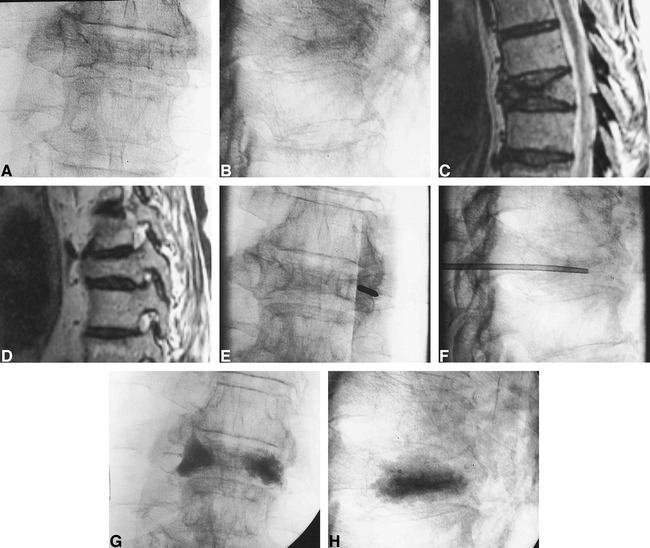
Case 4. A, Anteroposterior radiograph of the T8 vertebral body. B, Lateral radiograph of the same vertebral body shows a severe compression fracture. C, Sagittal T2-weighted MR image of the T8 vertebral body again shows a severe compression fracture. This mid-sagittal image shows the most severe portion of the compression fracture at the center of the vertebral body. D, Sagittal T2-weighted MR image of the T8 vertebral body shows relative preservation of vertebral body height far laterally. E, Anteroposterior radiograph shows the 13-gauge trocar in the vertebral body via a parapedicular approach. Note the far lateral approach in the area of the vertebral body with relative preservation of bone marrow. F, Lateral radiograph shows placement of a 13-gauge bone trocar into the vertebral body. G, Anteroposterior radiograph after vertebroplasty with PMMA in the far lateral aspect of the vertebral body bone marrow. The typical bow-tie appearance of vertebral bodies with severe compression fractures is shown. H, Lateral radiograph after vertebroplasty with PMMA filling the residual vertebral body bone marrow.
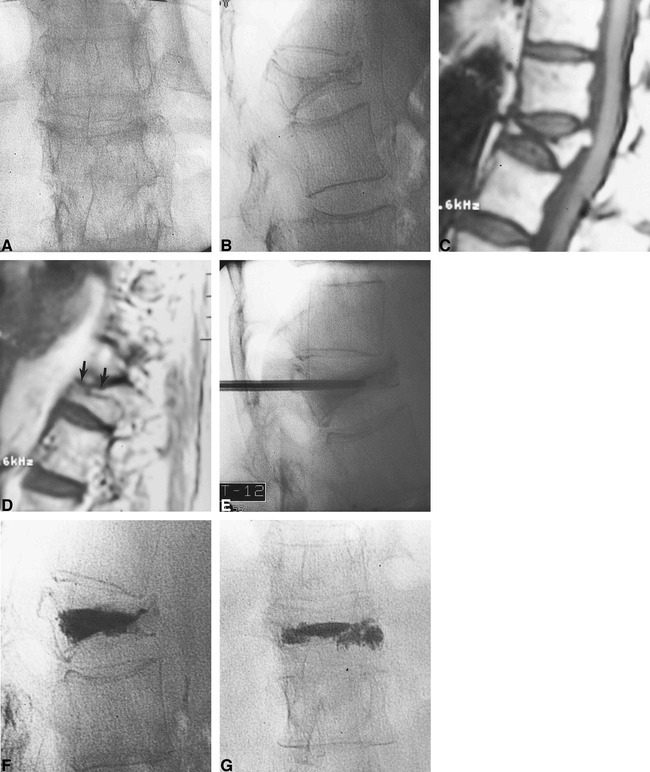
Case 5 A, Anteroposterior radiograph of the T12 vertebral body. B, Lateral radiograph of the same vertebral body shows a severe compression fracture. C, Sagittal T1-weighted MR image shows a severe compression deformity at the center of the vertebral body with some retropulsion of the posterior vertebral body. D, Sagittal T1-weighted MR image shows relative preservation of vertebral body bone marrow far laterally (arrows). E, Lateral radiograph shows placement of an 11-gauge trocar into the T12 vertebral body. F, Lateral radiograph of the T12 vertebral body after vertebroplasty. G, Anteroposterior radiograph after vertebroplasty with PMMA in the far lateral position, as well as a small amount of PMMA underneath the superior endplate fracture in the midline.
Comment in
-
Cementing the evidence: time for a randomized trial of vertebroplasty.AJNR Am J Neuroradiol. 2000 Sep;21(8):1373-4. AJNR Am J Neuroradiol. 2000. PMID: 11003266 Free PMC article. No abstract available.
References
-
- Mathis JM, Petri M, Naff N. Percutaneous vertebroplasty treatment of steroid-induced osteoporotic compression fractures. Arthritis Rheum 1998;41:171-175 - PubMed
-
- Weill A, Chiras J, Simon JM, et al. Spinal metastases: indications for and results of percutaneous injection of acrylic surgical cement. Radiology 1996;199:241-247 - PubMed
-
- Cotten A, Dewatre F, Cortet B, et al. Percutaneous vertebroplasty for osteolytic metastases and myeloma: effects of the percentage of lesion filling and the leakage of methyl methacrylate at clinical follow-up. Radiology 1996;200:525-530 - PubMed
-
- Deramond H, Depriester C, Toussaint P. Percutaneous vertebroplasty with polymethylmethacrylate: technique, indications, and results. Radiol Clin North Am 1998;36:533-546 - PubMed
MeSH terms
Substances
LinkOut - more resources
Full Text Sources
Other Literature Sources
Medical