. 2000 Oct;182(20):5730-6.
doi: 10.1128/JB.182.20.5730-5736.2000.

A single-transformation gene function test in diploid Candida albicans

Affiliations

A single-transformation gene function test in diploid Candida albicans

B Enloe et al. J Bacteriol. 2000 Oct.

Abstract

The fungal pathogen Candida albicans is naturally diploid, and current gene disruption strategies require two successive transformations. We describe here a genetic construct (UAU1) for which two copies may be selected. Insertion of UAU1 into one genomic site, after a single transformation, allows selection for segregants with two copies of the insertion. Major classes of segregants are those carrying homozygous insertion mutations and allelic triplications, which have two insertion alleles and a wild-type allele. Thus nonessential and essential genes may be distinguished rapidly through PCR tests for homozygosis and triplication. We find that homozygous mutations may be isolated at three nonessential loci (ADE2, RIM20, and YGR189), while only allelic triplications were found at two essential loci (SNF1 and CDC28). We have unexpectedly isolated homozygous mutants with mutations at CDC25; they are viable but defective in filamentation on serum-containing medium. The UAU1 cassette is thus useful to assess rapidly the essentiality of C. albicans genes.


Figures
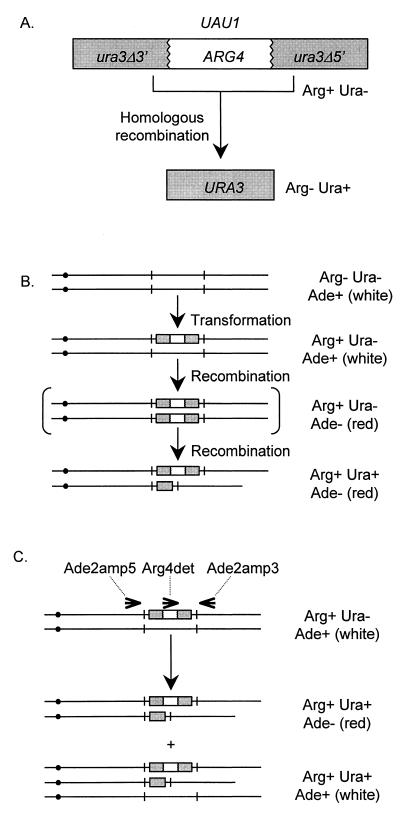
FIG. 1
FIG. 1
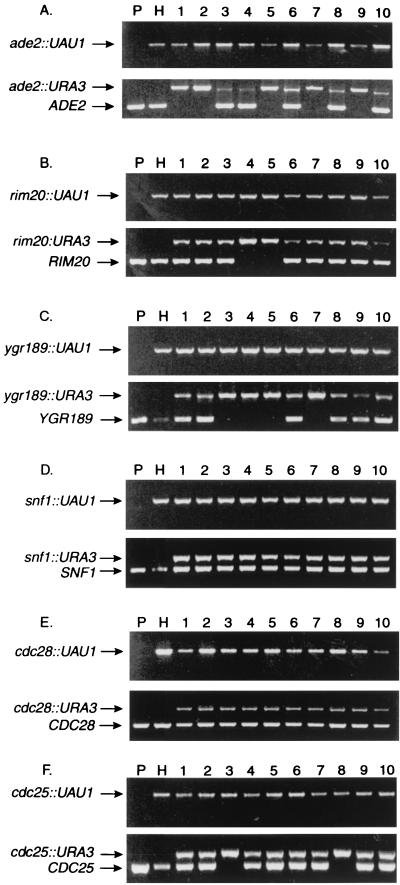
Genetic properties of UAU1. (A) Conversion of UAU1 to URA3. The UAU1 marker (top) comprises an intact ARG4 gene flanked by URA3 deletion derivatives ura3Δ3′ and ura3Δ5′. The URA3 segments are nonfunctional, so the UAU1 cassette confers an Arg+ Ura phenotype. The URA3 segments share 530 bp of homology and can thus recombine to yield an intact URA3 gene. Recombination excises the ARG4 gene and results in an Arg Ura+ phenotype. (B) Anticipated use of UAU1 to select for homozygous mutants (double-disruption selection). One allele of a gene (here ADE2) is disrupted with a UAU1 insertion through transformation with selection for an Arg+ phenotype. Growth of the transformant yields rare recombinant segregants in which the UAU1 insertion allele is homozygous. Such segregants may be selected after they undergo recombinational excision within one UAU1 cassette to yield a unique Arg+ Ura+ phenotype. (C) Outcome of double-disruption selection with an ade2::UAU1/ADE2 strain. Genotypes were determined with PCR primers depicted at the top. The ade2::UAU1/ADE2 strain yielded two classes of Arg+ Ura+ segregants. One class (homozygote) was Ade, grew into red colonies, and yielded diagnostic ade2::UAU1 and ade2::URA3 PCR products (Fig. 2A, lanes 1, 2, 5, 7, and 9). The other class (allelic triplication) was Ade+, grew into white colonies, and yielded ade2::UAU1, ade2::URA3, and ADE2 PCR products (Fig. 2A, lanes 3, 4, 6, 8, and 10). The latter class is depicted as a trisome as an example, but it may arise through translocation, tandem duplication, or other genetic rearrangements.
FIG. 2
FIG. 2
PCR analysis of double-disruption selection segregants. Each panel shows a composite of two agarose gels of PCRs conducted with genomic DNA templates. The upper-gel PCRs used amp3 and Arg4det primers; the lower-gel PCRs used amp3 and amp5 primers. (The amp3–amp5 PCRs are unreliable for detection of full-length UAU1 insertions, presumably because the smaller PCR products are amplified more efficiently.) Lanes: templates from parent strain BWP17 (lanes P), the respective UAU1 disruption heterozygote (lanes H), and 10 independent Arg+ Ura+ segregants from the disruption heterozygote (lanes 1 to 10). Panels show analyses for ADE2 (A), RIM20 (B), YGR189 (C), SNF1 (D), CDC28 (E), and CDC25 (F).
FIG. 3
FIG. 3
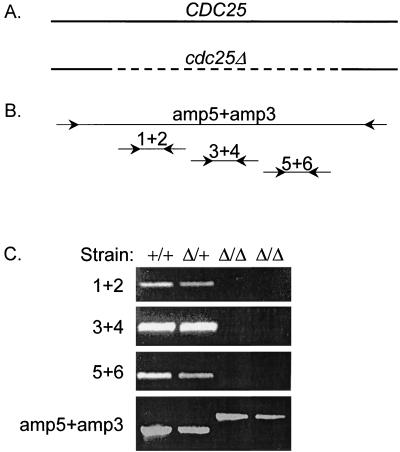
PCR analysis of cdc25Δ/cdc25Δ segregants. (A) Schematic diagram of wild-type and mutant CDC25 loci. The solid line represents the genomic CDC25 sequence. The dashed line represents the sequence deleted and replaced with UAU1 and URA3 in the cdc25::UAU1 and cdc25::URA3 alleles. (B) Locations of PCR primers. Each line represents a PCR amplification product that derives from the CDC25 sequences directly above (in panel A). The primer pair amp5 + amp3 (Cdc25amp5 and Cdc25amp3) can amplify wild-type and mutant CDC25 alleles. The primer pairs 1+2 (cdc25del1 and cdc25del2), 3+4 (cdc25del3 and cdc25del4), and 5+6 (cdc25del5 and cdc25del6) amplify regions that are deleted by the cdc25::UAU1 and cdc25::URA3 alleles. (C) PCR products from genomic templates. Genomic templates derived from strains BWP17 (CDC25/CDC25), BMY16 (cdc25::UAU1/CDC25), and the two cdc25::UAU1/cdc25::URA3 segregants were amplified by PCR with the primer pairs indicated, and PCR products were visualized after agarose gel electrophoresis.

References

    1. Care R S, Trevethick J, Binley K M, Sudbery P E. The MET3 promoter: a new tool for Candida albicans molecular genetics. Mol Microbiol. 1999;34:792–798. - PubMed
    1. Christianson T W, Sikorski R S, Dante M, Shero J H, Hieter P. Multifunctional yeast high-copy-number shuttle vectors. Gene. 1992;110:119–122. - PubMed
    1. Damagnez V, Cottarel G. Candida albicans CDK1 and CYB1: cDNA homologues of the cdc2/CDC28 and cdc13/CLB1/CLB2 cell cycle control genes. Gene. 1996;172:137–141. - PubMed
    1. Davis D, Wilson R B, Mitchell A P. RIM101-dependent and -independent pathways govern pH responses in Candida albicans. Mol Cell Biol. 2000;20:971–978. - PMC - PubMed
    1. Douglas C M, D'Ippolito J A, Shei G J, Meinz M, Onishi J, Marrinan J A, Li W, Abruzzo G K, Flattery A, Bartizal K, Mitchell A, Kurtz M B. Identification of the FKS1 gene of Candida albicans as the essential target of 1,3-beta-d-glucan synthase inhibitors. Antimicrob Agents Chemother. 1997;41:2471–2479. - PMC - PubMed

Publication types

LinkOut - more resources