. 2000 Sep;12(9):1647-66.
doi: 10.1105/tpc.12.9.1647.

Four genes of Medicago truncatula controlling components of a nod factor transduction pathway

Affiliations

Four genes of Medicago truncatula controlling components of a nod factor transduction pathway

R Catoira et al. Plant Cell. 2000 Sep.

Abstract

Rhizobium nodulation (Nod) factors are lipo-chitooligosaccharides that act as symbiotic signals, eliciting several key developmental responses in the roots of legume hosts. Using nodulation-defective mutants of Medicago truncatula, we have started to dissect the genetic control of Nod factor transduction. Mutants in four genes (DMI1, DMI2, DMI3, and NSP) were pleiotropically affected in Nod factor responses, indicating that these genes are required for a Nod factor-activated signal transduction pathway that leads to symbiotic responses such as root hair deformations, expressions of nodulin genes, and cortical cell divisions. Mutant analysis also provides evidence that Nod factors have a dual effect on the growth of root hair: inhibition of endogenous (plant) tip growth, and elicitation of a novel tip growth dependent on (bacterial) Nod factors. dmi1, dmi2, and dmi3 mutants are also unable to establish a symbiotic association with endomycorrhizal fungi, indicating that there are at least three common steps to nodulation and endomycorrhization in M. truncatula and providing further evidence for a common signaling pathway between nodulation and mycorrhization.


Figures
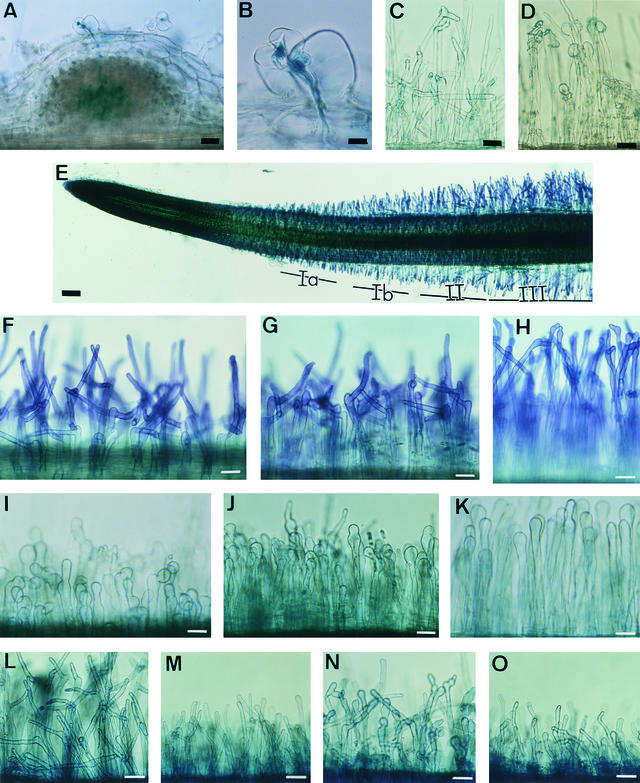
Figure 1.
Figure 1.
Root Hair Deformation Phenotypes of Wild-Type and Mutant Plants.
Figure 2.
Figure 2.
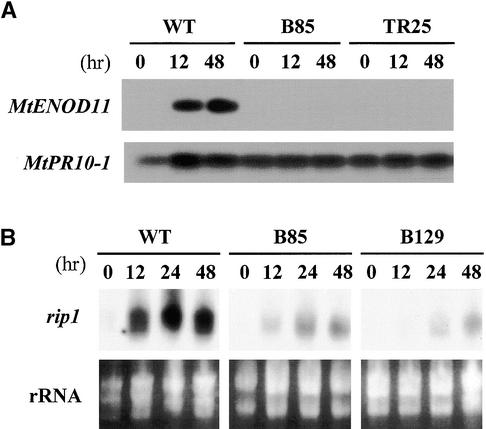
Analysis of Early Nodulin Gene Expression in Wild-Type and Mutant Plants in Response to Nod Factors. (A) RT-PCR analysis of MtENOD11 expression in wild type (WT) and mutant (B85, locus 4, and TR25, locus 2) roots treated with Nod factors at 10–8 M and harvested at the indicated times (see Methods). MtPR10-1 RNA was amplified as a control for the quality and quantity of the RNA samples. (B) RNA gel blot of rip1 expression in wild type (WT) and mutant (B85, locus 4, and B129, locus 1) roots treated with S. meliloti Nod factors at 10–8 M and harvested at the indicated times (see Methods). rRNA concentrations are shown to control for equal loading.
Figure 3.
Figure 3.
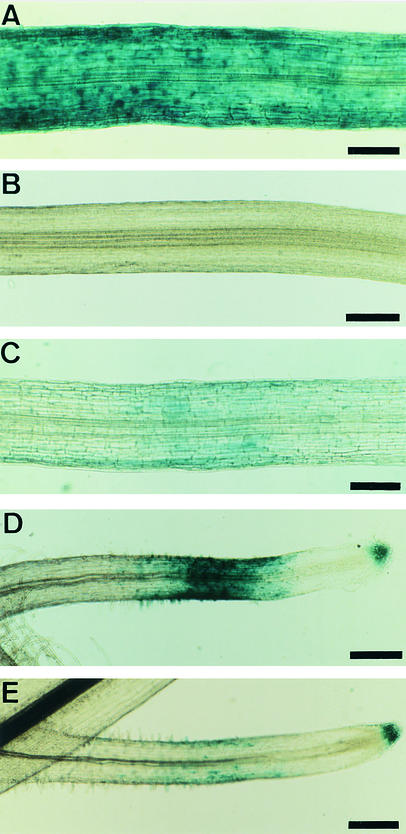
Histochemical Localization of GUS Activity in Roots of Transgenic Plants Carrying a Fusion between the Promoter of MtENOD11 and the GUS Reporter Gene after Treatment with S. meliloti Nod Factors for 6 hr. Primary roots ([A] to [C]) and secondary roots ([D] and [E]), which generally show more intense GUS staining than do the primary roots. (A) Wild type treated with 10–8 M. (B) B129 (locus 1) treated with 10–8 M. (C) C54 (locus 4) treated with 10–8 M. (D) Wild type treated with 10–9 M. (E) B85 (locus 4) treated with 10–9 M. formula image.
Figure 4.
Figure 4.
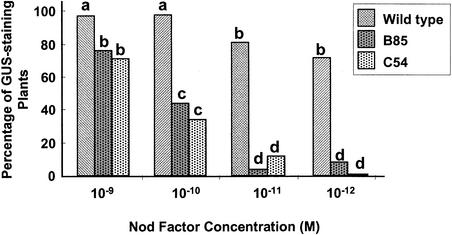
Effect of Different Nod Factor Concentrations on MtENOD11 Expression in Transgenic Lines of Wild Type, B85, and C54 (Both at Locus 4). At least two independent experiments were performed with 15 to 20 plants per sample, all of which were scored 6 hr after treatment with S. meliloti Nod factors. Values with different letters (a, b, and c) differ significantly at formula image. d, values that were not significantly different from control, untreated plants at formula image. Analysis of variance was conducted with Fisher's Exact test (Kendall and Stuart, 1976).
Figure 5.
Figure 5.
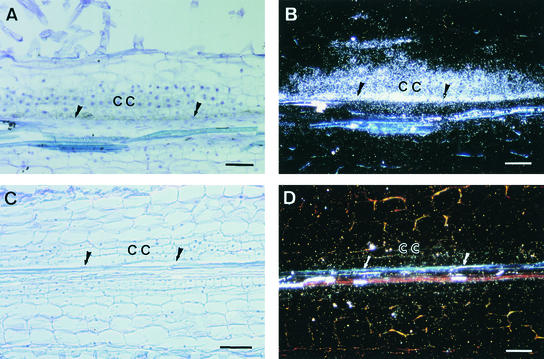
In Situ Hybridization Analysis of MtENOD40 mRNA in Roots of Wild-Type and B85 (Locus 4) Plants in Response to S. meliloti. Roots were hybridized with α-35S-UTP–labeled MtENOD40 RNA probes 48 hr after spot inoculation with S. meliloti GMI5626. Data are presented only for the antisense probes; no hybridization signals were detected with sense probes. (A) and (C) Bright-field microscopy; hybridization signals are visible as dark spots. (B) and (D) Dark-field microscopy; hybridization signals are visible as white dots. (A) and (B) Longitudinal section of a wild-type root showing MtENOD40 RNA localized in the cortical and pericycle dividing cells of a nodule primordium. (C) and (D) Longitudinal section of a B85 root, showing neither cell divisions nor MtENOD40 expression. CC, cortical cells; arrows, pericycle. formula image.
Figure 6.
Figure 6.
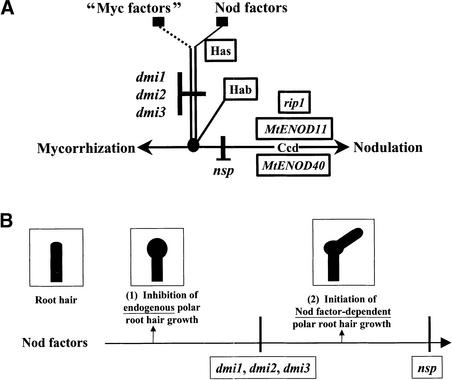
Models for the Intervention of DMI1, DMI2, DMI3, and NSP1 in Nod Factor Signal Transduction. (A) Model for roles in a Nod factor signal transduction pathway leading to MtENOD11, rip1, and MtENOD40 expression; cortical cell division; and nodulation. As deduced by the phenotypes of dmi1, dmi2, dmi3, and nsp1 mutants, DMI1, DMI2, and DMI3 presumably intervene at one or more steps of the pathway downstream of Has and upstream of both Hab and NSP. The part of the signaling pathway controlled by DMI1, DMI2, and DMI3 would be induced both by Nod factors and by potential mycorrhization signals (“Myc factors”) and would play a role in the preparation of the plant for infection by both rhizobia and endomycorrhizal fungi. Ccd, cortical cell division; Hab, root hair branching; Has, root hair swelling. (B) Model for roles in Nod factor–induced root hair tip growth changes. Nod factors would (1) inhibit endogenous polar root hair growth and (2) initiate Nod factor–dependent growth. dmi1, dmi2 and dmi3 mutants uncouple these two events, which indicates either that DMI1, DMI2, and DMI3 are required for an element or elements of Nod factor signal transduction downstream of (1) and upstream of (2) or that Nod factors trigger (1) and (2) by different pathways. nsp mutants are able to initiate polar growth in response to Nod factors, indicating that NSP is involved in a component of Nod factor signal transduction downstream of (2). The root hair swelling response is shown as a phenotype associated with the inhibition of endogenous polar root hair growth; the root hair branching response is shown as a phenotype associated with the initiation of Nod factor–dependent root hair growth. Root hair branching is the phenotype observed when purified Nod factors are applied, but in the normal Rhizobium–legume interaction, when Nod factor–producing rhizobia are present, our model predicts that this initiation of Nod factor–dependent root hair growth contributes to marked root hair curling, a key step in the initiation of rhizobial infection.

References

    1. Albrecht, C., Geurts, R., Lapeyrie, F., and Bisseling, T. (1998). Endomycorrhizae and rhizobial Nod factors both require Sym8 to induce the expression of the early nodulin genes PsENOD5 and PsENOD12A. Plant J. 15, 605–614. - PubMed
    1. Albrecht, C., Geurts, R., and Bisseling, T. (1999). Legume nodulation and mycorrhizae formation; two extremes in host specificity meet. EMBO J. 18, 281–288. - PMC - PubMed
    1. Ardourel, M., Demont, N., Debellé, F., Maillet, F., de Billy, F., Promé, J.C., Dénarié, J., and Truchet, G. (1994). Rhizobium meliloti lipooligosaccharide nodulation factors: Different structural requirements for bacterial entry into target root hair cells and induction of plant symbiotic developmental responses. Plant Cell 6, 1357–1374. - PMC - PubMed
    1. Asad, S., Fang, Y.W., Wycoff, K.L., and Hirsch, A.M. (1994). Isolation and characterization of cDNA and genomic clones of MsENOD40: Transcripts are detected in meristematic cells of alfalfa. Protoplasma 183, 10–23.
    1. Barker, D.G., et al. (1990). Medicago truncatula, a model plant for studying the molecular genetics of the Rhizobium–legume symbiosis. Plant Mol. Biol. Rep. 8, 40–49.

Publication types

MeSH terms

LinkOut - more resources