


Correlations between morphological, molecular biological, and physiological characteristics in clinical and nonclinical isolates of Acanthamoeba spp
- PMID: 11010891
- PMCID: PMC92317
- DOI: 10.1128/AEM.66.10.4408-4413.2000
Correlations between morphological, molecular biological, and physiological characteristics in clinical and nonclinical isolates of Acanthamoeba spp
Abstract
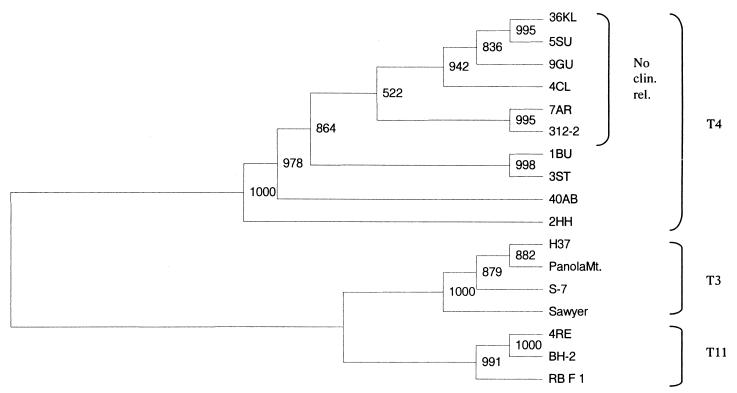
Eleven Acanthamoeba isolates, obtained from Acanthamoeba keratitis patients, from contact lens cases of non-Acanthamoeba keratitis patients, from asymptomatic individuals, from necrotic tissue, and from tap water and two reference strains were investigated by morphological, molecular biological, and physiological means in order to discriminate clinically relevant and nonrelevant isolates. All clinically relevant isolates showed Acanthamoeba sp. group II morphology. 18S ribosomal DNA sequencing revealed sequence type T4 to be the most prevalent group among the isolates and also the group recruiting most of the pathogenic strains. Interestingly, within T4 the strains of no clinical relevance clustered together. Moreover, physiological properties appeared to be highly consistent with initial pathogenicity and with sequence clustering. Altogether, the results of our study indicate a correlation between the phylogenetic relationship and pathogenicity.
Figures
References
-
- Altschul S F, Gish W, Miller W, Myers E W, Lipman D. Basic local alignment search tool. J Mol Biol. 1990;215:403–410. - PubMed
-
- Clark C G, Diamond L S. Ribosomal RNA genes of “pathogenic” and “nonpathogenic” Entamoeba histolytica are distinct. Mol Biochem Parasitol. 1991;49:297–303. - PubMed
-
- De Jonckheere J F. Riboprinting of Naegleria spp.: small-subunit versus large-subunit rDNA. Parasitol Res. 1994;80:230–234. - PubMed
MeSH terms
Substances
Associated data
- Actions
- Actions
- Actions
- Actions
- Actions
- Actions
- Actions
- Actions
LinkOut - more resources
Full Text Sources
Molecular Biology Databases
Miscellaneous
