


Microbial degradation of the multiply branched alkane 2,6,10,15,19, 23-hexamethyltetracosane (Squalane) by Mycobacterium fortuitum and Mycobacterium ratisbonense
- PMID: 11010899
- PMCID: PMC92325
- DOI: 10.1128/AEM.66.10.4462-4467.2000
Microbial degradation of the multiply branched alkane 2,6,10,15,19, 23-hexamethyltetracosane (Squalane) by Mycobacterium fortuitum and Mycobacterium ratisbonense
Abstract
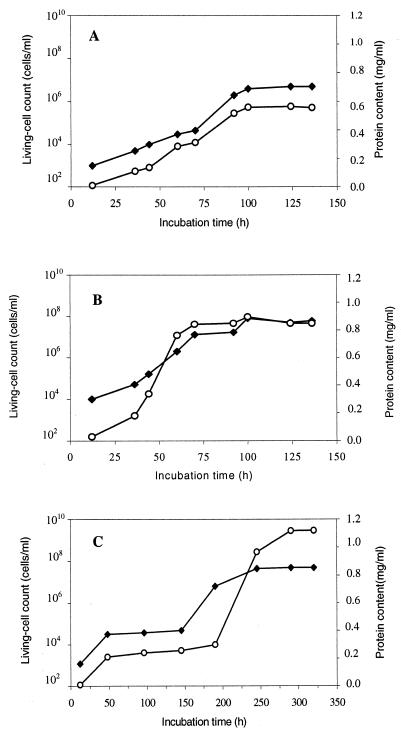
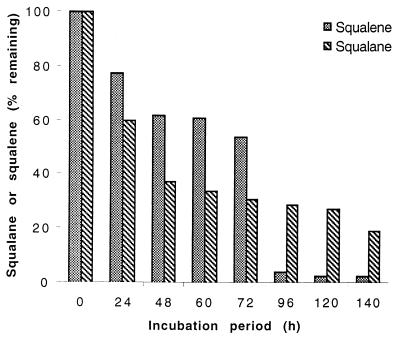
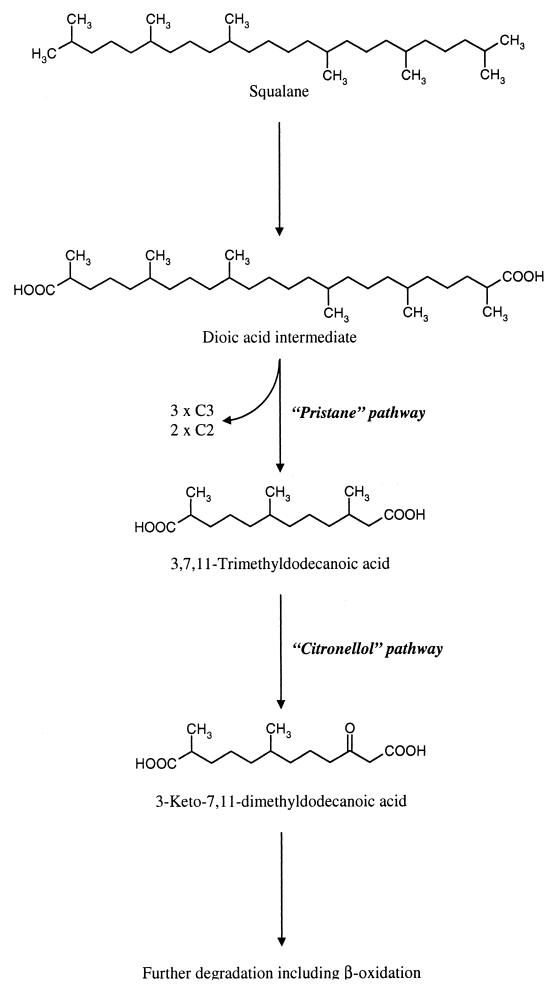
Among several bacterial species belonging to the general Gordonia, Mycobacterium, Micromonospora, Pseudomonas, and Rhodococcus, only two mycobacterial isolates, Mycobacterium fortuitum strain NF4 and the new isolate Mycobacterium ratisbonense strain SD4, which was isolated from a sewage treatment plant, were capable of utilizing the multiply branched hydrocarbon squalane (2,6,10,15,19, 23-hexamethyltetracosane) and its analogous unsaturated hydrocarbon squalene as the sole carbon source for growth. Detailed degradation studies and high-pressure liquid chromatography analysis showed a clear decrease of the concentrations of squalane and squalene during biomass increase. These results were supported by resting-cell experiments using strain SD4 and squalane or squalene as the substrate. The degradation of acyclic isoprenoids and alkanes as well as of acids derived from these compounds was also investigated. Inhibition of squalane and squalene degradation by acrylic acid indicated the possible involvement of beta-oxidation in the degradation route. To our knowledge, this is the first report demonstrating the biodegradation of squalane by using defined axenic cultures.
Figures
References
-
- Alexander M. Nonbiodegradable and other recalcitrant molecules. Biotechnol Bioeng. 1973;IV:611–647.
-
- Ausubel F M, Brent R, Kingston R E, Moore D D, Seidman J G, Smith J A, Struhl K. Current protocols in molecular biology. New York, N.Y: John Wiley & Sons, Inc.; 1995.
-
- Bradford M M. A rapid and sensitive method for the quantitation of microgram quantities of protein utilizing the principle of protein-dye binding. Anal Biochem. 1976;72:248–254. - PubMed
-
- Bühler M, Schindler J. Aliphatic hydrocarbons. In: Rehm H-J, Reed G, editors. Biotechnology. 6a. Weinheim, Germany: Verlag Chemie; 1984. pp. 329–385.
Publication types
MeSH terms
Substances
Associated data
- Actions
LinkOut - more resources
Full Text Sources
Molecular Biology Databases
