. 2000 Oct;66(10):4547-54.
doi: 10.1128/AEM.66.10.4547-4554.2000.

The presence of humic substances and DNA in RNA extracts affects hybridization results

Affiliations

The presence of humic substances and DNA in RNA extracts affects hybridization results

E W Alm et al. Appl Environ Microbiol. 2000 Oct.

Abstract

RNA extracts obtained from environmental samples are frequently contaminated with coextracted humic substances and DNA. It was demonstrated that the response in rRNA-targeted oligonucleotide probe hybridizations decreased as the concentrations of humic substances and DNA in RNA extracts increased. The decrease in hybridization signal in the presence of humic substances appeared to be due to saturation of the hybridization membrane with humic substances, resulting in a lower amount of target rRNA bound to the membrane. The decrease in hybridization response in the presence of low amounts of DNA may be the result of reduced rRNA target accessibility. The presence of high amounts of DNA in RNA extracts resulted in membrane saturation. Consistent with the observations for DNA contamination, the addition of poly(A) to RNA extracts, a common practice used to prepare RNA dilutions for membrane blotting, also reduced hybridization signals, likely because of reduced target accessibility and membrane saturation effects.


Figures

FIG. 1
FIG. 1
(a) Hybridization response for increasing amounts of RNA (nanograms of E. coli RNA applied per slot), expressed as SAB. (b) Change in slope between two sequential datum points in panel a.
FIG. 2
FIG. 2
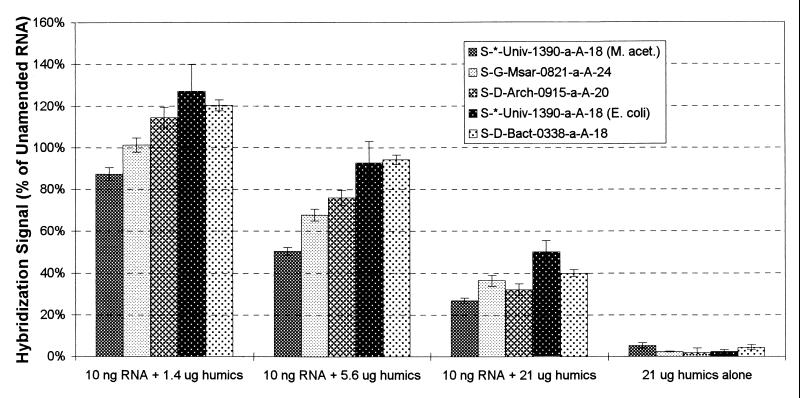
Hybridization response for RNA amended with humic acids and for humic acids alone. The hybridization response is expressed as a percentage of the hybridization response obtained with RNA only.
FIG. 3
FIG. 3
Radioactive signal for increasing amounts of humic acids added to 10 ng of radiolabeled RNA and for humic acids alone. The signal is expressed as the SAB.
FIG. 4
FIG. 4
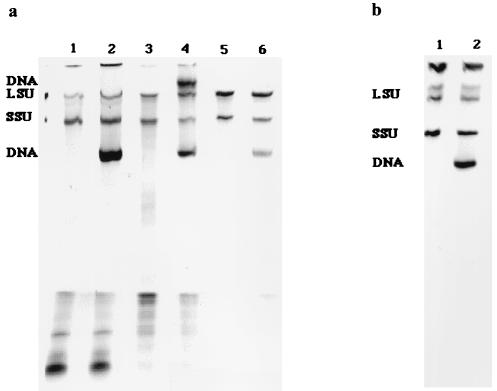
PAGE gels of nucleic acid samples extracted from various environmental samples. (a) Lanes 1 and 2, coastal marine microbial mat; lanes 3 and 4, anaerobic sewage sludge digester; lanes 5 and 6, solid waste digester. Samples in lanes 1, 3, and 5 were treated with FPLCpure DNase 1; samples in lanes 2, 4, and 6 are undigested controls. (b) Lane 1, Methanosaeta concilii 11 days after transfer into fresh medium (exponential growth phase); lane 2, M. concilii 25 days after transfer into fresh medium (stationary growth phase). LSU and SSU represent bands for the large rRNA of the large ribosomal subunit (23S and 23S-like rRNA) and for the small-subunit rRNA, respectively.
FIG. 5
FIG. 5
Hybridization response for RNA amended with DNA and for DNA alone. The hybridization response is expressed as a percentage of the hybridization response obtained with RNA only.
FIG. 6
FIG. 6
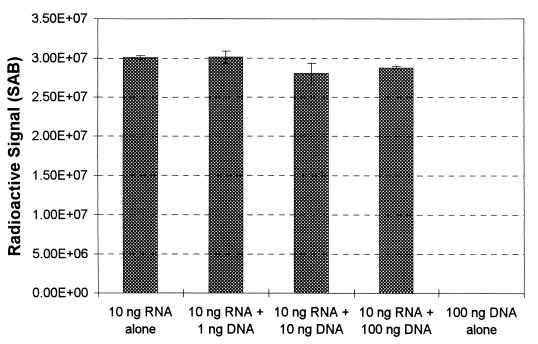
Radioactive signal for increasing amounts of DNA added to 10 ng of radiolabeled RNA and for DNA alone. The signal is expressed as the SAB.
FIG. 7
FIG. 7
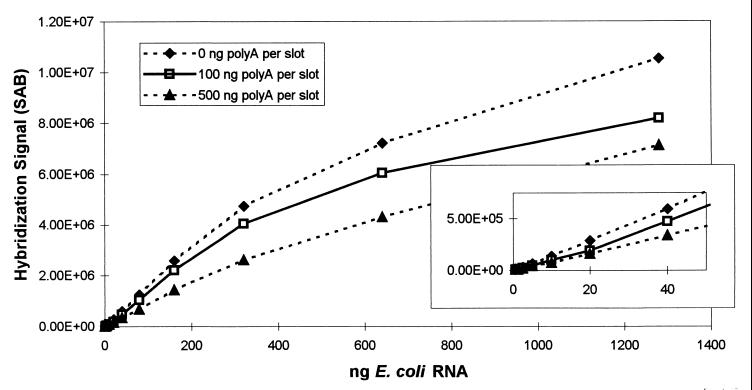
Hybridization response for increasing amounts of RNA, with or without poly(A) in the dilution water. The hybridization response is expressed as the SAB for increasing amounts of RNA applied to the membranes (nanograms of E. coli RNA applied per slot).
FIG. 8
FIG. 8
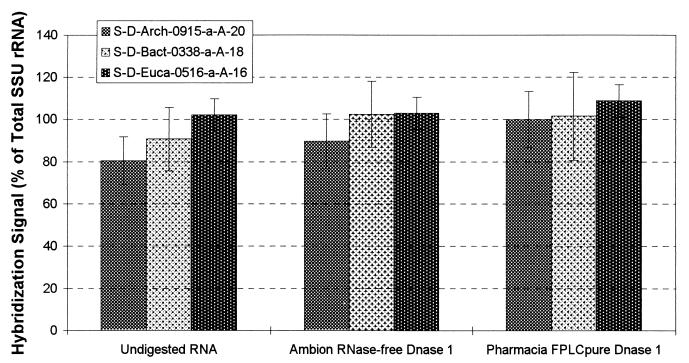
Hybridization response for RNA exposed to DNase. The hybridization response is expressed as a percentage of the response obtained with probe S-*-Univ-1390-a-A-18.

References

    1. Aiken G R, McKnight D M, Wershaw R L, MacCarthy P. Humic substances in soil, sediment, and water. New York, N.Y: John Wiley & Sons; 1985. Appendix A.
    1. Alm E W, Oerther D B, Larsen N, Stahl D A, Raskin L. The oligonucleotide probe database. Appl Environ Microbiol. 1996;62:3557–3559. - PMC - PubMed
    1. Alm E W, Stahl D A. Critical factors influencing the recovery and integrity of rRNA extracted from environmental samples: use of an optimized protocol to measure depth-related biomass distribution in freshwater sediments. J Microbiol Methods. 2000;40:153–162. - PubMed
    1. Amann R I, Binder B J, Olson R J, Chisolm S W, Devereux R, Stahl D A. Combination of 16S rRNA-targeted oligonucleotide probes with flow cytometry for analyzing mixed microbial populations. Appl Environ Microbiol. 1990;56:1919–1925. - PMC - PubMed
    1. Amann R I, Krumholz L, Stahl D A. Fluorescent-oligonucleotide probing of whole cells for determinative, phylogenetic, and environmental studies in microbiology. J Bacteriol. 1990;172:762–770. - PMC - PubMed

Publication types

MeSH terms

LinkOut - more resources