


doi: 10.1128/AEM.66.10.4585-4588.2000.
A rhamnolipid biosurfactant reduces cadmium toxicity during naphthalene biodegradation
Affiliations
- PMID: 11010924
- PMCID: PMC92350
- DOI: 10.1128/AEM.66.10.4585-4588.2000
Item in Clipboard
A rhamnolipid biosurfactant reduces cadmium toxicity during naphthalene biodegradation
Appl Environ Microbiol.
2000 Oct.
Abstract
A model cocontaminated system was developed to determine whether a metal-complexing biosurfactant, rhamnolipid, could reduce metal toxicity to allow enhanced organic biodegradation by a Burkholderia sp. isolated from soil. Rhamnolipid eliminated cadmium toxicity when added at a 10-fold greater concentration than cadmium (890 microM), reduced toxicity when added at an equimolar concentration (89 microM), and had no effect at a 10-fold smaller concentration (8.9 microM). The mechanism by which rhamnolipid reduces metal toxicity may involve a combination of rhamnolipid complexation of cadmium and rhamnolipid interaction with the cell surface to alter cadmium uptake.
Figures
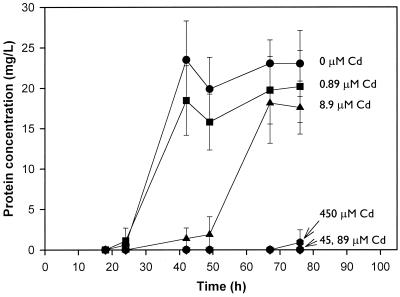
Effect of cadmium concentration on the growth of a Burkholderia sp. on naphthalene. Each point represents the mean protein concentration for triplicate flasks. Error bars represent standard deviations.
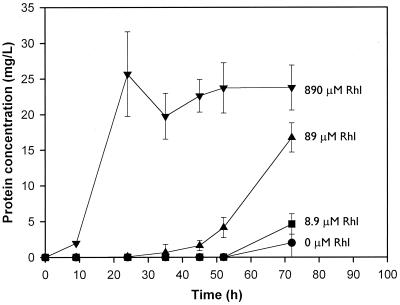
Effect of the rhamnolipid (Rhl) concentration on the growth of a Burkholderia sp. on naphthalene in the presence of 89 μM cadmium. Each point represents the mean protein concentration for triplicate flasks. Error bars represent standard deviations.
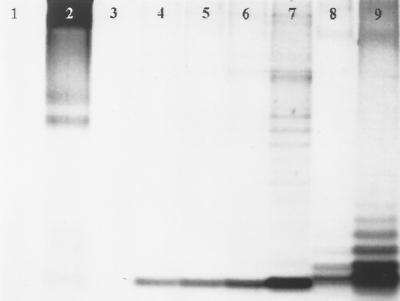
Sodium dodecyl sulfate-polyacrylamide gel electrophoresis of concentrated (10×) supernatants of suspensions of a Burkholderia sp. The gel was stained using a silver-staining procedure for LPS. Lanes: 1, buffer; 2, 5 μg of BSA; 3, 4485.6 μg (890 μM) of rhamnolipid; 4, supernatant of the Burkholderia sp. treated only with MSM; 5, supernatant of the Burkholderia sp. treated with 8.9 μM rhamnolipid; 6, supernatant of the Burkholderia sp. treated with 89 μM rhamnolipid; 7, supernatant of the Burkholderia sp. treated with 890 μM rhamnolipid; 8, 1 μg of P. aeruginosa serotype 10 LPS; 9, 10 μg of P. aeruginosa serotype 10 LPS. The gel was imaged and the band density (integrated density value) was determined using the SpotDenso function of AlphaImager (Alpha Innotech, San Leandro, Calif.).
References
-
- Babich H, Stotzky G. Effect of cadmium on microbes in vitro and in vivo: influence of clay minerals. In: Babich H, Stotzky G, editors. Microbial ecology. Berlin, Germany: Springer-Verlag; 1978. pp. 412–415.
-
- Enger E D, Smith B F. Hazardous and toxic wastes. In: Enger E D, Smith B F, editors. Environmental science: the study of interrelationships. Dubuque, Iowa: Wm. C. Brown Publishers; 1992.
Publication types
MeSH terms
Substances
LinkOut - more resources
Full Text Sources
Other Literature Sources
