


Identification of MEFV-independent modifying genetic factors for familial Mediterranean fever
- PMID: 11017802
- PMCID: PMC1288556
- DOI: 10.1016/S0002-9297(07)62944-9
Identification of MEFV-independent modifying genetic factors for familial Mediterranean fever
Abstract
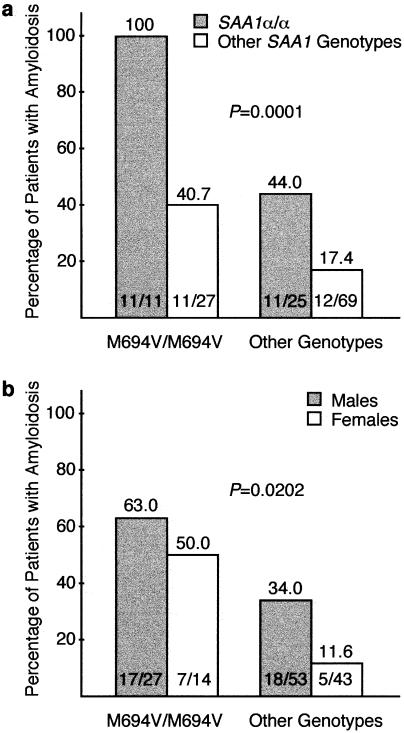
Familial Mediterranean fever (FMF) is a recessively inherited disorder predisposing to renal amyloidosis and associated with mutations in MEFV, a gene encoding a protein of unknown function. Differences in clinical expression have been attributed to MEFV-allelic heterogeneity, with the M694V/M694V genotype associated with a high prevalence of renal amyloidosis. However, the variable risk for patients with identical MEFV mutations to develop this severe complication, prevented by lifelong administration of colchicine, strongly suggests a role for other genetic and/or environmental factors. To overcome the well-known difficulties in the identification of modifying genetic factors, we investigated a relatively homogeneous population sample consisting of 137 Armenian patients with FMF from 127 independent families living in Armenia. We selected the SAA1, SAA2, and APOE genes-encoding serum amyloid proteins and apolipoprotein E, respectively-as well as the patients' sex, as candidate modifiers for renal amyloidosis. A stepwise logistic-regression analysis showed that the SAA1alpha/alpha genotype was associated with a sevenfold increased risk for renal amyloidosis, compared with other SAA1 genotypes (odds ratio [OR] 6. 9; 95% confidence interval [CI] 2.5-19.0). This association, which was present whatever the MEFV genotype, was extremely marked in patients homozygous for M694V (11/11). The risk for male patients of developing renal amyloidosis was fourfold higher than that for female patients (OR=4.0; 95% CI=1.5-10.8). This association, particularly marked in patients who were not homozygous for M694V (34.0% vs. 11.6%), was independent of SAA1-allelic variations. Polymorphisms in the SAA2 or APOE gene did not appear to influence susceptibility to renal amyloidosis. Overall, these data, which provide new insights into the pathophysiology of FMF, demonstrate that susceptibility to renal amyloidosis in this Mendelian disorder is influenced by at least two MEFV-independent factors of genetic origin-SAA1 and sex-that act independently of each other.
Figures
References
Electronic-Database Information
-
- Online Mendelian Inheritance in Man (OMIM), http://www.ncbi.nlm.nih.gov/omim/ (for FMF [MIM 249100])
References
-
- Baba S, Masago S, Takahashi T, Kasama T, Sugimura H, Tsugane S, Tsutsui Y, Shirasawa H (1995) A novel allelic variant of serum amyloid A, SAA1 γ: genomic evidence, evolution, frequency, and implication as a risk factor for reactive systemic AA-amyloidosis. Hum Mol Genet 4:1083–1087 - PubMed
-
- Bernot A, da Silva C, Petit J, Cruaud C, Caloustian C, Castet V, Ahmed-Arab M, Dross C, Dupont M, Cattan D, Smaoui N, Dode C, Pecheux C, Nedelec B, Medaxian J, Rozenbaum M, Rosner I, Delpech M, Grateau G, Demaille J, Weissenbach J, Touitou I (1998) Non-founder mutations in the MEFV gene establish this gene as the cause of familial Mediterranean fever. Hum Mol Genet 7:1317–1325 - PubMed
-
- Booth D, Booth S, Gillmore J, Hawkins P, Pepys M (1998a) SAA1 alleles as risk factors in reactive systemic AA amyloidosis. Amyloid 5:262–265 - PubMed
-
- Booth DR, Gillmore JD, Booth SE, Pepys MB, Hawkins PN (1998b) Pyrin/marenostrin mutations in familial Mediterranean fever. QJM 91:603–606 - PubMed
-
- Castaño EM, Prelli F, Pras M, Frangione B (1995) Apolipoprotein E carboxyl-terminal fragments are complexed to amyloids A and L. J Biol Chem 270:17610–17615 - PubMed
Publication types
MeSH terms
Substances
LinkOut - more resources
Full Text Sources
Medical
Miscellaneous
