


Discharge behaviour of single motor units during maximal voluntary contractions of a human toe extensor
- PMID: 11018121
- PMCID: PMC2270114
- DOI: 10.1111/j.1469-7793.2000.00227.x
Discharge behaviour of single motor units during maximal voluntary contractions of a human toe extensor
Abstract
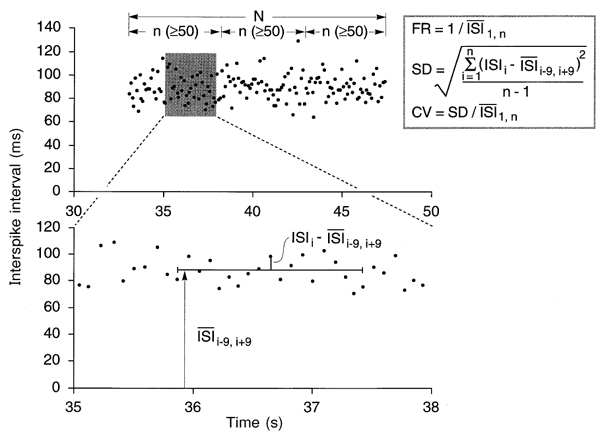
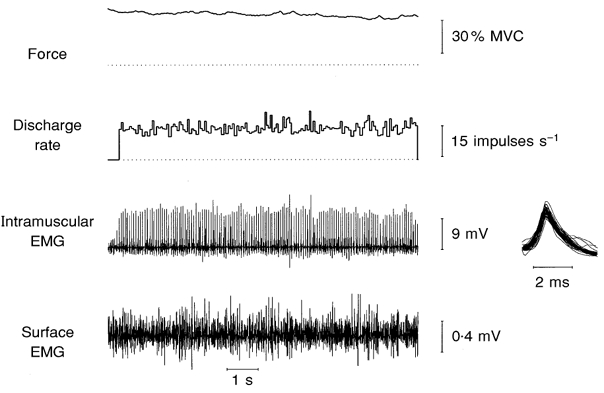
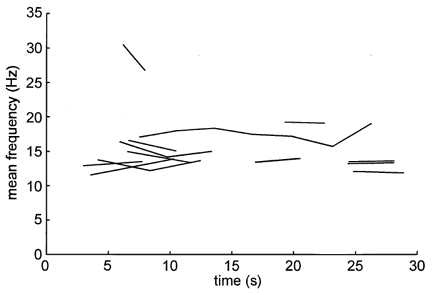
1. While it is known that the average firing rate of a population of motoneurones declines with time during a maximal voluntary contraction, at least for many muscles, it is not known how the firing patterns of individual motoneurones adapt with fatigue. To address this issue we used tungsten microelectrodes to record spike trains (mean +/- s.e.m., 183 +/- 27 spikes per train; range, 100-782 spikes) from 26 single motor units in extensor hallucis longus during sustained (60-180 s) maximal dorsiflexions of the big toe in seven human subjects. 2. Long spike trains were recorded from 13 units during the first 30 s of a maximal voluntary contraction (mean train duration, 9.6 +/- 1.2 s; range, 3.6-21.9 s) and from 13 units after 30 s (mean train duration, 16.6 +/- 3.7 s; range, 7.1-58.1 s). Maximal isometric force generated by the big toe declined to 78.3 +/- 6.3 % of its control level by 60-90 s and to 39.5 +/- 1.4 % of control by 120-150 s. Despite this substantial fatigue, mean firing rates did not change significantly over time, declining only slightly from 15.8 +/- 0.7 Hz in the first 30 s to 14.0 +/- 0.5 Hz by 60-90 s and 13.6 +/- 0.3 Hz by 120-150 s. 3. To assess fatigue-related adaptation in discharge frequency and variability of individual motor units, each spike train was divided into 2-15 equal segments containing at least 50 interspike intervals. Discharge variability was measured from the coefficient of variation (s.d. /mean) in the interspike intervals, with the s.d. being calculated using a floating mean of 19 consecutive intervals. Adaptation was computed as the average change in firing rate or variability that would occur for each 1 s of activity. There were no systematic changes in either firing rate or variability with time. 4. We conclude that single motoneurones supplying the extensor hallucis longus, a muscle comprised primarily of slow twitch muscle units, show little adaptation in firing with fatigue, suggesting that a progressive reduction in firing rate is not an invariable consequence of the fatigue associated with sustained maximal voluntary contractions.
Figures
References
-
- Bellemare F, Woods JJ, Johansson R, Bigland-Ritchie B. Motor-unit discharge rates in maximal voluntary contractions of three human muscles. Journal of Neurophysiology. 1983;50:1380–1392. - PubMed
-
- Bigland-Ritchie B, Furbush FF, Gandevia SC, Thomas CK. Voluntary discharge frequencies of human motoneurons at different muscle lengths. Muscle and Nerve. 1992a;15:130–137. - PubMed
Publication types
MeSH terms
Grants and funding
LinkOut - more resources
Full Text Sources
