


doi: 10.1073/pnas.97.21.11343.
Independent adaptation to riverine habitats allowed survival of ancient cetacean lineages
Affiliations
- PMID: 11027333
- PMCID: PMC17202
- DOI: 10.1073/pnas.97.21.11343
Item in Clipboard
Independent adaptation to riverine habitats allowed survival of ancient cetacean lineages
Proc Natl Acad Sci U S A.
.
Abstract
The four species of "river dolphins" are associated with six separate great river systems on three subcontinents and have been grouped for more than a century into a single taxon based on their similar appearance. However, several morphologists recently questioned the monophyly of that group. By using phylogenetic analyses of nucleotide sequences from three mitochondrial and two nuclear genes, we demonstrate with statistical significance that extant river dolphins are not monophyletic and suggest that they are relict species whose adaptation to riverine habitats incidentally insured their survival against major environmental changes in the marine ecosystem or the emergence of Delphinidae.
Figures
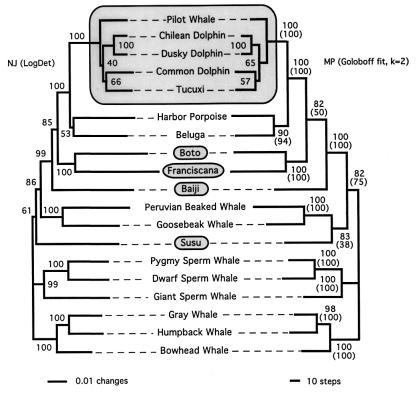
Unrooted molecular phylogeny of cetaceans based on nuDNA and mtDNA
sequences. The left and right sides show the NJ (under LogDet
distances) and MP (under Goloboff fit criterion with
k = 2) trees, respectively. Bootstrap values are
indicated at the nodes (1,000 and 400 replicates for NJ and MP,
respectively). Values between parentheses correspond to bootstrap
values (400 replicates) for ML analyses (see Fig. 2 for tree topology).
Topology of the MP tree is stable to Goloboff weighting (with
k = 0–8). Unweighted MP analysis yielded a tree in
which the positions of the sperm whale and [beaked whales + susu]
clades are exchanged; these two alternative topologies have tree
lengths differing by two evolutionary events and are not significantly
different under the Kishino-Hasegawa test. The large and small shaded
boxes indicate the radiation of delphinids and the four river dolphin
species, respectively. Note that the exact placement of the susu
differs between the NJ and MP/ML trees.
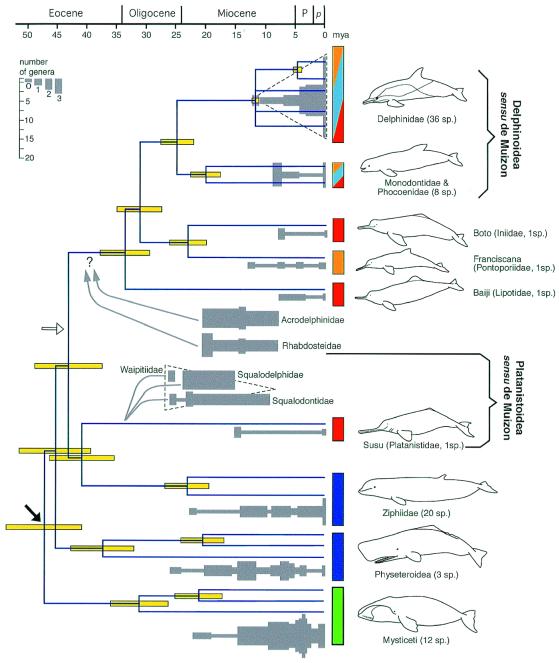
ML tree topology (−lnL = 19019.05697) combined with calculated
dates of divergences as well as estimates of generic diversity of
relevant fossil taxa (gray-shaded boxes). Generic diversity estimates
are from ref. . Only genera considered stable enough and based on
diagnostic material are considered. Numbers of extant species are given
between parentheses for each group. Vertical colored boxes indicate
habitat: green, specialization in filter feeding (baleen whales); dark
blue, specialization for deep feeding on squids (beaked and sperm
whales); orange, coastal waters; light blue, oceanic waters; and red,
fluvial environment (whereas the boto, baiji, and susu are exclusively
riverine, some delphinoid species consist of distinct coastal and
fluvial populations). Each horizontal yellow bar indicates twice the
value of the standard deviation for the age of the corresponding node.
Hence, standard deviations are not referring to the
topology of the tree. Dotted triangles indicate the
radiation of Delphinidae and concurrent gradual extinction of
Waipitiidae, Squalodelphidae, and Squalodontidae. The black arrow at
the base of the tree indicates the position of the root when all nu and
mt data are used in a simultaneous ML analysis and by using
hippopotamus as an outgroup. This result is, however, unstable because
several gene fragments support an alternative root, indicated by the
white arrow. Whichever of these two rooting hypotheses is correct is
irrelevant to the issues discussed and conclusions reached in the
present paper. P, Pliocene and p, Pleistocene.
References
-
- Rice D W. Marine Mammals of the World: Systematics and Distribution. Lawrence, KS: Allen; 1998.
-
- Heyning J E. Contrib Sci Nat Hist Mus Los Angeles. 1989;405:1–64.
-
- LeDuc R G, Perrin W F, Dizon A E. Mar Mamm Sci. 1999;15:619–648.
-
- Chen P, Liu R, Wang D, Zhang X. Biology, Rearing and Conservation of Baiji. Beijing: Science Press; 1997.
-
- Pilleri G. Invest Cetacea. 1974;4:44–70.
Publication types
MeSH terms
Substances
Associated data
- Actions
- Actions
- Actions
- Actions
- Actions
- Actions
- Actions
- Actions
- Actions
- Actions
- Actions
- Actions
- Actions
- Actions
- Actions
- Actions
- Actions
- Actions
- Actions
- Actions
- Actions
- Actions
- Actions
- Actions
- Actions
- Actions
- Actions
- Actions
- Actions
- Actions
LinkOut - more resources
Full Text Sources
