


Treatment of fibromyalgia with antidepressants: a meta-analysis
- PMID: 11029681
- PMCID: PMC1495596
- DOI: 10.1046/j.1525-1497.2000.06279.x
Treatment of fibromyalgia with antidepressants: a meta-analysis
Abstract
Background: Fibromyalgia is a common, poorly understood musculoskeletal pain syndrome with limited therapeutic options.
Objective: To systematically review the efficacy of antidepressants in the treatment of fibromyalgia and examine whether this effect was independent of depression.
Design: Meta-analysis of English-language, randomized, placebo-controlled trials. Studies were obtained from searching MEDLINE, EMBASE, and PSYCLIT (1966-1999), the Cochrane Library, unpublished literature, and bibliographies. We performed independent duplicate review of each study for both inclusion and data extraction.
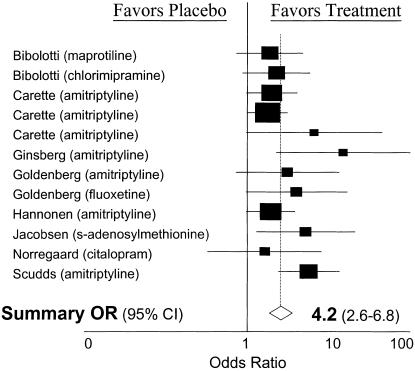
Main results: Sixteen randomized, placebo-controlled trials were identified, of which 13 were appropriate for data extraction. There were 3 classes of antidepressants evaluated: tricyclics (9 trials), selective serotonin reuptake inhibitors (3 trials), and S-adenosylmethionine (2 trials). Overall, the quality of the studies was good (mean score 5.6, scale 0-8). The odds ratio for improvement with therapy was 4.2 (95% confidence interval [95% CI], 2.6 to 6.8). The pooled risk difference for these studies was 0.25 (95% CI, 0.16 to 0.34), which calculates to 4 (95% CI, 2.9 to 6.3) individuals needing treatment for 1 patient to experience symptom improvement. When the effect on individual symptoms was combined, antidepressants improved sleep, fatigue, pain, and well-being, but not trigger points. In the 5 studies where there was adequate assessment for an effect independent of depression, only 1 study found a correlation between symptom improvement and depression scores. Outcomes were not affected by class of agent or quality score using meta-regression.
Conclusion: Antidepressants are efficacious in treating many of the symptoms of fibromyalgia. Patients were more than 4 times as likely to report overall improvement, and reported moderate reductions in individual symptoms, particularly pain. Whether this effect is independent of depression needs further study.
Figures

Comment in
- ACP J Club. 2001 May-Jun;134(3):85
References
-
- Wolfe F. Fibromyalgia, the clinical syndrome. Rheum Dis Clin NA. 1989;15:1–17. - PubMed
-
- Goldenberg DL. Fibromyalgia syndrome a decade later: what have we learned? Arch Intern Med. 1999;159:777–85. - PubMed
-
- Hudson JL, Goldenberg DL, Pope Hg, Jr, Keck Pe, Jr, Schlesinger L. Comorbidity of fibromyalgia with medical and psychiatric disorders. Am J Med. 1992;92:363–7. - PubMed
-
- Triadafilopoulos G, Simms RW, Goldenberg DL. Bowel dysfunction in fibromyalgia syndrome. Dig Dis Sci. 1991;36:59–64. - PubMed
-
- Ahles TA, Khan SA, Yunus MB, Spiegell DA, Masi AT. Psychiatric status of patients with primary fibromyalgia, patients with rheumatoid arthritis and subjects without pain: a blind comparison of DSM-III diagnoses. Am J Psychiatry. 1991;148:1721–6. - PubMed
Publication types
MeSH terms
Substances
LinkOut - more resources
Full Text Sources
Other Literature Sources
Medical