Bifidobacterium strains from resident infant human gastrointestinal microflora exert antimicrobial activity
- PMID: 11034580
- PMCID: PMC1728100
- DOI: 10.1136/gut.47.5.646
Bifidobacterium strains from resident infant human gastrointestinal microflora exert antimicrobial activity
Abstract
Background and aims: The gastrointestinal microflora exerts a barrier effect against enteropathogens. The aim of this study was to examine if bifidobacteria, a major species of the human colonic microflora, participates in the barrier effect by developing antimicrobial activity against enterovirulent bacteria.
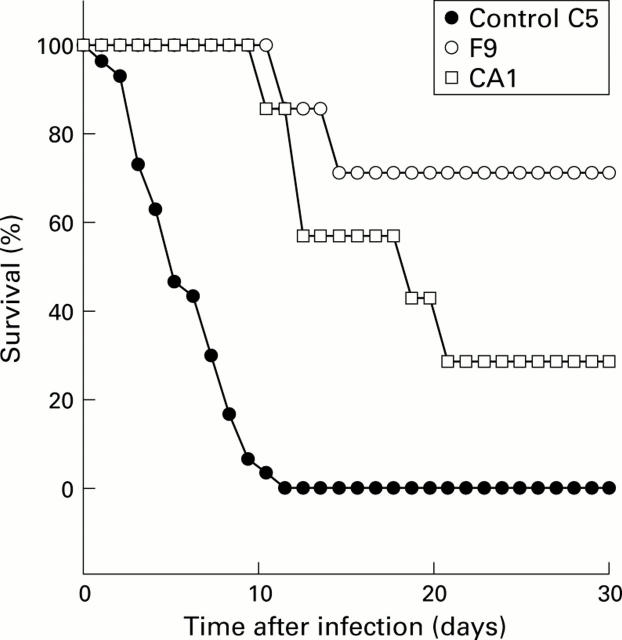
Methods: Antibacterial activity was examined in vitro against a wide range of Gram negative and Gram positive pathogens. Inhibition of Salmonella typhimurium SL1334 cell association and cell invasion was investigated in vitro using Caco-2 cells. Colonisation of the gastrointestinal tract in vivo by bifidobacteria was examined in axenic C3/He/Oujco mice. Antimicrobial activity was examined in vivo in axenic C3/He/Oujco mice infected by the lethal S typhimurium C5 strain.
Results: Fourteen human bifidobacterium strains isolated from infant stools were examined for antimicrobial activity. Two strains (CA1 and F9) expressed antagonistic activity against pathogens in vitro, inhibited cell entry, and killed intracellular S typhimurium SL1344 in Caco-2 cells. An antibacterial component(s) produced by CA1 and F9 was found to be a lipophilic molecule(s) with a molecular weight of less than 3500. In the axenic C3/He/Oujco mice, CA1 and F9 strains colonised the intestinal tract and protected mice against S typhimurium C5 lethal infection.
Conclusion: Several bifidobacterium strains from resident infant human gastrointestinal microflora exert antimicrobial activity, suggesting that they could participate in the "barrier effect" produced by the indigenous microflora.
Figures
References
Publication types
MeSH terms
LinkOut - more resources
Full Text Sources
Other Literature Sources
Medical
Molecular Biology Databases
Miscellaneous