


Intravenous prostaglandin for induction of labour
- PMID: 11034778
- PMCID: PMC8456460
- DOI: 10.1002/14651858.CD002864
Intravenous prostaglandin for induction of labour
Abstract
Background: Intravenous prostaglandin E2 and F2 alpha can be used to induce labour. The use of intravenous prostaglandins in this context has been limited by perceived unacceptable maternal side effect profiles. This is one of a series of reviews of methods of cervical ripening and labour induction using standardised methodology.
Objectives: To determine the effects of intravenous prostaglandin for third trimester cervical ripening or induction of labour.
Search strategy: The Cochrane Pregnancy and Childbirth Group trials register, The Cochrane Controlled Trials Register and bibliographies of relevant papers.
Selection criteria: The criteria for inclusion included the following: (1) clinical trials comparing intravenous prostaglandin used for third trimester cervical ripening or labour induction with placebo/no treatment or other methods listed above it on a predefined list of labour induction methods; (2) random allocation to the treatment or control group; (3) adequate allocation concealment; (4) violations of allocated management not sufficient to materially affect conclusions; (5) clinically meaningful outcome measures reported; (6) data available for analysis according to the random allocation; (7) missing data insufficient to materially affect the conclusions.
Data collection and analysis: A strategy has been developed to deal with the large volume and complexity of trial data relating to labour induction. This involves a two-stage method of data extraction. The initial data extraction is done centrally, and incorporated into a series of primary reviews arranged by methods of induction of labour, following a standardised methodology. The data will then be extracted from the primary reviews into a series of secondary reviews, arranged by category of woman. To avoid duplication of data in the primary reviews, the labour induction methods have been listed in a specific order, from one to 25. Each primary review includes comparisons between one of the methods (from two to 25) with only those methods above it on the list.
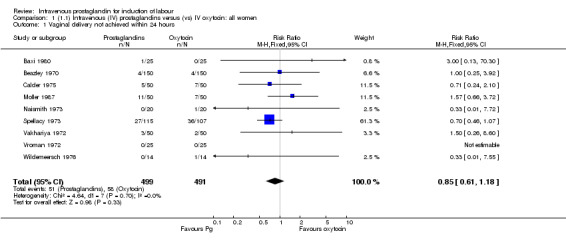
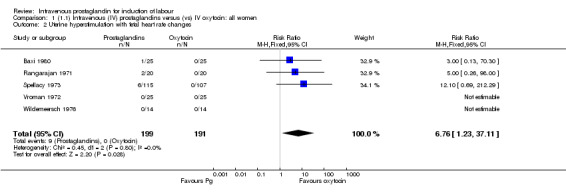
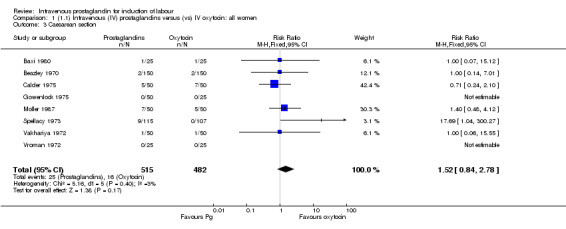
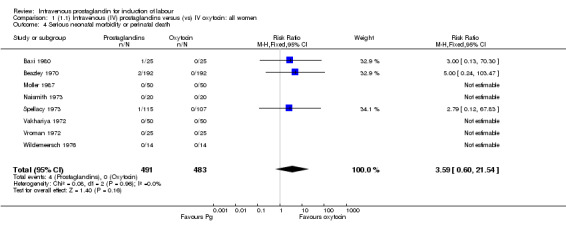
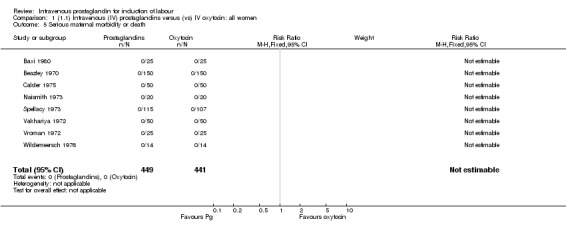
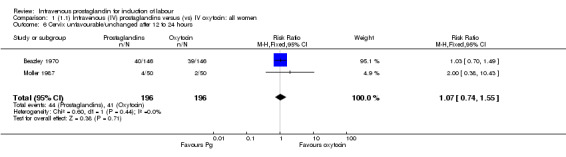
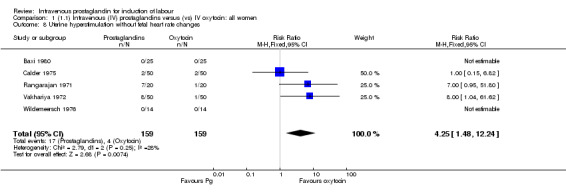
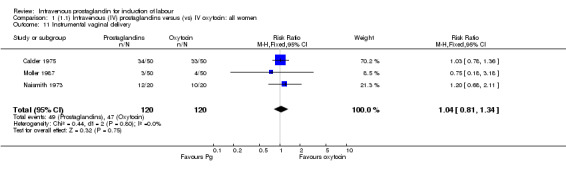
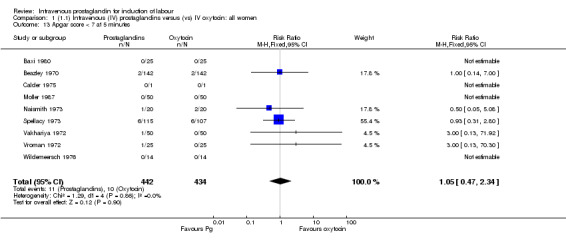
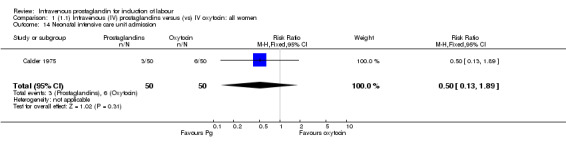
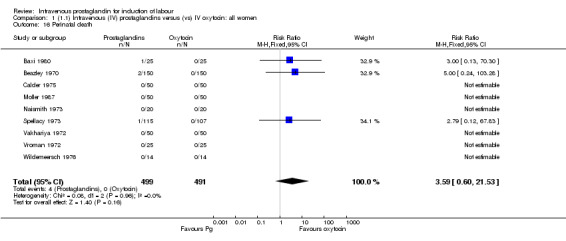
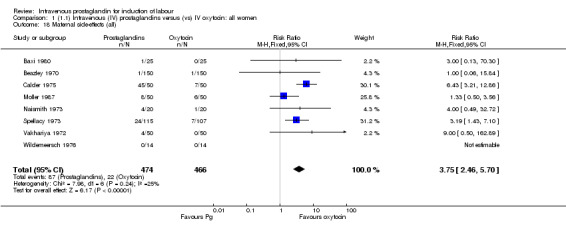
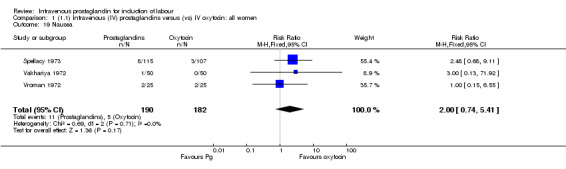
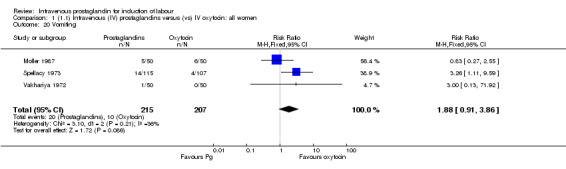
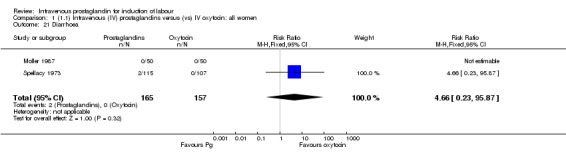
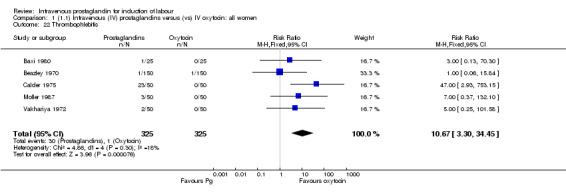
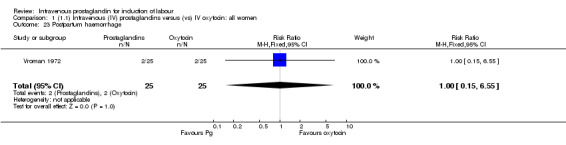
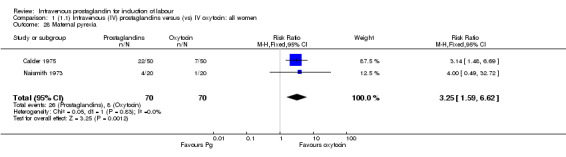
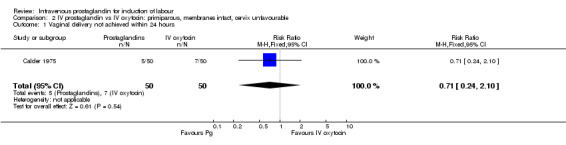
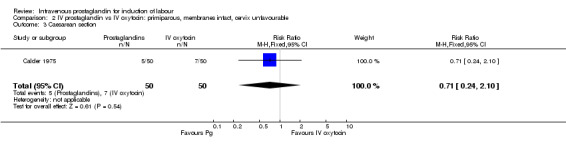
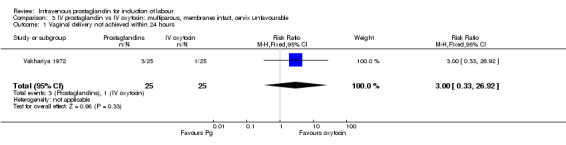
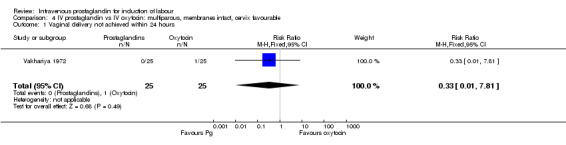
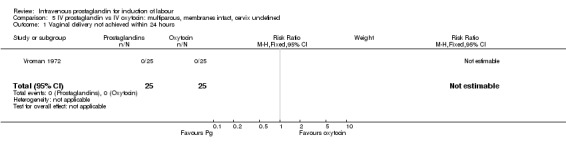
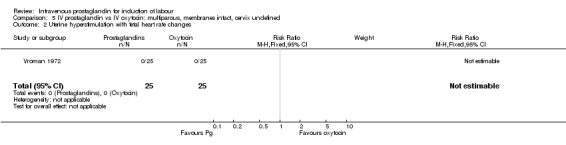
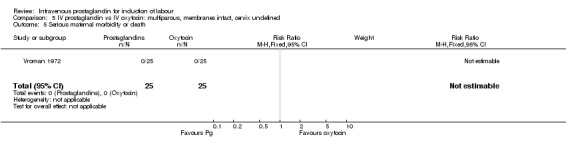
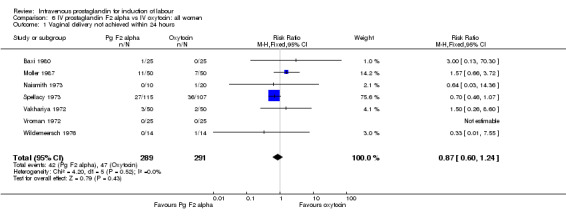
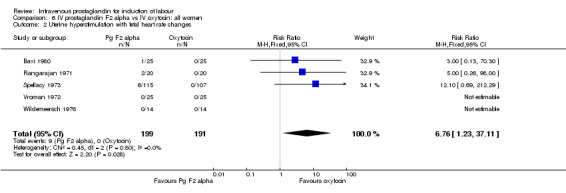
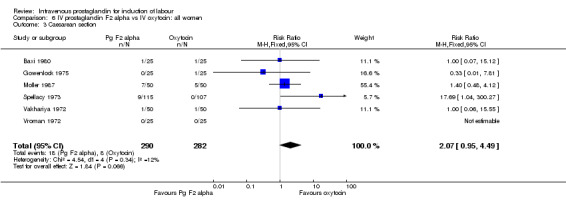
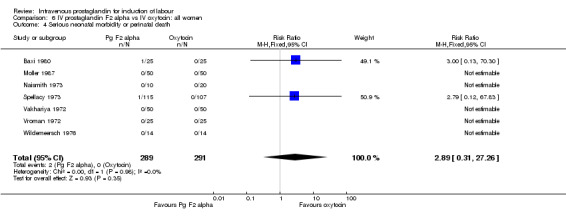
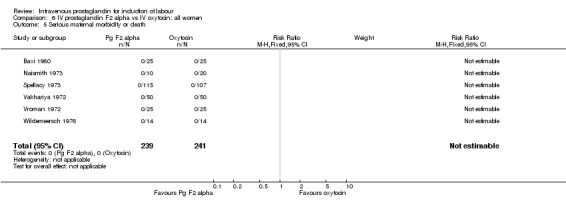
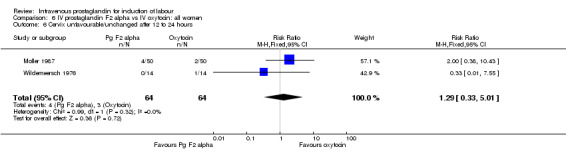
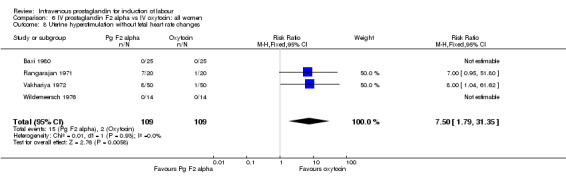
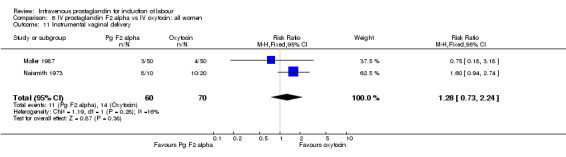
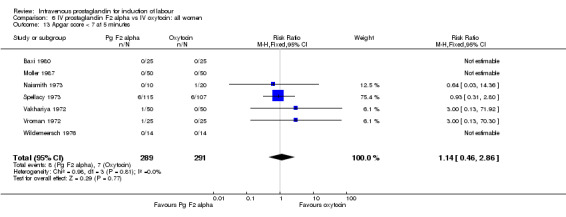
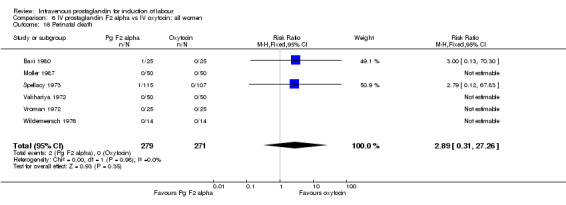
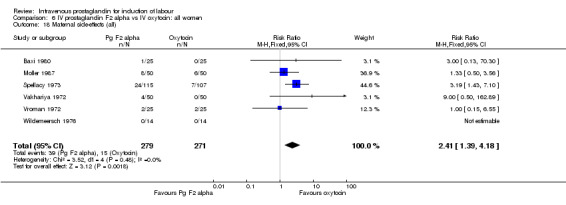
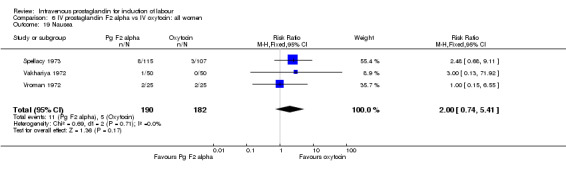
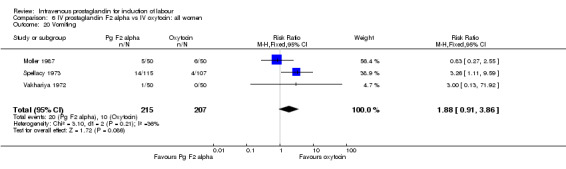
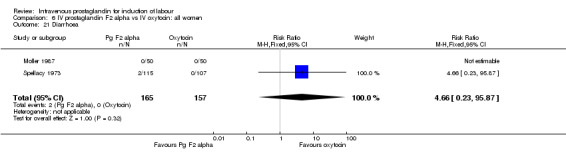
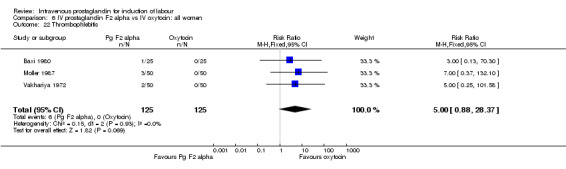
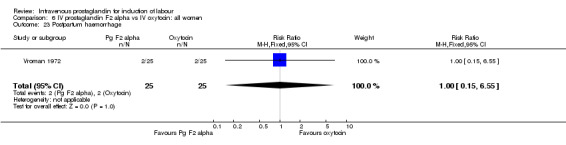
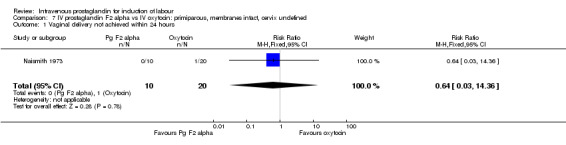
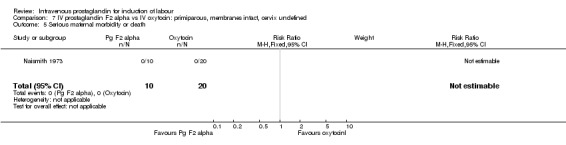
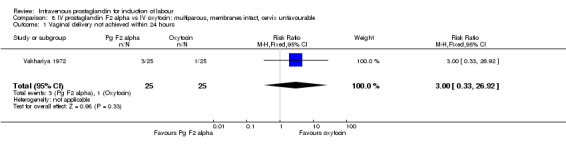
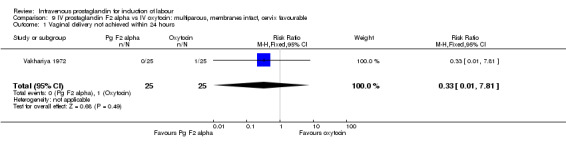
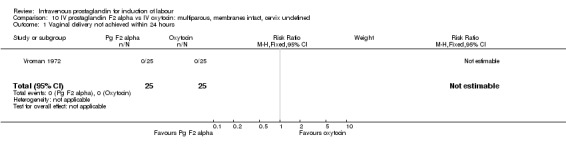
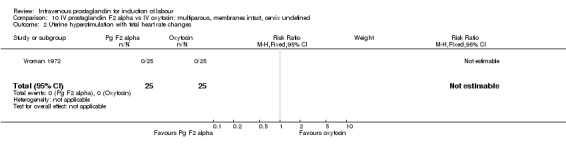
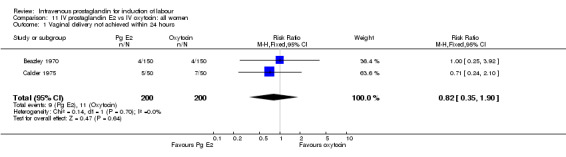
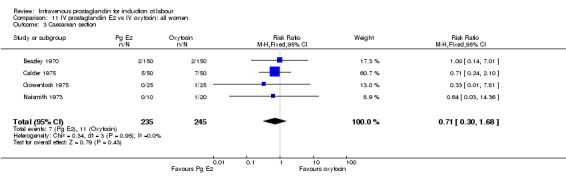
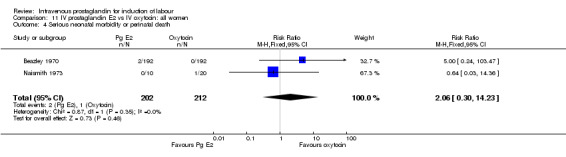
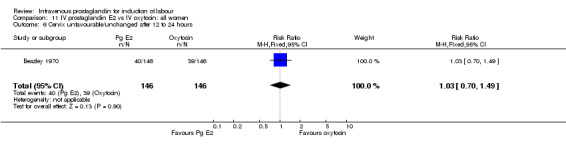
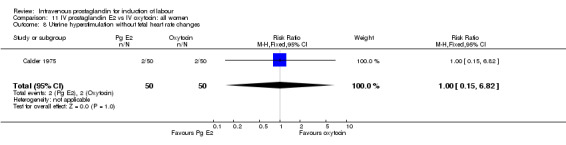
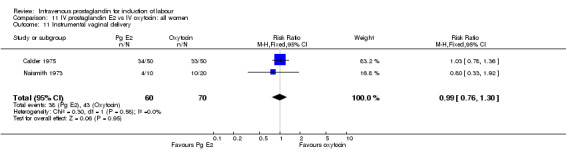
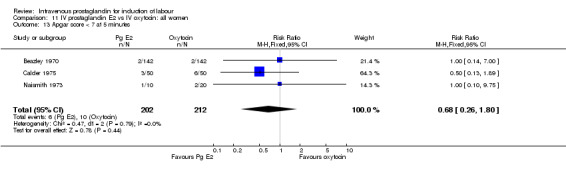
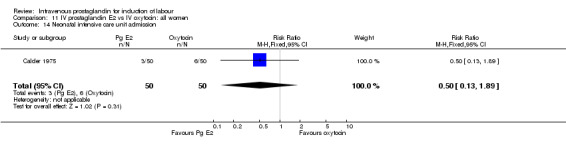
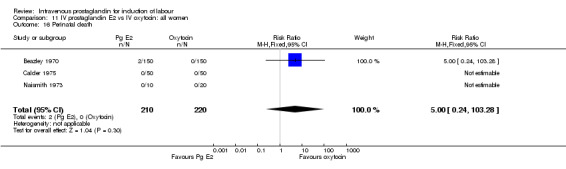
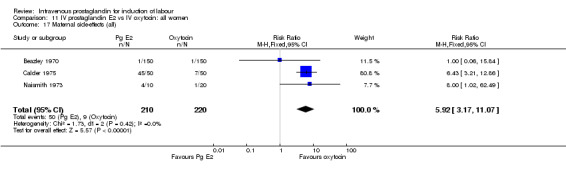
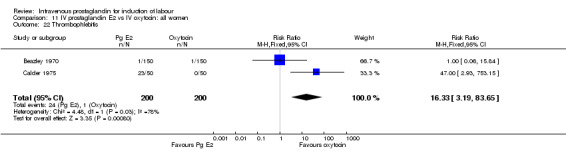
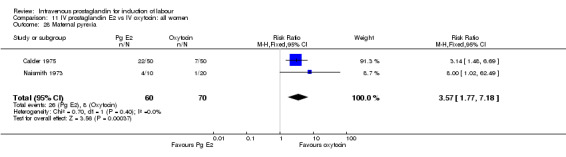
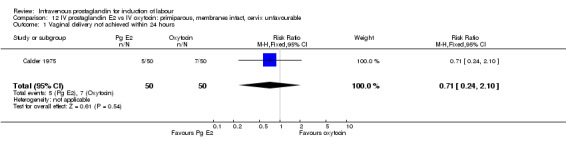
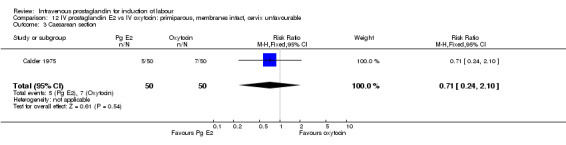
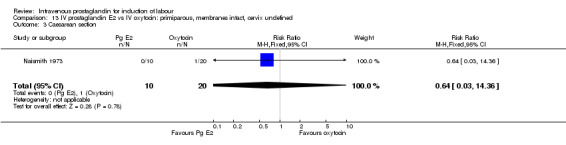
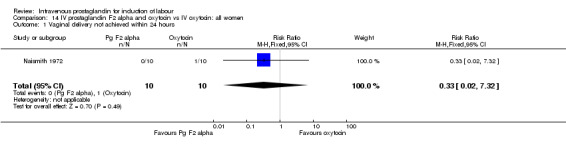
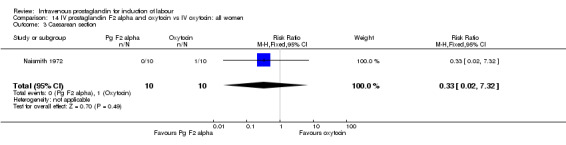
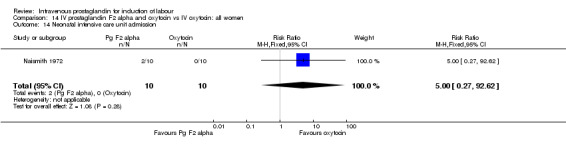
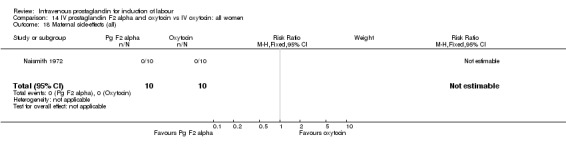
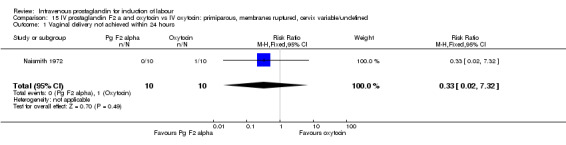
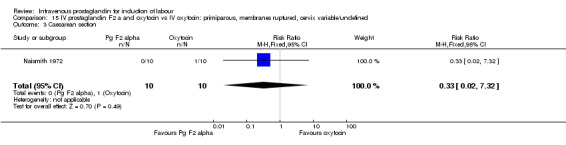
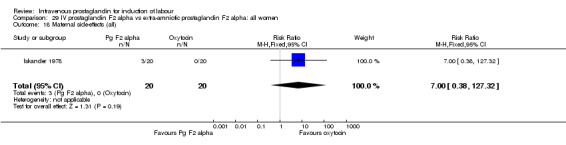
Main results: Thirteen trials were eligible for inclusion in this review. Two trials (comprising 400 women) compared intravenous prostaglandin E2 to intravenous oxytocin, a further seven trials (comprising 590 women) compared intravenous prostaglandin F2 alpha to intravenous oxytocin. Two trials (comprising 115 women) each randomised women to one of three treatment arms namely intravenous oxytocin or intravenous prostaglandin F2 alpha or prostaglandin E2. One trial reported a comparison of combined oxytocin and prostaglandin F2 alpha and oxytocin alone in 20 women and lastly one trial compared extra amniotic prostaglandin E2 versus intravenous prostaglandin E2 (40 women). The use of intravenous prostaglandin was associated with higher rates of uterine hyperstimulation with changes in the fetal heart rate (relative risk (RR) 6.76, 95% confidence interval (CI) 1.23-37.11) and without (RR 4.25, 95%CI 1.48-12.24) compared to oxytocin. Use of prostaglandins was also associated with significantly more maternal side effects (gastrointestinal, thrombophlebitis and pyrexia, RR 3.75, 95% CI 2.46-5.70) than oxytocin. Prostaglandin was no more likely to result in vaginal delivery than oxytocin (RR 0.85, 95% CI 0.61-1.18). No significant differences emerged from subgroup analysis or from the trials comparing combination oxytocin/prostaglandin F2 alpha and oxytocin or extra amniotic versus intravenous prostaglandin E2.
Reviewer's conclusions: Intravenous prostaglandin is no more efficient than intravenous oxytocin for the induction of labour but its use is associated with higher rates of maternal side effects and uterine hyperstimulation than oxytocin. No conclusions can be drawn form the comparisons of combination of prostaglandin F2 alpha and oxytocin compared to oxytocin alone or extra amniotic and intravenous prostaglandin E2.
Conflict of interest statement
None known.
Figures
References
References to studies included in this review
Baxi 1980 {published data only}
-
- Baxi LV, Petrie RH, Caritis SN. Induction of labor with low‐dose prostaglandin F2alpha and oxytocin. American Journal of Obstetrics and Gynecology 1980;136:28‐31. - PubMed
Beazley 1970 {published data only}
-
- Beazley JM, Gillespie A. Double‐blind trial of prostaglandin E2 and oxytocin in induction of labour. Lancet 1971;1:152‐5. - PubMed
Calder 1975 {published data only}
-
- Calder AA, Embrey MP. Comparison of intravenous oxytocin and prostaglandin E2 for induction of labour using automatic and non‐automatic infusion techniques. British Journal of Obstetrics and Gynaecology 1975;82:728‐33. - PubMed
Gowenlock 1975 {published data only}
-
- Gowenlock AH, Taylor DS, Sanderson JH. Biochemical and haematological changes during the induction of labour at term with oxytocin, prostaglandin E2 and prostaglandin F2alpha. British Journal of Obstetrics and Gynaecology 1975;82:215‐20. - PubMed
Iskander 1978 {published data only}
-
- Iskander MN. A comparison of the efficacy and safety of extra‐amniotic prostaglandin E2 and intravenous prostaglandin E2 for the induction of labour in patients with unripe cervices. Journal of International Medical Research 1978;6:144‐6. - PubMed
Moller 1987 {published data only}
-
- Moller M, Thomsen AC, Sorensen J, Forman A. Oxytocin‐ or low‐dose prostaglandin F2alpha‐infusion for stimulation of labor after primary rupture of membranes. Acta Obstetricia et Gynecologica Scandinavica 1987;66:103‐6. - PubMed
Naismith 1972 {published data only}
Naismith 1973 {published data only}
-
- Naismith WCMK, Barr W, MacVicar J. Comparison of intravenous prostaglandins F2alpha and E2 with intravenous oxytocin in the induction of labour. Journal of Obstetrics and Gynaecology of the British Commonwealth 1973;80:531‐5. - PubMed
Rangarajan 1971 {published data only}
-
- Rangarajan NS, Croix GE, Moghissi KS. Induction of labor with prostaglandin. Obstetrics & Gynecology 1971;38:546‐50. - PubMed
Spellacy 1973 {published data only}
-
- Spellacy WN, Gall SA, Shevach AB, Holsinger KK. The induction of labor at term. Comparisons between prostaglandin F2alpha and oxytocin infusion. Obstetrics & Gynecology 1973;41:14‐21. - PubMed
Vakhariya 1972 {published data only}
-
- Vakhariya VR, Sherman AI. Prostaglandin F2alpha for induction of labor. American Journal of Obstetrics and Gynecology 1972;113:212‐22. - PubMed
Vroman 1972 {published data only}
-
- Vroman S, Thiery M, Yo Le Sian A, Depiere M, Vanderheyden C, Derom R, et al. A double blind comparative study of prostaglandin F2alpha and oxytocin for the elective induction of labor. European Journal of Obstetrics & Gynecology and Reproductive Biology 1972;4S:115‐23.
Wildemeersch 1976 {published data only}
-
- Wildemeersch DA, Schellen AMCM. Double‐blind trial of prostaglandin F2alpha and oxytocin in the induction of labour. Current Medical Research and Opinion 1976;4:263‐6. - PubMed
References to studies excluded from this review
Amano 1999 {published data only}
-
- Amano K, Saito K, Shoda T, Tani A, Yoshihara H, Nishijima M. Elective induction of labor at 39 weeks of gestation: a prospective randomized trial. Journal of Obstetrics and Gynaecology Research 1999;25:33‐7. - PubMed
Anderson 1972 {published data only}
-
- Anderson GG, Hobbins JC, Speroff L. Intravenous prostaglandins E2 and F2alpha for the induction of term labor. American Journal of Obstetrics and Gynecology 1972;112:382‐6. - PubMed
Brandel 1998 {published data only}
-
- Brandel E, Bascou V, Meeus JB, Magnin G. Results of a randomised trial of cervical ripening in premature rupture of membranes at term: intravenous prostaglandin E2 versus intravaginal prostaglandin E2 [Resultats d'un essai randomise de maturation cervicale dans les ruptures prematurees de membranes a terme: prostine E2 intraveineuse versus prostine E2 en gel vaginal]. Journal de Gynecologie, Obstetrique et Biologie de la Reproduction (Paris) 1998;27:111.
Bremme 1980 {published data only}
-
- Bremme K, Eneroth P. Changes in serum hormone levels during labor induced by oral PGE2 or oxytocin infusion. Acta Obstetricia et Gynecologica Scandinavica 1980;92 Suppl:31‐43. - PubMed
Calder 1974 {published data only}
-
- Calder AA, Moar VA, Ounsted MK, Turnbull AC. Increased bilirubin levels in neonates after induction of labour by intravenous prostaglandin E2 or oxytocin. Lancet 1974;2:1339‐42. - PubMed
Kanhai 1989 {published data only}
-
- Kanhai HHH, Keirse MJNC. Induction of labour after fetal death: a randomized controlled trial of two prostaglandin regimens. British Journal of Obstetrics and Gynaecology 1989;96:1400‐4. - PubMed
-
- Kanhai HHH, Keirse MJNC. Intravenous administration of sulfprostone for the induction of labour after fetal death: a randomized comparison of two dose schedules. World Congress of Gynecology and Obstetrics; 1988 October 23‐28; Brazil; 1988:201‐2.
-
- Kanhai HHH, Keirse MJNC. Intravenous administration of sulprostone for the induction of labour after fetal death: a randomized comparison of two dose schedules. Proceedings of 1st European Congress on Prostaglandins in Reproduction, Vienna, Austria, 1988.
Le Maire 1972 {published data only}
-
- Maire WJ, Spellacy WN, Shevach AB, Gall SA. Changes in plasma estriol and progesterone during labor induced with prostaglandin F2alpha or oxytocin. Prostaglandins 1972;2:93‐101. - PubMed
Lindmark 1976 {published data only}
-
- Lindmark G, Nilsson BA. A comparative study of uterine activity in labour induced with prostaglandin F2alpha or oxytocin and in spontaneous labour I. Pattern of uterine contractions. Acta Obstetricia et Gynecologica Scandinavica 1976;55:453‐60. - PubMed
Lipshitz 1984 {published data only}
-
- Lipshitz J, Lipshitz EM. Uterine and cardiovascular effects of fenoterol and hexoprenaline in prostaglandin F2alpha‐induced labor in humans. Obstetrics & Gynecology 1984;63:396‐400. - PubMed
Reichel 1985 {published data only}
-
- Reichel R, Husslein P, Goschen K, Rasche M, Sinzinger H. Studies of the uptake of prostaglandin e2 administered locally by various means to achieve ripening of the cervix and induction of labour [Untersuchungen zur Resorption von Prostaglandin E2 nach unterschiedlicher lokaler Applikation zur Zervixreifung und zur Geburtseinleitung]. Wiener Klinische Wochenschrift 1985;97:500‐3. - PubMed
Rosa 1974 {published data only}
-
- Rosa P. A comparison of the efficiency of oxytocin and prostaglandin F2alpha in the treatment of dystocia in the primiparous woman at term. Journal de Gynecologie, Obstetrique et Biologie de la Reproduction (Paris) 1974;6:571‐80. - PubMed
Scher 1972 {published data only}
-
- Scher J, Davey DA, Baillie P, Friend J, Friend DM. A comparison of prostaglandin F2alpha and oxytocin in the induction of labour. South African Medical Journal 1972;46:2009‐12. - PubMed
Spellacy 1971 {published data only}
-
- Spellacy WN, Buhi WC, Holsinger KK. The effect of prostaglandin F2alpha and E2 on blood glucose and plasma insulin levels during pregnancy. American Journal of Obstetrics and Gynecology 1971;111:239‐43. - PubMed
Spellacy 1972 {published data only}
-
- Spellacy WN, Gall SA. Prostaglandin F2alpha and oxytocin for term labor induction. The prostaglandins. Clinical applications in human reproduction. New York: Futura, 1972:107‐13.
Thomsen 1987 {published data only}
-
- Thomsen AC. Induction of labour by low‐dose PGF2alpha and oxytocin. A randomised double‐blind study. Personal communication 1987.
Van Heerden 1992 {published data only (unpublished sought but not used)}
-
- Heerden J, Steyn DW. Management of prelabour rupture of the membranes after 34 weeks gestation: early vs delayed induction of labour. Eleventh Conference on Priorities in Perinatal Care in South Africa. 1992:98‐100.
References to studies awaiting assessment
Craft 1971 {published data only}
Roberts 1970 {published data only}
-
- Roberts G. Induction of labour using prostaglandins. Journal of Reproduction and Fertility 1970;23:370‐1. - PubMed
Additional references
Clarke 1999
-
- Clarke M, Oxman AD, editors. Cochrane Reviewers' Handbook 4.0 [updated July 1999]. In: Review Manager (RevMan) [Computer program]. Version 4.0 Oxford, England: The Cochrane Collaboration, 1999.
Hofmeyr 2000
Johnston 1993
-
- Johnston TA, Greer IA, Kelly RW, Calder AA. Plasma prostaglandin metabolite concentrations in normal and dysfunctional labour. British Journal of Obstetrics and Gynaecology 1993;100:483‐8. - PubMed
Kanhai 1988a
-
- Kanhai HHH, Keirse MJNC. Intravenous administration of sulprostone for the induction of labour after fetal death: a randomized comparison of two dose schedules. Proceedings of 1st European Congress on Prostaglandins in Reproduction, Vienna, Austria, 1988.
Kanhai 1988b
-
- Kanhai HHH, Keirse MJNC. Intravenous administration of sulfprostone for the induction of labour after fetal death: a randomized comparison of two dose schedules. World Congress of Gynecology and Obstetrics; 1988 October 23‐28; Brazil; 1988:201‐2.
Keirse 1993
-
- Keirse MJNC. Any prostaglandin (by any route) vs oxytocin (any route) for induction of labour. [revised 22 April 1993]. In: Enkin MW, Keirse MJNC, Renfrew MJ, Neilson JP, Crowther C (eds.) Pregnancy and Childbirth Module. In: The Cochrane Pregnancy and Childbirth Database [database on disk and CDROM]. The Cochrane Collaboration; Issue 2, Oxford: Update Software; 1995.
MacKenzie 1999
-
- MacKenzie AZ. Labor induction including pregnancy termination for fetal anomaly. In: James DK, Steer PJ, Weiner CP, Gonik B editor(s). High risk pregnancy, management options. 2nd Edition. London: WB Saunders, 1999:1079‐102.
RevMan 1999 [Computer program]
-
- The Cochrane Collaboration. Review Manager (RevMan). Version 4.0 for Windows. Oxford, England: The Cochrane Collaboration, 1999.
Publication types
MeSH terms
Substances
LinkOut - more resources
Full Text Sources
Miscellaneous
