. 2000 Nov;68(11):6215-22.
doi: 10.1128/IAI.68.11.6215-6222.2000.

Neisseria gonorrhoeae porin modifies the oxidative burst of human professional phagocytes

Affiliations

Neisseria gonorrhoeae porin modifies the oxidative burst of human professional phagocytes

D R Lorenzen et al. Infect Immun. 2000 Nov.

Abstract

A hallmark of infection with the gram-negative bacterium Neisseria gonorrhoeae is the local infiltration and subsequent activation of polymorphonuclear neutrophils. Several gonococcal outer membrane proteins are involved in the interaction with and the activation of these phagocytes, including gonococcal porin, the most abundant protein in the outer membrane. Previous work suggests that this porin plays a role in various cellular processes, including inhibiting neutrophils activation and phagosome maturation in professional phagocytes. Here we investigated the ability of porin to modify the oxidative metabolism of human peripheral blood neutrophils and monocytes in response to particulate stimuli (including live gonococci) and soluble agents. The activation of the oxidative metabolism was determined by chemiluminescence amplified with either luminol or lucigenin. We found that treatment of the phagocytes with porin inhibits the release of reactive oxygen species measured as luminol-enhanced chemiluminescence in response to zymosan, latex particles, and gonococci. The engulfment of these particles was not, however, affected by porin treatment. Similar effects of porin on the chemiluminescence response were observed in cytochalasin B-treated neutrophils exposed to the soluble chemotactic peptide N-formylmethionyl-leucyl-phenylalanine. This indicates that porin selectively inhibits granule fusion with those cellular membranes that are in direct contact with porin, namely, the phagosomal and plasma membranes. This porin-induced downregulation of oxidative metabolism may be a potent mechanism by which gonococci modulate oxygen-dependent reactions by activated phagocytes at inflammation sites.


Figures
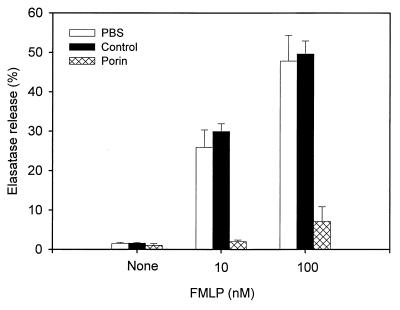
FIG. 1
FIG. 1
Effect of porin on FMLP-induced elastase release of human PMN. Cytochalasin B-exposed PMN were incubated with porin for 5 min or the corresponding buffer control (see Materials and Methods) and then stimulated with FMLP (10 or 100 nM). After additional 30 min, the supernatants were recovered and assayed for elastase activity in untreated (PBS) and treated neutrophil cultures. The results are expressed as percentage of the total release obtained from detergent-treated PMN. The data represent the mean ± the standard deviation of three independent experiments with cells derived from three different donors.
FIG. 2
FIG. 2
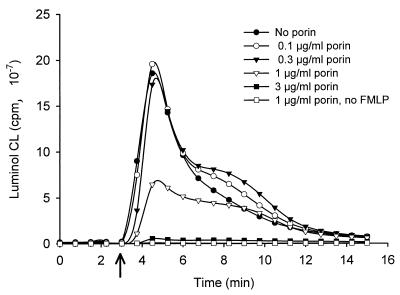
Effect of porin on the luminol-enhanced CL response to FMLP in cytochalasin B-treated PMN. PMN were treated with cytochalasin B (2.5 μg/ml, 20 min) before incubation with different concentrations of porin or the corresponding buffer control for 3 min. CL was stimulated by addition of 100 nM FMLP (see arrow).
FIG. 3
FIG. 3
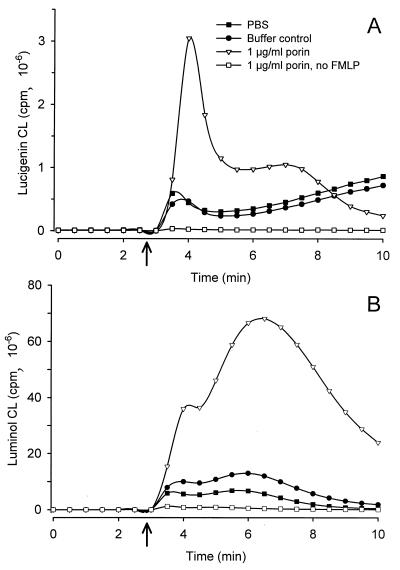
Effect of porin on neutrophil oxidative response to the activating peptide FMLP. PMNs were preincubated with porin (1.0 μg/ml), with corresponding buffer control, or with PBS for 3 min and subsequently stimulated by adding 100 nM FMLP to each sample (see arrow). Control cells treated with porin but without FMLP were run in parallel. Shown are representative results of three experiments. (A) Kinetics of lucigenin-enhanced CL of normal PMN. (B) Kinetics of luminol-enhanced CL of normal PMN.
FIG. 4
FIG. 4
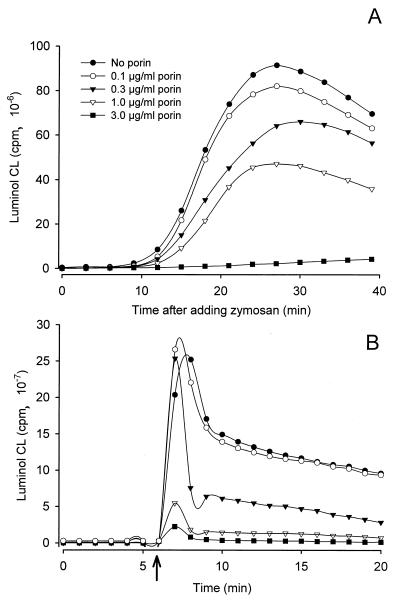
Luminol-enhanced CL of human PMN treated with gonococcal porin. PMN were incubated with different concentrations of porin and then stimulated by adding either zymosan (A) or latex beads (B). An arrow marks the point at which latex beads were added. The data shown are from one of three experiments, all of which gave similar results.
FIG. 5
FIG. 5
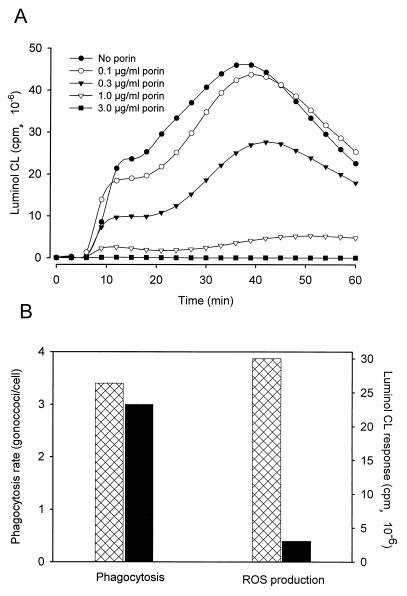
Effect of porin on the oxidative burst and phagocytic activity of PMN induced by viable gonococci. (A) Luminol-enhanced CL of normal PMN in response to invasive Opa52 gonococci. PMN were preincubated with increasing concentrations of porin before bacteria were added. Cells in the absence of bacteria were also tested but gave no signal (data not shown). The graph shows the results of one representative experiment out of three total. (B) Phagocytic activity occurring in parallel with the CL response. PMN were exposed to Opa52+ gonococci in the absence (hatched columns) or presence (black columns) of porin. Shown are the results of a representative experiment with phagocytosis and CL assays performed in parallel using PMN from one donor.
FIG. 6
FIG. 6
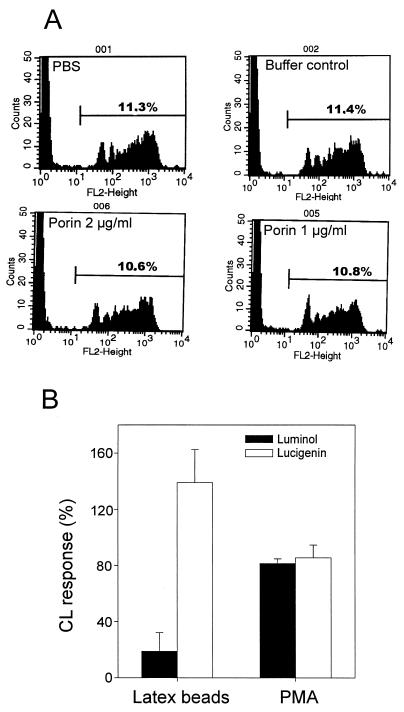
Effect of porin on PBMC phagocytosis and luminol- and lucigenin-enhanced CL. (A) Phagocytosis of fluorescent latex beads. Beads were added to untreated (PBS) or PBMC-treated with 1 or 2 μg of porin per ml or a corresponding buffer control. After the removal of noningested beads, samples were analyzed by using FACSort. Phagocytic cells, which had ingested latex beads, were visualized by an increase in fluorescence intensity. Cells without beads were also analyzed and showed no fluorescence in the above-marked region (data not shown). (B) Luminol- and lucigenin-enhanced CL response to latex beads. PBMC were treated with porin prior to stimulation with latex beads. CL amplified by luminol or lucigenin was measured in five separate assays and the results are expressed as % of CL activity (± The standard error of the mean) of the relevant control (cells treated with stimulators in the absence of porin and set as 100%). The control means of the five experiments were as follows: luminol plus latex, (20.27 ± 15.3) × 107 cpm; lucigenin plus latex, (3.74 ± 2.3) × 107 cpm; luminol plus PMA, (36.12 ± 14.3) × 107 cpm; and lucigenin plus PMA, (18.73 ± 9.7) × 107 cpm.

References

    1. Aida Y, Pabst M J. Priming of neutrophils by lipopolysaccharide for enhanced release of superoxide. Requirement for plasma but not for tumor necrosis factor-alpha. J Immunol. 1990;145:3017–3030. - PubMed
    1. Albrecht D, Jungi T W. Luminol-enhanced chemiluminescence induced in peripheral blood-derived human phagocytes: obligatory requirement of myeloperoxidase exoocytosis by monocytes. J Leukoc Biol. 1993;54:300–306. - PubMed
    1. Alcorn T M, Zheng H Y, Gunther M R, Hassett D J, Cohen M S. Variation in hydrogen peroxide sensitivity between different strains of Neisseria gonorrhoeae is dependent on factors in addition to catalase activity. Infect Immun. 1994;62:2138–2140. - PMC - PubMed
    1. Allen R C. Phagocytic leukocyte activities and chemiluminescence: a kinetic approach to analysis. Methods Enzymol. 1986;133:449–493. - PubMed
    1. Bauer F J, Rudel T, Stein M, Meyer T F. Mutagenesis of the Neisseria gonorrhoeae porin reduces invasion in epithelial cells and enhances phagocyte responsiveness. Mol Microbiol. 1999;31:903–913. - PubMed

Publication types

MeSH terms

LinkOut - more resources