. 2000 Oct 24;97(22):12091-6.
doi: 10.1073/pnas.220211797.

Phosphorylation-dependent targeting of cAMP response element binding protein to the ubiquitin/proteasome pathway in hypoxia

Affiliations

Phosphorylation-dependent targeting of cAMP response element binding protein to the ubiquitin/proteasome pathway in hypoxia

C T Taylor et al. Proc Natl Acad Sci U S A. .

Abstract

Hypoxia activates a number of gene products through degradation of the transcriptional coactivator cAMP response element binding protein (CREB). Other transcriptional regulators (e.g., beta-catenin and NF-kappa B) are controlled through phosphorylation-targeted proteasomal degradation, and thus, we hypothesized a similar degradative pathway for CREB. Differential display analysis of mRNA derived from hypoxic epithelia revealed a specific and time-dependent repression of protein phosphatase 1 (PP1), a serine phosphatase important in CREB dephosphorylation. Subsequent studies identified a previously unappreciated proteasomal-targeting motif within the primary structure of CREB (DSVTDS), which functions as a substrate for PP1. Ambient hypoxia resulted in temporally sequential CREB serine phosphorylation, ubiquitination, and degradation (in vitro and in vivo). HIV-tat peptide-facilitated loading of intact epithelia with phosphopeptides corresponding to this proteasome targeting motif resulted in inhibition of CREB ubiquitination. Further studies revealed that PP1 inhibitors mimicked hypoxia-induced gene expression, whereas proteasome inhibitors reversed the hypoxic phenotype. Thus, hypoxia establishes conditions that target CREB to proteasomal degradation. These studies may provide unique insight into a general mechanism of transcriptional regulation by hypoxia.


Figures
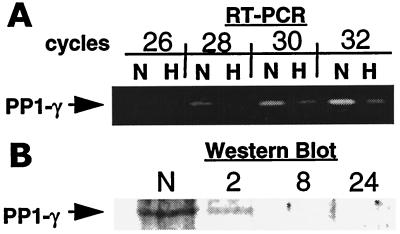
Figure 1
Figure 1
Hypoxia decreases expression of PP1γ. (A) Reverse transcription–PCR (RT-PCR) was used to confirm results obtained in differential mRNA display. PP1γ message was detected in T84 cells. Samples were obtained after 26, 28, 30, or 32 PCR cycles. PP1γ mRNA was diminished in hypoxic cells (H) when compared with normoxic controls (N). (B) Western blot analysis was performed to determine the impact of hypoxia on PP1γ expression in T84 cells. Data from A and B are representative of three experiments.
Figure 2
Figure 2
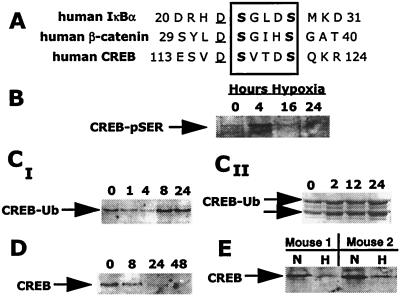
In vitro and in vivo localization of phosphorylation-dependent proteasomal-targeting motif in CREB. (A) Homologous serine phosphorylation sites within IκB, β-catenin, and CREB may represent phosphorylation-dependent targeting sites to ubiquitination and proteasomal degradation (15). (BD) Sequential serine phosphorylation (CREB-pSER), ubiquitination (CREB-Ub), and expression of CREB. (B) Exposure of T84 cells to hypoxia results in the transient serine phosphorylation of CREB, maximal at 4 h. (CI) Time-dependent CREB ubiquitination with onset at 8 h. (CII) Multiple ubiquitinated CREB species. (D) CREB is diminished in epithelial cells with a significant decrease observed by 24 h. (E) CREB levels are decreased in mucosal scrapings (epithelial enriched) from mice exposed to hypoxia. Data shown are representative of at least three experiments.
Figure 3
Figure 3
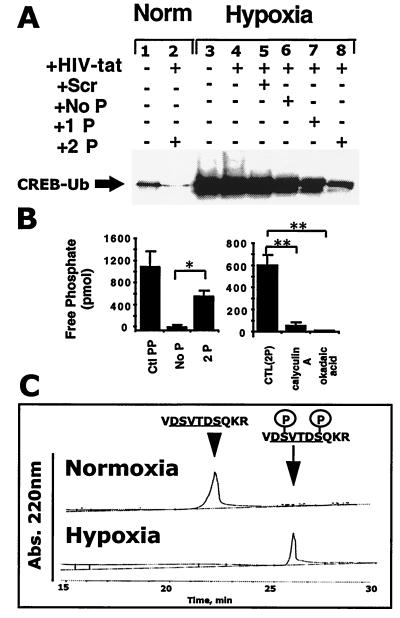
Synthetic CREB targeting phosphopeptide sequences inhibit CREB ubiquitination in a phosphorylation-dependent manner. (A) Baseline level of CREB ubiquitination is detectable in T84 cells (Lane 1). Lane 2 represents normoxic CREB in the presence of the double-phosphorylated CREB-targeting phosphopeptide. Lane 3 represents hypoxic CREB in the absence of peptide treatment, and lanes 4–8 (left to right) represent CREB from hypoxia-treated cells in the presence of the HIV-tat peptide alone, HIV-tat with scrambled peptide, HIV-tat with the unphosphorylated CREB-targeting peptide, HIV-tat with the single-phosphorylated CREB-targeting peptide, and HIV-tat with the double-phosphorylated CREB-targeting peptide, respectively. Data are representative of two experiments. (B) The CREB targeting sequence is a substrate for PP1 dephosphorylation. (Left) Coincubation of the phosphorylated form of the CREB-targeting sequence (2P) with purified PP1 results in the liberation of free phosphate when compared with the unphosphorylated control (Ctl; No P; n = 6, P < 0.05). A threonine phosphopeptide (Ctl PP) served as a positive control. (Right) The phosphatase inhibitors okadaic acid (4 μM) and calyculin A (400 nM) abolished PP1-mediated dephosphorylation of the phosphorylated targeting sequence of CREB (n = 6, P < 0.05). (C) Hypoxia decreases phosphopeptide dephosphorylation. Coincubation of the double-phosphorylated CREB-targeting sequence (2P) with normoxic T84 (Upper) but not hypoxic (Lower) lysates results in peptide dephosphorylation as measured by HPLC (representative tracings of two experiments). Abs., absorbance.
Figure 4
Figure 4
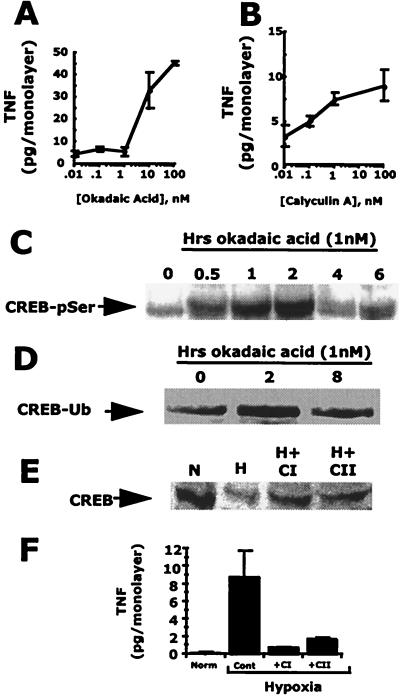
Pharmacological inhibition of protein phosphatase induces the hypoxic phenotype. Treatment of T84 cells grown on permeable support inserts with okadaic acid (A) or calyculin A (B) results in the concentration-dependent induction of TNFα. Treatment of T84 cells with okadaic acid (1 nM) resulted in a time-dependent serine phosphorylation (CREB-pSer) (C) and ubiquitination (CREB-Ub) (D) of CREB. (D) T84 cells exposed to hypoxia have decreased levels of nuclear CREB (lane 2) when compared with normoxic controls (lane 1). In the presence of ALLN or ALLM (100 μM each), hypoxia-elicited CREB depletion is decreased. (E) Hypoxia elicits release of TNFα. In the presence of ALLN or ALLM, hypoxia-elicited TNFα release is inhibited significantly (n = 3–6; P < 0.05 in each case). T84 cells exposed to hypoxia have decreased levels of nuclear CREB (lane 2) when compared with normoxic controls (lane 1). In the presence of ALLN (CI) or ALLM (CII; 100 μM each), hypoxia-elicited CREB depletion is decreased. (F) ALLN or ALLM inhibit hypoxia-elicited TNFα release (n = 3–6; P < 0.05 in each case).
Figure 5
Figure 5
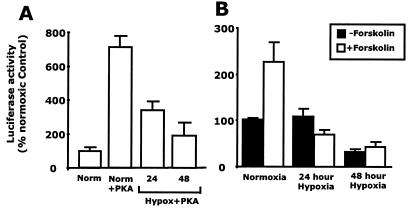
Hypoxia inhibits CREB-dependent gene transcription. (A) T84 cells were cotransfected with a CRE-luciferase reporter gene and cAMP-dependent PKA. Normoxic cotransfectants (Norm + PKA) demonstrated increased luciferase activity when compared with cells transfected with the luciferase reporter gene alone (Norm). Cells exposed to hypoxia for 24 and 48 h showed a time-dependent decrease in luciferase activity. (B) T84 cells were transfected with a CRE-luciferase reporter gene and exposed to hypoxia (0–48 h). Cells were then exposed to forskolin (2 μM). In normoxic cells, forskolin stimulated a significant increase in luciferase gene expression. Data shown are representative of three experiments.
Figure 6
Figure 6
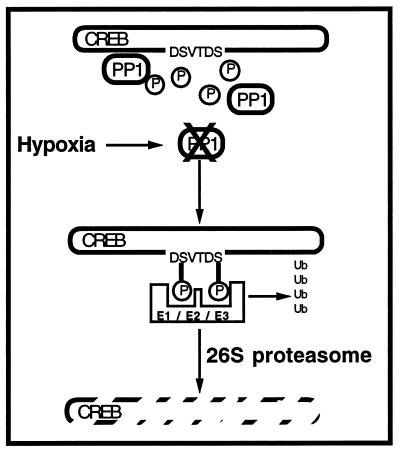
Schematic representation of phosphorylation-dependent targeting of CREB to proteasomal degradation by hypoxia. Hypoxia elicits the rapid depletion of PP1, resulting in decreased dephosphorylation of proteins within the targeting sequence. Resultant hyperphosphorylation of proteins attracts ubiquitination (Ub) through the coordinated activities of E1, E2, and E3. Ubiquitination of targeted peptides leads to degradation via the 26S proteasome. Proteins degraded through this targeting system in hypoxia include transcriptional modulators important in transformation to the hypoxic phenotype.

References

    1. Taylor C T, Colgan S P. Pharm Res. 1999;16:1498–1505. - PubMed
    1. Bunn HF, Poyton RO. Physiol Rev. 1996;6:839–885. - PubMed
    1. Semenza G L. Curr Opin Genet Dev. 1998;8:588–594. - PubMed
    1. Wang G L, Jiang B H, Rue E A, Semenza G L. Proc Natl Acad Sci USA. 1995;92:5510–5514. - PMC - PubMed
    1. Wang G L, Semenza G L. J Biol Chem. 1995;270:1230–1237. - PubMed

Publication types

LinkOut - more resources