. 2000 Nov;44(11):3079-86.
doi: 10.1128/AAC.44.11.3079-3086.2000.

Cloning and characterization of SmeDEF, a novel multidrug efflux pump from Stenotrophomonas maltophilia

Affiliations

Cloning and characterization of SmeDEF, a novel multidrug efflux pump from Stenotrophomonas maltophilia

A Alonso et al. Antimicrob Agents Chemother. 2000 Nov.

Abstract

Stenotrophomonas maltophilia is a nosocomial bacterial pathogen intrinsically resistant to several antibiotics. The mechanisms involved in this intrinsic multiresistance phenotype are poorly understood. A library of chromosomal DNA from a spontaneous multidrug-resistant S. maltophilia D457R mutant (A. Alonso and J. L. Martinez, Antimicrob. Agents Chemother. 41:1140-1142, 1997) was screened for complementation of erythromycin susceptibility on an antibiotic-hypersusceptible Escherichia coli DeltaacrAB strain. Cloning and further analysis revealed that a 6-kbp region constituting a transcriptional unit was capable of complementing the antibiotic-susceptible phenotype of an E. coli DeltaacrAB strain. We identified three open reading frames, smeD, smeE and smeF, which code for members of the membrane fusion protein, resistance nodulation division, and outer membrane factor families, respectively. Drug susceptibility assays indicated that the SmeDEF system cloned in E. coli mediates resistance to a wide range of antibiotics. Ethidium bromide and norfloxacin accumulation experiments in the presence and in the absence of carbonyl cyanide m-chlorophenylhydrazone showed that this system constitutes a drug efflux pump dependent on the membrane proton motive force. The presence of high levels of smeDEF mRNA in the multiresistant D457R mutant was consistent with the high levels of SmeF (formerly Omp54) observed in the same strain. In contrast, transcription levels of smeDEF in the D457 strain were tiny, which correlates with the low levels of SmeF observed for this strain. Also, for both the D457 and D457R strains, we observed growth phase-dependent regulation in which the highest level of transcription corresponded to early exponential phase, with transcription decreasing throughout the growth curve to undetectable levels at 24 h.


Figures
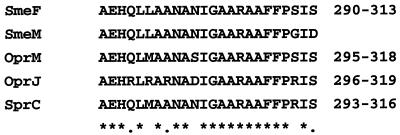
FIG. 1
FIG. 1
Alignment of a conserved region of SmeF with the same region in the S. maltophilia OMP SmeM and other efflux OMPs (OprM and OprJ from P. aeruginosa and SprC from Pseudomonas putida). Residues conserved in all proteins are indicated with an asterisk, and residues conserved in four proteins are indicated by a dot. The numbers at the right indicate the positions of the amino acid sequences in the proteins.
FIG. 2
FIG. 2
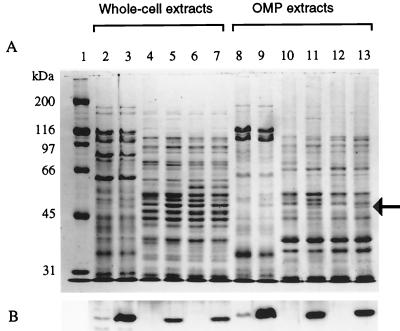
Analysis of SmeF expression by bacterial strains containing the smeDEF operon. (A) Protein profiles obtained by SDS-8% polyacrylamide gel electrophoresis of protein extracts from S. maltophilia and E. coli strains either expressing or not expressing or not expressing smeDEF. (B) Results of Western blot analysis of the same samples using an anti-SmeF antibody. In all cases, samples contained 5 μg of protein. Lanes 2 to 7, whole-cell protein extracts; lanes 8 to 13, OMP fractions. Slight differences in protein mobilities were observed between whole-cell extracts and OMP fractions. Lane 1, molecular mass standards; lanes 2 and 8, S. maltophilia D457 strain; lanes 3 and 9, S. maltophilia D457R strain; lanes 4 and 10, E. coli AA81; lanes 5 and 11, E. coli AA81(pAS1); lanes 6 and 12, E. coli AA68; lanes 7 and 13, E. coli AA68(pAS1). The arrow shows the position of SmeF. Note that the protein is expressed only in E. coli strains containing smeDEF genes. Also, SmeF is overexpressed in the MDR S. maltophilia D457R mutant and is detectable, although at a low level, in the wild-type D457 strain.
FIG. 3
FIG. 3
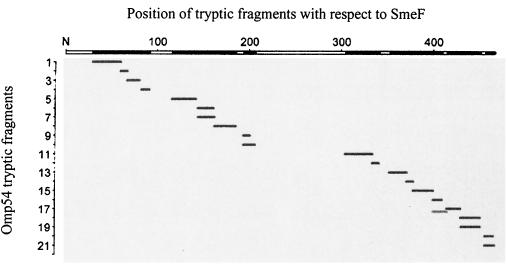
Mass spectrometry analysis of tryptic fragments obtained from Omp54. The masses of the fragments obtained after in gel tryptic digestion of Omp54 were compared with those deduced from the smeF sequence. Black rectangles on the x axis indicate that the experimentally determined masses and the deduced masses were identical within an absolute error of less than 0.08 Da.
FIG. 4
FIG. 4
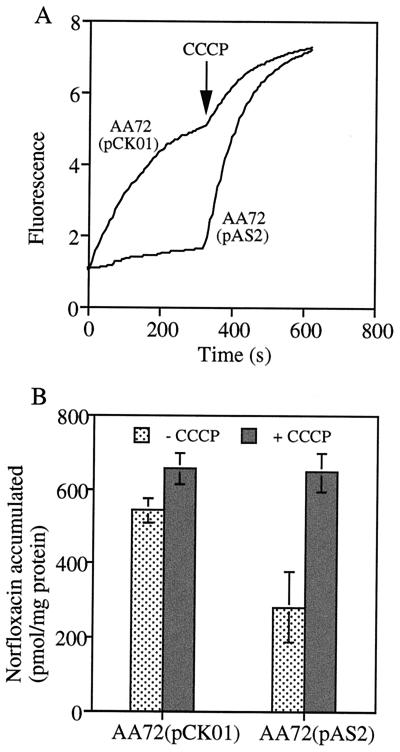
Intracellular accumulation of drugs by E. coli strains containing or not containing smeDEF. (A) Accumulation of ethidium bromide; (B) accumulation of norfloxacin. In both cases, the proton uncoupler CCCP was added at a final concentration of 100 μM. Note that the accumulation of both drugs is much lower for the E. coli strain AA72(pAS2) encoding smeDEF than for the control strain AA72(pCK01). Accumulation is restored to reach the same level in both strains after treatment with CCCP. The increased accumulation of the control strain AA72(pCK01) in the presence of CCCP is probably the consequence of the activities of endogenous E. coli pumps other than acrAB and that mediating ethidium bromide efflux.
FIG. 5
FIG. 5
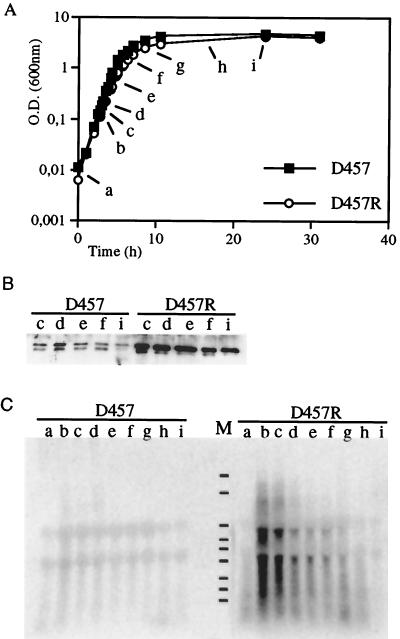
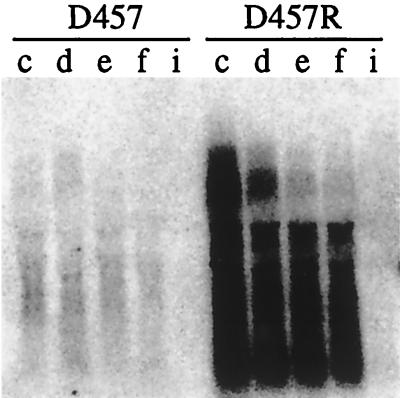
Growth-dependent analysis of smeDEF expression in S. maltophilia D457 and D457R strains. (A) Samples were withdrawn throughout the growth curve. O.D., optical density. (B) Results of Western blot analysis using an anti-SmeF antibody of protein extracts obtained along the growth cycle either from the wild-type S. maltophilia D457 strain or from the D457R mutant. Note that SmeF protein is much more highly expressed in the D457R mutant than in the D457 strain and that expression of this protein is nearly constant throughout the cell cycle, with a small reduction at the stationary phase of growth. (C) Results of a Northern blot analysis, using an smeD probe, of RNAs obtained at different points along the growth curve of the S. maltophilia D457 and S. maltophilia D457R strains. Lane M, RNA molecular size markers (from top to bottom: 6.9, 4.7, 2.7, 1.8, 1.5, 1.0, 0.6, 0.4, and 0.3 kb). Notice the strong induction of smeDEF in the D457R mutant strain at early exponential phase. Also, the low levels of smeDEF transcripts observed for the wild-type D457 strain are remarkable.
FIG. 6
FIG. 6
Growth-dependent analysis of smeDEF expression in the S. maltophilia D457 strain. Due to the low level of smeDEF transcripts observed for the S. maltophilia D457 strain in previous experiments (Fig. 3), a new Northern blot analysis of samples obtained throughout the growth curves of both the D457 and D457R strains (Fig. 3A) was performed as described in the text. The growth-phase regulation of the amount of smeDEF RNA in the wild type was similar to that in the MDR mutant.

References

    1. Aires J R, Kohler T, Nikaido H, Plesiat P. Involvement of an active efflux system in the natural resistance of Pseudomonas aeruginosa to aminoglycosides. Antimicrob Agents Chemother. 1999;43:2624–2628. - PMC - PubMed
    1. Alonso A, Martínez J L. Multiple antibiotic resistance in Stenotrophomonas maltophilia. Antimicrob Agents Chemother. 1997;41:1140–1142. - PMC - PubMed
    1. Alonso A, Martínez J L. Stenotrophomonas maltophilia D457R contains a cluster of genes from gram-positive bacteria involved in antibiotic and heavy metal resistance. Antimicrob Agents Chemother. 2000;44:1778–1782. - PMC - PubMed
    1. Atlas R M. Handbook of microbiological media. London, United Kingdom: CRC Press, Inc.; 1993.
    1. Bagdasarian M, Bagdasarian M M. Gene cloning and expression. In: Gerhardt P, Murray R G E, Wood W A, Krieg N R, editors. Methods for general and molecular bacteriology. Washington, D.C.: American Society for Microbiology; 1994. pp. 406–417.

Publication types

MeSH terms

Substances

LinkOut - more resources