. 2000 Oct 16;151(2):297-310.
doi: 10.1083/jcb.151.2.297.

Sorting of yeast membrane proteins into an endosome-to-Golgi pathway involves direct interaction of their cytosolic domains with Vps35p

Affiliations

Sorting of yeast membrane proteins into an endosome-to-Golgi pathway involves direct interaction of their cytosolic domains with Vps35p

S F Nothwehr et al. J Cell Biol. .

Abstract

Resident late-Golgi membrane proteins in Saccharomyces cerevisiae are selectively retrieved from a prevacuolar-endosomal compartment, a process dependent on aromatic amino acid-based sorting determinants on their cytosolic domains. The formation of retrograde vesicles from the prevacuolar compartment and the selective recruitment of vesicular cargo are thought to be mediated by a peripheral membrane retromer protein complex. We previously described mutations in one of the retromer subunit proteins, Vps35p, which caused cargo-specific defects in retrieval. By genetic and biochemical means we now show that Vps35p directly associates with the cytosolic domains of cargo proteins. Chemical cross-linking, followed by coimmunoprecipitation, demonstrated that Vps35p interacts with the cytosolic domain of A-ALP, a model late-Golgi membrane protein, in a retrieval signal-dependent manner. Furthermore, mutations in the cytosolic domains of A-ALP and another cargo protein, Vps10p, were identified that suppressed cargo-specific mutations in Vps35p but did not suppress the retrieval defects of a vps35 null mutation. Suppression was shown to be due to an improvement in protein sorting at the prevacuolar compartment. These data strongly support a model in which Vps35p acts as a "receptor" protein for recognition of the retrieval signal domains of cargo proteins during their recruitment into retrograde vesicles.


Figures
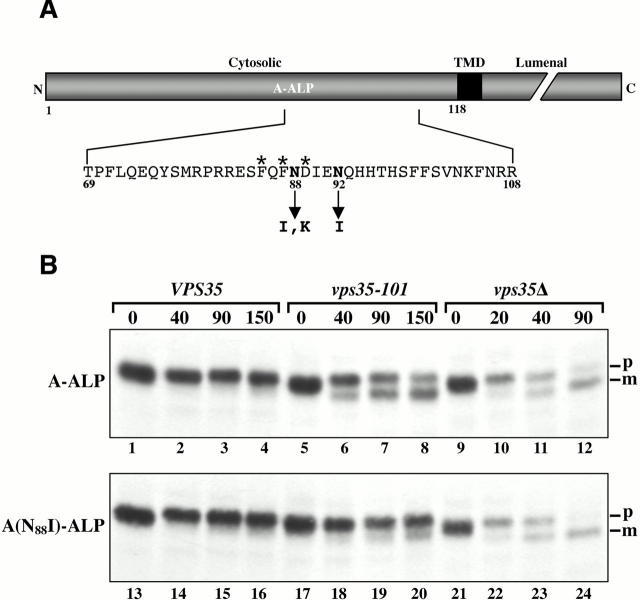
Figure 2
Figure 2
(A) The positions of three independent mutations in the A-ALP cytoplasmic domain that specifically suppress the vps35-101 allele are shown. A schematic diagram of A-ALP is shown with the lumenal, transmembrane (TMD), and cytosolic domains indicated. The cytosolic domain residues previously shown to comprise a PVC-to-TGN retrieval signal (Nothwehr et al. 1993) are labeled with asterisks and the suppressor mutations (N88I, N88K, and N92I) are indicated with arrows. (B) The N88I mutation in the cytosolic domain of A-ALP reduces its rate of vacuolar processing in a vps35-101 strain. Yeast strains were pulse labeled with [35S]methionine/cysteine for 10 min and chased for the times indicated in minutes above the upper panel. The cells were lysed and wild-type or mutant A-ALP was immunoprecipitated and analyzed by SDS-PAGE and fluorography. The following strain–plasmid combinations were analyzed in lanes 1–4, 5–8, 9–12, 13–16, 17–20, and 21–24, respectively: SNY36-9A–pSN345, SNY110–pSN345, SNY80–pSN345, SNY36–9A–pSN346, SNY110–pSN346, and SNY80–pSN346. The positions of precursor (p) and processed mature (m) A-ALP are indicated.
Figure 1
Figure 1
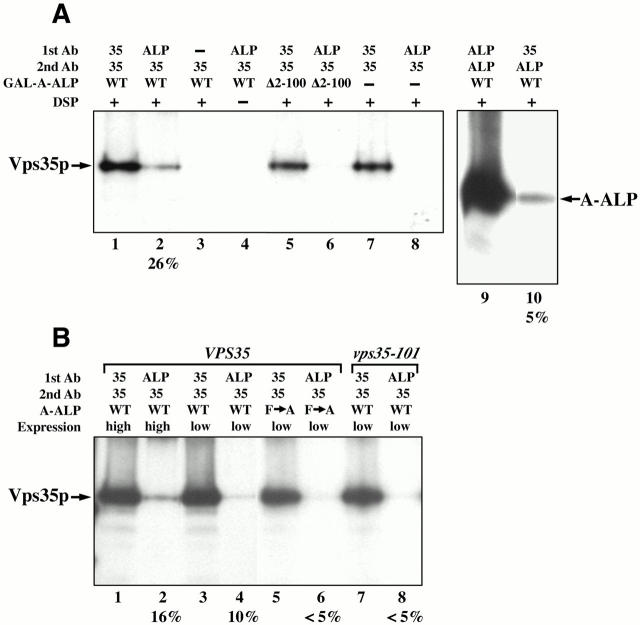
Vps35p and A-ALP are members of a protein complex. (A) Extracts from 35S-labeled yeast strains were cross-linked with DSP (lanes 1–3 and 5–10) and immunoprecipitated using the indicated antibodies (1st Ab) where 35 and ALP refer to anti-Vps35p and anti-ALP, respectively. Addition of no antibody or no DSP is indicated () for samples in lanes 3 and 4, respectively. The immunoprecipitated proteins were denatured, reduced, and then precipitated again (2nd Ab) before being analyzed by SDS-PAGE and fluorography. In lanes 1–4, 5 and 6, 7 and 8, and 9 and 10 the following yeast strain–plasmid combinations were analyzed, respectively: AHY63–pAH98, AHY63–pSN343, AHY63 (no plasmid), and AHY63–pAH98. (B) The same cross-linking approach as described in (A) was used. The following yeast strain–plasmid combinations were used in lanes 1 and 2, 3 and 4, 5 and 6, and 7 and 8, respectively: AHY63–pAH98, AHY63–pSN55, AHY63–pSN100, and SNY102–pSN55. Wild-type or mutant A-ALP was expressed from the GAL1 promoter (high) or from the endogenous STE13 promoter (low), as indicated. In both A and B the percent cross-linking (see Materials and Methods) obtained for some samples is indicated under the corresponding row numbers for each panel.
Figure 3
Figure 3
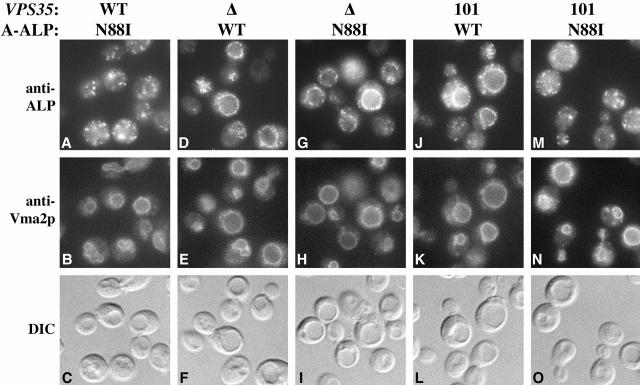
An N88I mutation in the cytosolic domain of A-ALP restores Golgi localization to A-ALP expressed in a vps35-101 strain. The following strains (shown respectively from left to right) were analyzed: SNY71–pSN346, PBY1–pSN345, PBY1–pSN346, PBY2–pSN345 and PBY2–pSN346. Strains propagated at 30°C were fixed, spheroplasted, and costained with antibodies against ALP and Vma2p. After subsequent detection with fluorochromes (see Materials and Methods) the cells were viewed by DIC optics and by epifluorescence through filters specific for FITC and Texas red.
Figure 4
Figure 4
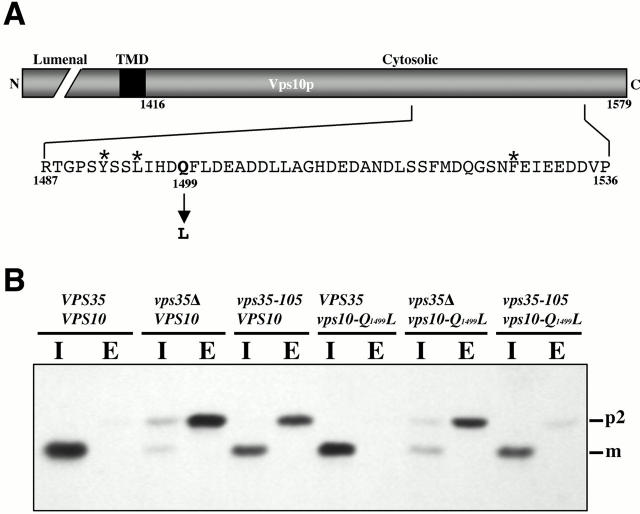
A Q1499L mutation in Vps10p suppresses the CPY sorting defect of a vps35-105 strain. (A) A schematic diagram of Vps10p is shown with the lumenal, transmembrane (TMD), and cytosolic domains indicated. The cytosolic domain residues previously shown to comprise a PVC-to-TGN retrieval signal (Cooper and Stevens 1996) are indicated with asterisks and the suppressor mutation is indicated with an arrow. (B) SNY36-9A, SNY80, SNY114, SHY28, SHY29, and SHY30 cells (left to right) were pulsed with [35S]methionine/cysteine for 10 min and chased for 45 min with unlabeled amino acids. CPY was immunoprecipitated from intracellular (I) and extracellular (E) fractions and analyzed by SDS-PAGE and fluorography. The positions of the Golgi (p2) and vacuolar (m) forms of CPY are indicated.
Figure 5
Figure 5
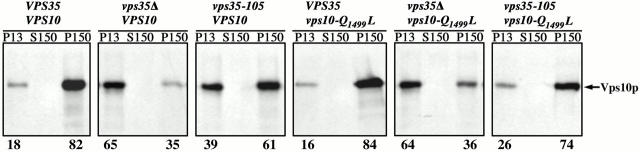
A Q1499L mutation in Vps10p suppresses the vacuolar mislocalization defect in vps35-105 cells. Spheroplasted cells were pulsed for 25 min with [35S]methionine/cysteine and chased for 45 min with unlabeled amino acids. The spheroplasts were lysed and lysates were centrifuged at 13,000 g to generate a pellet fraction (P13). The supernatant was then centrifuged at 150,000 g to generate pellet (P150) and supernatant (S150) fractions. Wild-type or mutant Vps10p was then immunoprecipitated from each fraction and analyzed by SDS-PAGE and fluorography. The relative percentage of Vps10p present in the P13 and P150 fractions as determined by Phosphorimager analysis is indicated below each panel. The strains are described in the legend to Fig. 4 B.
Figure 6
Figure 6
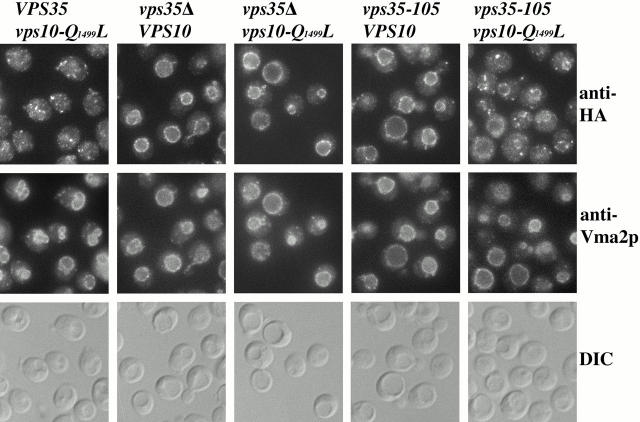
The Vps10-Q1499L mutant protein exhibits a predominantly Golgi localization pattern in vps35-105 cells. The following strains (shown respectively from left to right) were analyzed: SNY135, SNY132, SNY136, SNY133, and SNY137. Strains propagated at 30°C were fixed, spheroplasted, and costained with antibodies against the HA epitope and Vma2p. After subsequent detection with fluorochromes (see Materials and Methods) the cells were viewed by DIC optics and by epifluorescence through filters specific for FITC and Texas red.
Figure 7
Figure 7
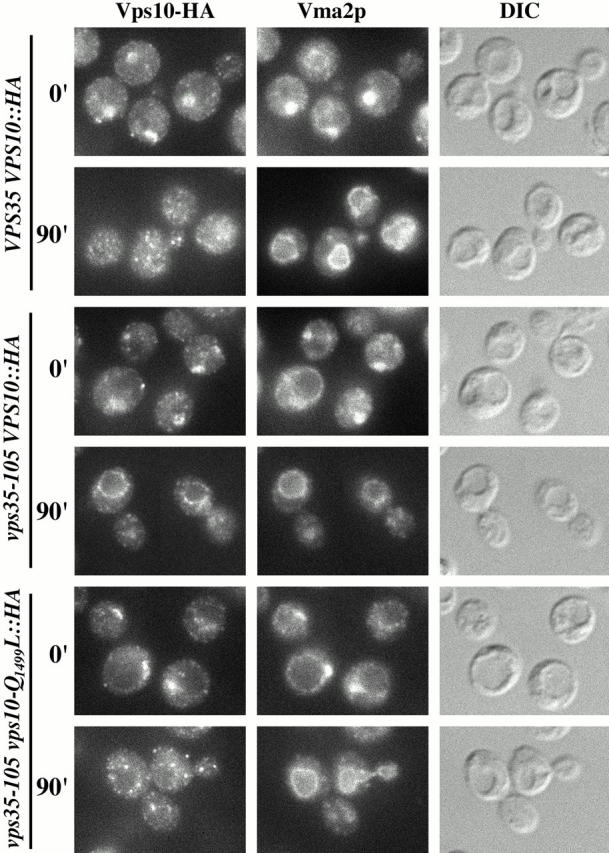
Suppression of the vps35-105 allele by the Q1499L mutation in Vps10p is due to improved sorting at the PVC. Strain SNY128 carrying pHY5 and strains SNY129 and SNY134, each carrying pHY5 and pSN350 were analyzed (shown respectively from top to bottom). All strains carry a vps27Δ mutation (Table ) and pHY5 expresses VPS27 under the GAL1 promoter (Table ). Strains were propagated in media containing raffinose. At the 0 min time point the cultures were adjusted to 2% galactose to induce expression of VPS27. After 0 and 90 min of galactose addition cells were fixed, spheroplasted, costained with antibodies against the HA epitope and Vma2p, and analyzed as described in the legend to Fig. 6.
Figure 8
Figure 8
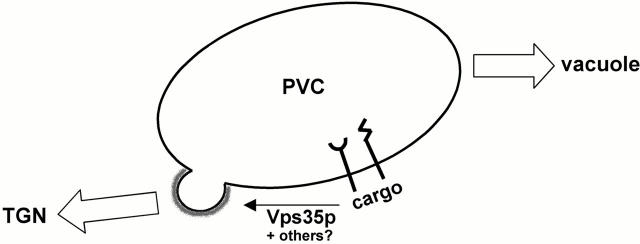
A schematic model of the sorting of cargo proteins from the PVC to TGN in yeast is shown. At the PVC ,Vps35p associates with the cytosolic domains of cargo proteins such as Vps10p and DPAP A via their retrieval signals. This interaction leads to concentration of cargo within forming vesicles that then bud off and are delivered to the TGN. Other proteins that may participate in this process include Vps29p, Vps26p, and Grd19p. A vesicle coat containing Vps5p and Vps17p is represented by the gray halo. For additional details see the text.

References

    1. Adams A.E.M., Botstein D., Drubin D.G. A yeast actin-binding protein is encoded by SAC6, a gene found by suppression of an actin mutation. Science. 1989;243:231–233. - PubMed
    1. Bankaitis V.A., Johnson L.M., Emr S.D. Isolation of yeast mutants defective in protein targeting to the vacuole. Proc. Natl. Acad. Sci. USA. 1986;83:9075–9079. - PMC - PubMed
    1. Bonifacino J.S., Dell'Angelica E.C. Molecular bases for the recognition of tyrosine-based sorting signals. J. Cell Biol. 1999;145:923–926. - PMC - PubMed
    1. Brigance W.T., Barlowe C., Graham T.R. Organization of the yeast Golgi complex into at least four functionally distinct compartments. Mol. Biol. Cell. 2000;11:171–182. - PMC - PubMed
    1. Bryant N.J., Stevens T.H. Two separate signals act independently to localize a yeast late Golgi membrane protein through a combination of retrieval and retention. J. Cell Biol. 1997;136:287–297. - PMC - PubMed

Publication types

MeSH terms