Case Reports
. 2000 Dec;67(6):1563-8.
doi: 10.1086/316893. Epub 2000 Oct 18.

Apparently normal ovarian differentiation in a prepubertal girl with transcriptionally inactive steroidogenic factor 1 (NR5A1/SF-1) and adrenocortical insufficiency

Affiliations
Case Reports

Apparently normal ovarian differentiation in a prepubertal girl with transcriptionally inactive steroidogenic factor 1 (NR5A1/SF-1) and adrenocortical insufficiency

A Biason-Lauber et al. Am J Hum Genet. 2000 Dec.

Abstract

Steroidogenic factor 1 (NR5A1/SF-1) plays an essential role in the development of the hypothalamic-pituitary-adrenal and hypothalamic-pituitary-gonadal axes, controlling expression of their many important genes. The recent description of a 46,XY patient bearing a mutation in the NR5A1 gene, causing male pseudohermaphroditism and adrenal failure, demonstrated the crucial role of SF-1 in male gonadal differentiation. The role of SF-1 in human ovarian development was, until now, unknown. We describe a phenotypically and genotypically normal girl, with signs and symptoms of adrenal insufficiency and no apparent defect in ovarian maturation, bearing a heterozygote G-->T transversion in exon 4 of the NR5A1 gene that leads to the missense R255L in the SF-1 protein. The exchange does not interfere with protein translation and stability. Consistent with the clinical picture, R255L is transcriptionally inactive and has no dominant-negative activity. The inability of the mutant (MUT) NR5A1/SF-1 to bind canonical DNA sequences might offer a possible explanation for the failure of the mutant protein to transactivate target genes. This is the first report of a mutation in the NR5A1 gene in a genotypically female patient, and it suggests that NR5A1/SF-1 is not necessary for female gonadal development, confirming the crucial role of NR5A1/SF-1 in adrenal gland formation in both sexes.


Figures
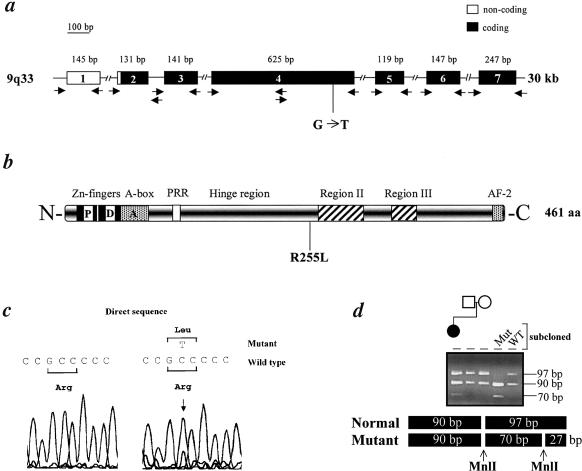
Figure  1
Figure 1
NR5A1 gene (a) and protein (b). Blackened boxes represent the coding exons; unblackened boxes, the noncoding exons. The sizes (in base pairs) of the PCR products are also indicated. The oligonucleotides used for genomic DNA amplification are depicted by arrows. The position of the transversion in exon 4 and the correspondent R255L missense mutation in the hinge region of the NR5A1/SF-1 protein are sketched. P box = proximal box; D box = distal box; A box = FTZ-F1 box; PRR = proline-rich region; regions II and III = domains conserved among NR5A1/SF-1 proteins with unclear function; AF-2 = activation function domain. c, DNA sequences. Chromatograms obtained by direct sequencing of PCR products showing the presence of the heterozygote G→T substitution in exon 4, not present in healthy individuals (WT, representative example from 30, 60 alleles). d, Restriction endonuclease analysis of a 626-bp exon 4 PCR product. The rearrangement introduces a novel MnlI (CCTC[N]7) restriction site that generates two additional bands of 27 and 70 bp in the patient, leaving another 90-bp band intact. The presence of the transversion in the heterozygote state was confirmed by restriction analysis in cloned and amplified DNA.
Figure  2
Figure 2
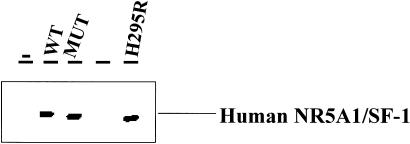
Expression of WT and MUT NR5A1/SF-1. Western blot analysis was performed on protein extract of 293 cells transiently transfected with an empty pCMV4 vector (−), the expression vector containing the WT NR5A1/SF-1 cDNA or the MUT NR5A1/SF-1 R255L cDNA, using lipofectamine reagent (Life Technologies). As positive control, protein extract from NCI-H295R human adrenal carcinoma cells was used (H295R). The antihuman NR5A1/SF-1 antibodies were used at 1:250 dilution and were purchased from Upstate Biotechnology. The R255L rearrangement does not interfere with protein translation or stability.
Figure  3
Figure 3
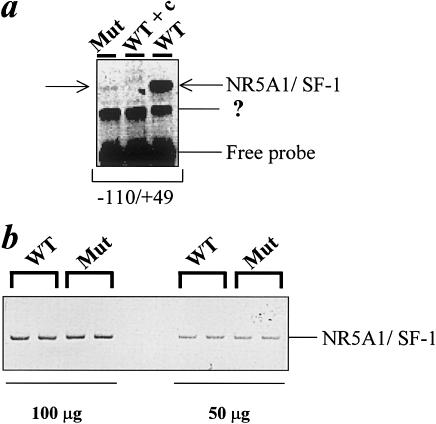
a, DNA-binding capacity of human MUT NR5A1/SF-1. Nuclear extracts prepared from 293 cells transfected with WT in the absence or presence of a 10-fold excess cold competitor (WT + c) or MUT NR5A1/SF-1 underwent electrophoretic mobility-shift assay using phospholabeled probes corresponding to one of the two sites of the human CYP11A promoter (−110 to +49). Similar results were obtained by use of the other binding site (−1679/−1620) (not shown). A non-NR5A1/SF-1 protein binding to the −110/+49 sequence is also present in the reaction (?). b, Western blot analysis demonstrating that the differences in binding capacity are not due to variations in expression between WT and MUT NR5A1/SF-1. The protein extract duplicates were loaded in two different amounts (100 and 50 mg).
Figure   4
Figure 4
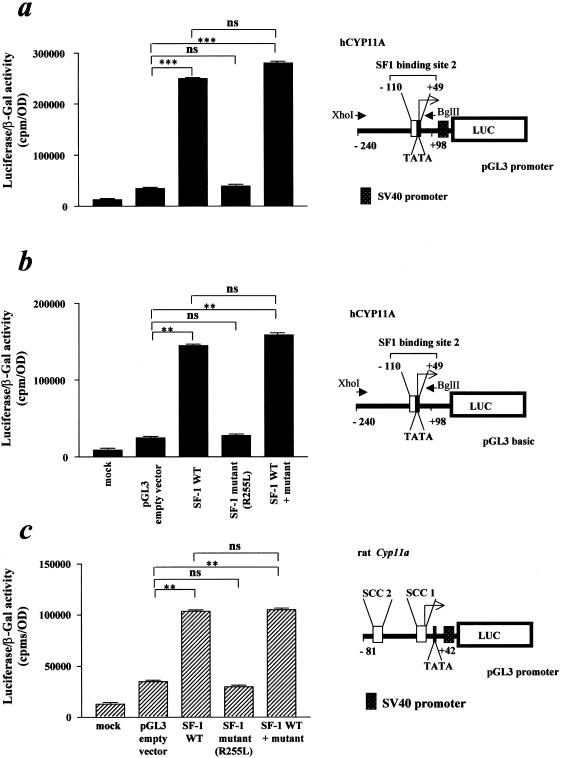
Transcriptional activity of MUT NR5A1/SF-1. A luciferase reporter construct (10 mg) containing two human CYP11A promoter regions (a and b, blackened bars; binding site 2: −110 to +49; with or without SV40 promoter) and part of the rat Cyp11a promoter region (c, hatched bars; −81/+42) was transfected into 293 cells with WT, MUT NR5A1/SF-1, or a combination of the two (molar ratio 1:1). Mock transfected 293 cells serve as negative control, whereas the luciferase-containing empty vector (pGL3; Promega) represents background luciferase activity. The results were subjected to statistical analysis (t-test, paired). *** = P<.0001; ** = P<.001; ns = not significant. The data represent the mean ± SD of three independent experiments.

References

Electronic-Database Information

    1. Généthon, http://www.genethon.fr
    1. National Center for Biotechnology Information, http://www.ncbi.nlm.nih.gov/
    1. Online Mendelian Inheritance in Man (OMIM), http://www.ncbi.nlm.nih.gov/Omim (for NR5A1 [MIM 184757], 3-@β-hydroxysteroid dehydrogenase deficiency [MIM 201810], STAR [600617], AMH [MIM 600957], and DAX-1 [MIM 300200])

References

    1. Achermann JC, Ito M, Ito M, Hindmarsh PC, Jameson JL (1999) A mutation in the gene encoding steroidogenic factor-1 causes XY sex reversal and adrenal failure in humans. Nat Genet 22:125–126 - PubMed
    1. Biason-Lauber A, Zachmann M, Schoenle EJ (2000) Effect of leptin on CYP17 enzymatic activities in human adrenal cells: new insight in the onset of adrenarche. Endocrinology 141:1446–1454 - PubMed
    1. Clemens JW, Lala DS, Parker KL, Richards JS (1994) Steroidogenic factor-1 binding and transcriptional activity of the cholesterol side-chain cleavage promoter in the rat granulosa cells. Endocrinology 134:1499–1508 - PubMed
    1. Dib C, Faure S, Fizames C, Samson D, Drouot N, Vignal A, Millasseau P, Marc S, Hazan J, Seboun E, Lathrop M, Gyapay G, Morissette J, Weissenbach J (1996) A comprehensive genetic map of the human genome based on 5,264 microsatellites. Nature 380:152–154 - PubMed
    1. Dracopoli NC, Haines JL, Korf BR, Morton CC, Seidman CE, Seidman JG, Smith DR (eds) (2000) Current protocols in human genetics. Vol 3. John Wiley & Sons, New York

Publication types

MeSH terms