


Parallel acquisition of awareness and trace eyeblink classical conditioning
- PMID: 11040257
- PMCID: PMC311341
- DOI: 10.1101/lm.33400
Parallel acquisition of awareness and trace eyeblink classical conditioning
Abstract
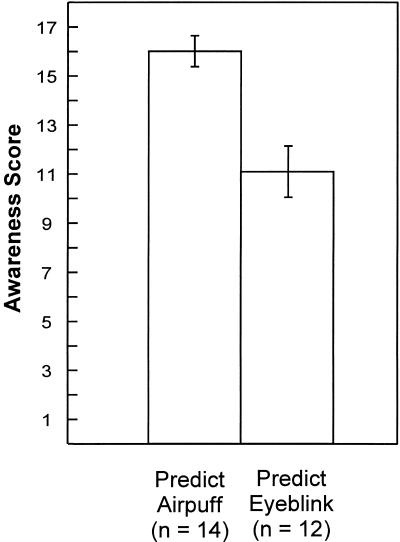
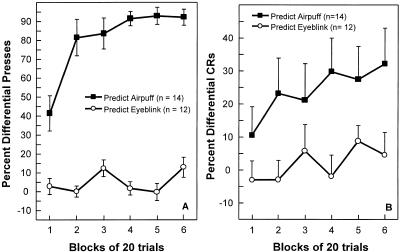
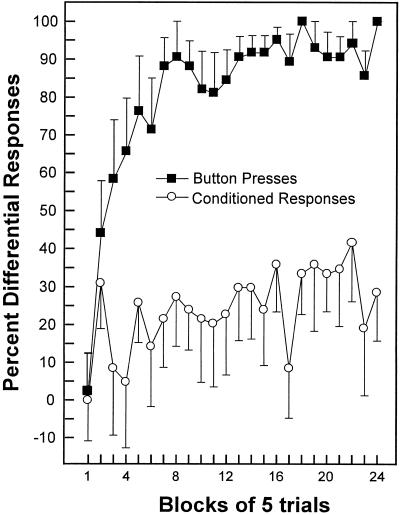
Trace eyeblink conditioning (with a trace interval >/=500 msec) depends on the integrity of the hippocampus and requires that participants develop awareness of the stimulus contingencies (i.e., awareness that the conditioned stimulus [CS] predicts the unconditioned stimulus [US]). Previous investigations of the relationship between trace eyeblink conditioning and awareness of the stimulus contingencies have manipulated awareness or have assessed awareness at fixed intervals during and after the conditioning session. In this study, we tracked the development of knowledge about the stimulus contingencies trial by trial by asking participants to try to predict either the onset of the US or the onset of their eyeblinks during differential trace eyeblink conditioning. Asking participants to predict their eyeblinks inhibited both the acquisition of awareness and eyeblink conditioning. In contrast, asking participants to predict the onset of the US promoted awareness and facilitated conditioning. Acquisition of knowledge about the stimulus contingencies and acquisition of differential trace eyeblink conditioning developed approximately in parallel (i.e., concurrently).
Figures
References
-
- Berger TW, Orr WB. Hippocampectomy selectively disrupts discrimination reversal conditioning of the rabbit nictitating membrane response. Behav Brain Res. 1983;8:49–68. - PubMed
-
- Clark RE, Squire LR. Classical conditioning and brain systems: A key role for awareness. Science. 1998;280:77–81. - PubMed
-
- ————— Human eyeblink classical conditioning: Effects of manipulating awareness of the stimulus contingencies. Psychol Sci. 1999;10:14–18.
-
- Daum I, Ackerman H. Frontal-type memory impairment associated with thalamic damage. Int J Neurosci. 1994;75:187–198. - PubMed
Publication types
MeSH terms
Grants and funding
LinkOut - more resources
Full Text Sources