


Effects of the selective M1 muscarinic receptor antagonist dicyclomine on emotional memory
- PMID: 11040260
- PMCID: PMC311344
- DOI: 10.1101/lm.34900
Effects of the selective M1 muscarinic receptor antagonist dicyclomine on emotional memory
Abstract
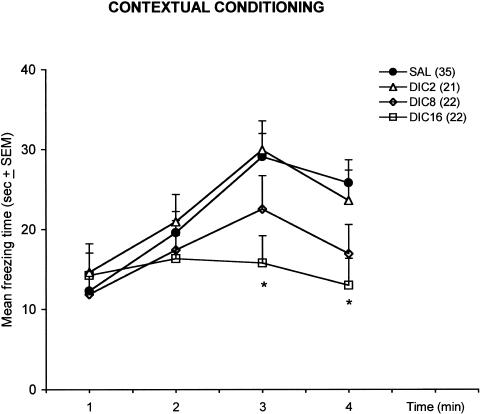
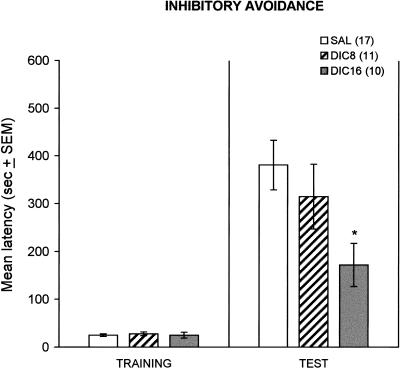
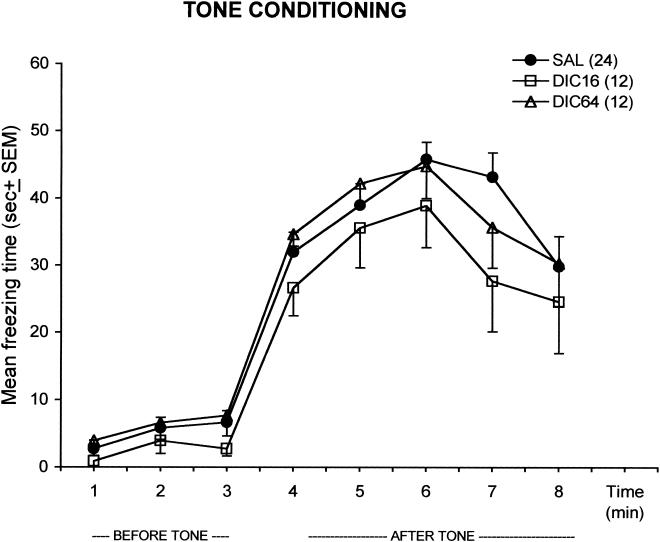
The nonselective muscarinic antagonist scopolamine is known to impair the acquisition of some learning tasks such as inhibitory avoidance. There has been recent research into the effects of this drug in contextual fear conditioning and tone fear conditioning paradigms. The purpose of the present study was to assess the role of the selective M1 muscarinic antagonist dicyclomine in these paradigms and in the inhibitory avoidance test. Rats were administered different doses of dicyclomine or saline 30 min before acquisition training. The animals were tested 24 hr later, and it was observed that 16 mg/kg of dicyclomine impaired both contextual fear conditioning and inhibitory avoidance. However, dicyclomine (up to 64 mg/kg) did not affect tone fear conditioning. These results suggest that the selective M1 muscarinic antagonist dicyclomine differentially affects aversively motivated tasks known to be dependent on hippocampal integrity (such as contextual fear conditioning and inhibitory avoidance) but does not affect similar hippocampus-independent tasks.
Figures
References
-
- Anagnostaras SG, Maren S, Fanselow MS. Scopolamine selectively disrupts the acquisition of contextual fear conditioning in rats. Neurobiol Learn Mem. 1995;64:191–194. - PubMed
-
- Anagnostaras SG, Maren S, Sage JR, Goodrich S, Fanselow MS. Scopolamine and Pavlovian fear conditioning in rats: Dose-effect analysis. Neuropsychopharmacology. 1999b;21:731–744. - PubMed
-
- Andrews JS, Jansen JH, Linders S, Princen A. Effects of disrupting the cholinergic system on short-term spatial memory in rats. Psychopharmacology. 1994;115:485–494. - PubMed
-
- Aura J, Sirvio J, Riekkinen P., Jr Methoctramine moderately improves memory but pirenzepine disrupts performance in delayed non-matching to position test. Eur J Pharmacol. 1997;333:129–134. - PubMed
Publication types
MeSH terms
Substances
LinkOut - more resources
Full Text Sources
Medical