. 2000 Oct;12(10):1961-74.
doi: 10.1105/tpc.12.10.1961.

Genetic interactions during root hair morphogenesis in Arabidopsis

Affiliations

Genetic interactions during root hair morphogenesis in Arabidopsis

J S Parker et al. Plant Cell. 2000 Oct.

Abstract

Root hairs are a major site for the uptake of water and nutrients into plants and form an increasingly important model system for studies of development of higher plants and cell biology. We have identified loss-of-function mutations in eight new genes required for hair growth in Arabidopsis: SHAVEN1 (SHV1), SHV2, and SHV3; CENTIPEDE1 (CEN1), CEN2, and CEN3; BRISTLED1 (BST1); and SUPERCENTIPEDE1 (SCN1). We combined mutations in 79 pairs of genes to determine the stages at which these and six previously known genes contribute to root hair formation. Double mutant phenotypes revealed roles for several genes that could not have been predicted from the single mutant phenotypes. For example, we show that TIP1 and RHD3 are required much earlier in hair formation than previous studies have suggested. We present a genetic model for root hair morphogenesis that defines the roles of each gene, and we suggest hypotheses about functional relationships between genes.


Figures

Figure 1.
Figure 1.
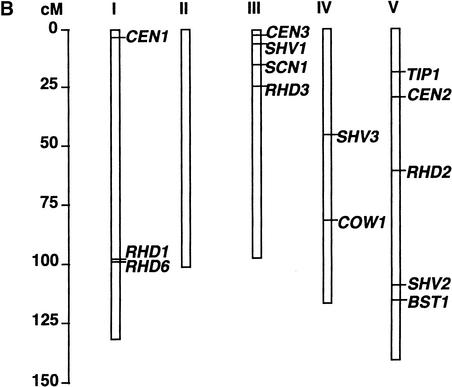
Mutant Phenotypes and Map Positions of Genes Involved in Root Hair Morphogenesis. (A) Root hairs of wild-type and single mutant seedlings. Mature root hairs of mutants at each new locus are shown alongside those of plants mutated at previously identified loci (rhd6, rhd2-1, rhd3-1, tip1-2, and cow1-1). (B) Locations on the Arabidopsis genetic map of genes involved in root hair formation. Shown for comparison are previously published map positions of other loci included in this study: RHD1, RHD2, and RHD3 (Schiefelbein and Somerville, 1990); RHD6 (Masucci and Schiefelbein, 1994); TIP1 (Ryan et al., 1998); and COW1 (Grierson et al., 1997).
Figure 1.
Figure 1.
Mutant Phenotypes and Map Positions of Genes Involved in Root Hair Morphogenesis. (A) Root hairs of wild-type and single mutant seedlings. Mature root hairs of mutants at each new locus are shown alongside those of plants mutated at previously identified loci (rhd6, rhd2-1, rhd3-1, tip1-2, and cow1-1). (B) Locations on the Arabidopsis genetic map of genes involved in root hair formation. Shown for comparison are previously published map positions of other loci included in this study: RHD1, RHD2, and RHD3 (Schiefelbein and Somerville, 1990); RHD6 (Masucci and Schiefelbein, 1994); TIP1 (Ryan et al., 1998); and COW1 (Grierson et al., 1997).
Figure 2.
Figure 2.
Mature Root Hairs of Double Mutant Plants with Epistatic Phenotypes. Root hairs of wild-type and single mutant plants are shown for comparison. The rhd6 rhd2-2 double mutant is mostly bald, as is the rhd6 single mutant. This is an example of epistasis, where the rhd6 mutation is epistatic to rhd2-2. Other results shown here demonstrate that shv1-1 is epistatic to both shv2-1 and shv3 and that shv2-1 is epistatic to cen3-2.
Figure 3.
Figure 3.
Mature Root Hairs of Double Mutant Plants with Partly Suppressed Phenotypes. Root hairs on tip1-1 rhd2-3 double mutant roots are frequently longer than those on rhd2-3 single mutant roots. This phenotype suggests that the wild-type function of TIP1 contributes to the short root hair phenotype of the rhd2-3 mutant. Results shown here demonstrate similar roles for RHD3 in the shv2-1 phenotype, and for SCN1 in the shv1-1 and shv2-1 phenotypes. The phenotypes of tip1-2 and shv2-1 tip1-2 are almost indistinguishable, suggesting that tip1-2 is almost completely epistatic to shv2-1. The shv1-1 and shv2-1 single mutant phenotypes are shown in Figure 2.
Figure 4.
Figure 4.
Mature Root Hairs of Double Mutant Plants with Additive Phenotypes. Examples of three categories of additive double mutants are shown. cow1-2 bst1 and cow1-2 cen2-1 have class 1 additive phenotypes, in which the defects of the parental lines affecting hair length, hair shape, and the production of multiple hairs from a single site of hair formation are combined in the double mutants. scn1-1 shv3 has a class 2 phenotype; synergistic effects greatly reduce the proportion of hairs >40 μm long, and a very high proportion of cells produce only a large swelling. rhd3-1 bst1 and rhd3-1 cen1-2 have class 3 additive phenotypes; both mutations affect hair length, but root hair lengths on double mutants are similar to that of one of the single mutant parents. Comparable pictures of the wild type and shv3 are shown in Figure 2, and of scn1-1 and rhd3-1 in Figure 3.
Figure 5.
Figure 5.
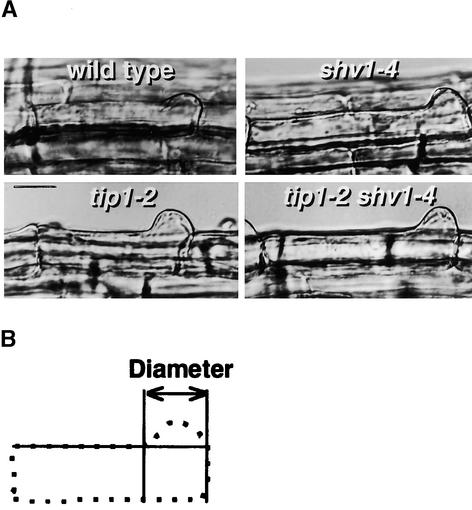
tip1-2 Affects the Diameter of the Swelling Formed during Root Hair Initiation. (A) Young root hairs of wild-type, shv1-4, tip1-2, and tip1-2 shv1-4 plants. Most root hairs on shv1-4 (4%, sd ± 2%) and tip1-2 shv1-4 (9%, sd ± 3) plants did not progress beyond the stage shown (see Tables 1 and 4). For this character, shv1-4 tip1-2 plants had the shv1-4 phenotype (Table 1). formula image. (B) Measurement of the diameters of young root hairs similar to those shown in (A). The shape of a root hair cell is shown with a dotted line. A horizontal line indicates the shape of the cell that had no hair formed, identifying the limits of the swelling that had formed at the beginning of hair formation. Student's t tests showed that the diameters of wild-type (21.55 μm, formula image) and shv1-4 (21.82 μm, formula image) hairs were not significantly different from each other but were significantly smaller than those of tip1-2 (27.29 μm, formula image) and shv1-4 tip1-2 (24.73 μm, formula image). These results show that before growth ceases (a characteristic of shv1-4), root hairs on shv1-4 tip1-2 plants have an increased diameter, which is a characteristic of tip1-2.
Figure 6.
Figure 6.
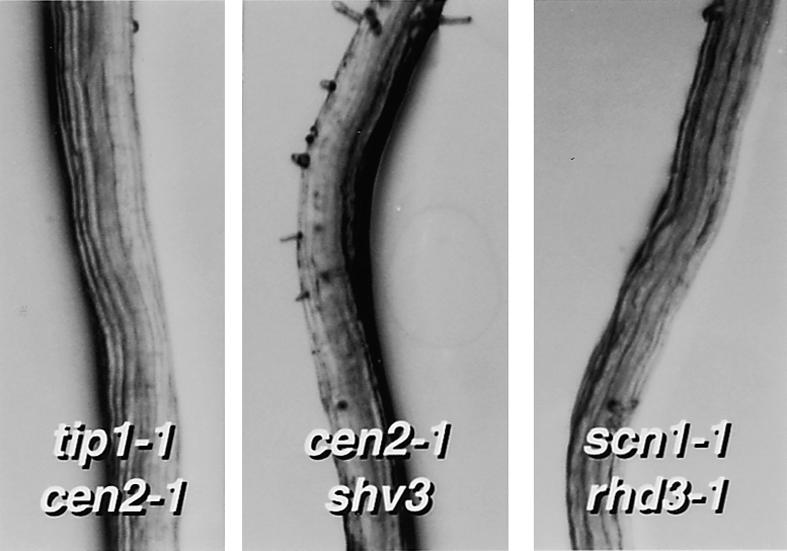
Synergistic Phenotypes Affecting the Beginning of Hair Formation. The double mutants shown have a severe hairless phenotype that is not seen in the parental single mutant lines. Comparable pictures of the wild type and shv3 are shown in Figure 2, tip1-1 and scn1-1 in Figure 3, and cen2-1 in Figure 4.
Figure 7.
Figure 7.
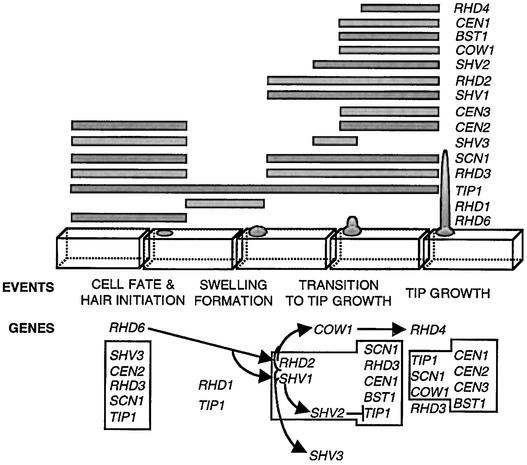
Genetic Contributions to Root Hair Development. This diagram combines the information obtained from this study with that from previous publications (Schiefelbein and Somerville, 1990; Schiefelbein et al., 1993; Masucci and Schiefelbein, 1994; Grierson et al., 1997; Ryan et al., 1998). Wild-type development is summarized by a line drawing. Horizontal bars represent stages at which each gene is involved. The sequence of gene action is indicated below. A mutation in a gene immediately before an arrow is epistatic to a mutation in the gene immediately after an arrow (complete epistasis results are listed in Table 2). A blunted line indicates hypothetical negative regulation of TIP1 by SHV2 during the transition to tip growth. Boxed areas indicate double mutant results that identify functional relationships between genes during a particular stage of morphogenesis.

References

    1. Bibikova, T.N., Jacob, T., Dahse, I., and Gilroy, S. (1998). Localized changes in apoplastic and cytoplasmic pH are associated with root hair development in Arabidopsis thaliana. Development 125, 2925–2934. - PubMed
    1. DiCristina, M., Sessa, G., Dolan, L., Linstead, P., Baima, S., Ruberti, I., and Morelli, G. (1996). The Arabidopsis Athb-10 (GLABRA2) is an HD-Zip protein required for regulation of root hair development. Plant J. 10, 393–402. - PubMed
    1. Dolan, L., and Scheres, B. (1998). Root pattern: Shooting in the dark? Semin. Cell Dev. Biol. 9, 201–206. - PubMed
    1. Dolan, L., Duckett, C.M., Grierson, C., Linstead, P., Schneider, K., Lawson, E., Dean, C., Poethig, S., and Roberts, K. (1994). Clonal relationships and cell patterning in the root epidermis of Arabidopsis. Development 120, 2465–2474.
    1. Galway, M.E., Masucci, J.D., Lloyd, A.M., Walbot, V., Davis, R.W., and Schiefelbein, J.W. (1994). The TTG gene is required to specify epidermal-cell fate and cell patterning in the Arabidopsis root. Dev. Biol. 166, 740–754. - PubMed

Publication types