Comparative Study
. 2000 Oct;12(10):2001-8.
doi: 10.1105/tpc.12.10.2001.

Alterations in CER6, a gene identical to CUT1, differentially affect long-chain lipid content on the surface of pollen and stems

Affiliations
Comparative Study

Alterations in CER6, a gene identical to CUT1, differentially affect long-chain lipid content on the surface of pollen and stems

A Fiebig et al. Plant Cell. 2000 Oct.

Abstract

Very long chain lipids contribute to the hydrophobic cuticle on the surface of all land plants and are an essential component of the extracellular pollen coat in the Brassicaceae. Mutations in Arabidopsis CER genes eliminate very long chain lipids from the cuticle surface and, in some cases, from the pollen coat. In Arabidopsis, the loss of pollen coat lipids can disrupt interactions with the stigma, inhibiting pollen hydration and causing sterility. We have positionally cloned CER6 and demonstrate that a wild-type copy complements the cer6-2 defect. In addition, we have identified a fertile, intragenic suppressor, cer6-2R, that partially restores pollen coat lipids but does not rescue the stem wax defect, suggesting an intriguing difference in the requirements for CER6 activity on stems and the pollen coat. Importantly, analysis of this suppressor demonstrates that low amounts of very long chain lipids are sufficient for pollen hydration and germination. The predicted CER6 amino acid sequence resembles that of fatty acid-condensing enzymes, consistent with its role in the production of epicuticular and pollen coat lipids >28 carbons long. DNA sequence analysis revealed the nature of the cer6-1, cer6-2, and cer6-2R mutations, and segregation analysis showed that CER6 is identical to CUT1, a cDNA previously mapped to a different chromosome arm. Instead, we have determined that a new gene, CER60, with a high degree of nucleotide and amino acid similarity to CER6, resides at the original CUT1 locus.


Figures
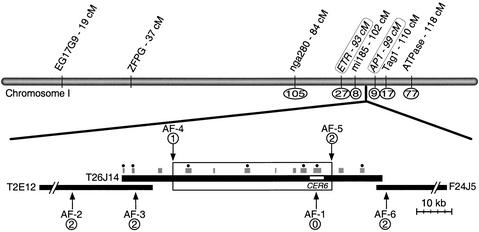
Figure 1.
Figure 1.
Genetic and Physical Mapping of CER6 on Chromosome 1 and T26J14. cer6-2 was positionally mapped between mi185 and AP1 on chromosome 1 by scoring PCR-based markers; the indicated positions in centimorgans correspond to the map generated from recombinant inbred lines (http://nasc.nott.ac.uk/new_ri_map.html). New PCR-based markers were generated at ETR and AP1; the centimorgan positions correspond to the phenotypic marker map (Koornneef, 1994) and within the BAC clones T2E12, T26J14, and F24J5 (AF-1 through AF-6). Circled numbers indicate the number of recombination events detected between each marker and CER6. The 45-kb region between AF-4 and AF-5 (open box) defines the boundaries of the region containing CER6; annotated genes (gray boxes), some of which correspond to ESTs (filled circles), are indicated. The white line within the T26J14 BAC indicates the fragment used for complementation experiments.
Figure 2.
Figure 2.
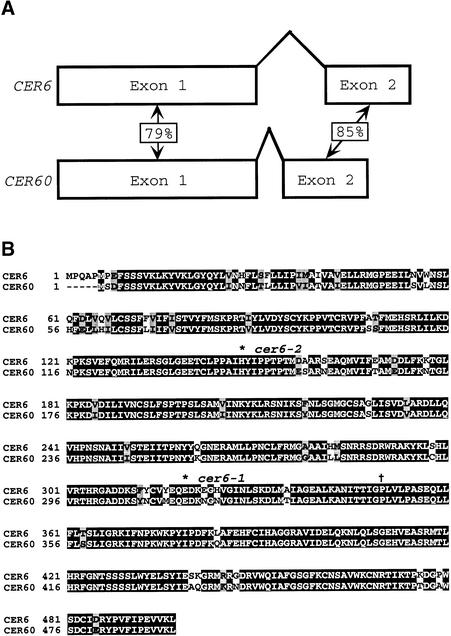
Sequence Analysis of CER6 and CER60. (A) Scale drawing of the CER6 and CER60 genes, indicating the percentage of DNA sequence identity for each exon. (B) Sequence alignment of CER6 and CER60, generated by using ClustalW 1.8 (http://dot.imgen.bcm.tmc.edu:9331/multi-align/multi-align.html) and Boxplot (http://www.ch.embnet.org/software/BOX_form.html). (*), residues altered by the mutations; black shading, identical residues; gray shading, similar residues; (), position of the exon1/exon2 splice junction. Dashes were introduced to optimize alignment.
Figure 3.
Figure 3.
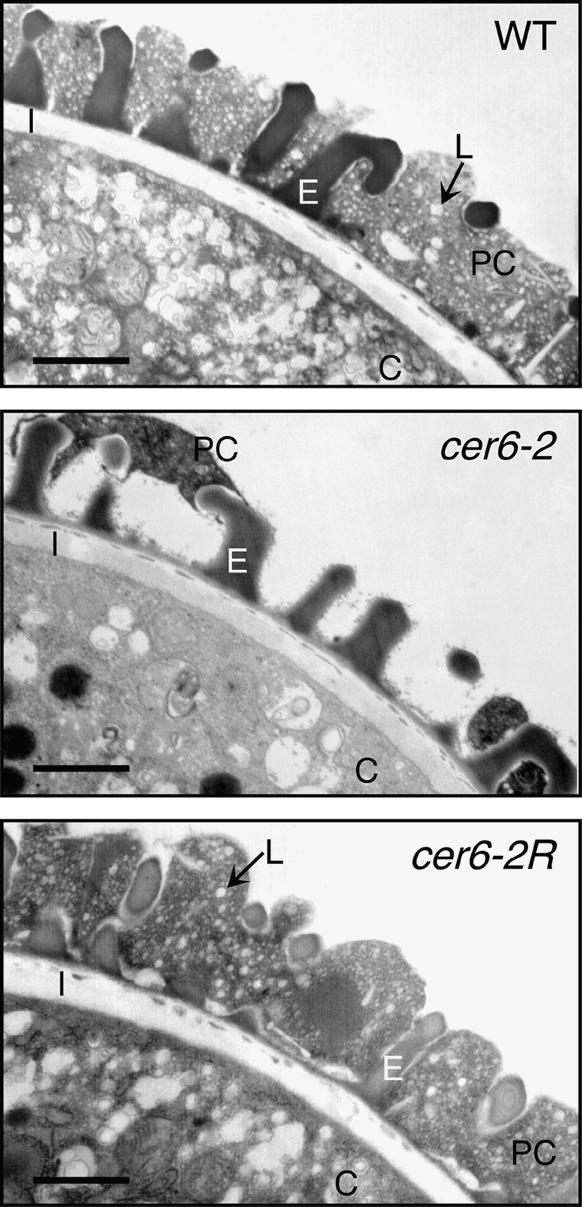
Morphology of the cer6-2R Pollen Coat. Transmission electron microscopy of wild-type (WT), cer6-2, and cer6-2R pollen grains, showing the resemblance between cer6-2R pollen grains and the wild type. C, cytoplasm; E, exine; I, intine; L, lipid droplet; PC, pollen coat. formula image.
Figure 4.
Figure 4.
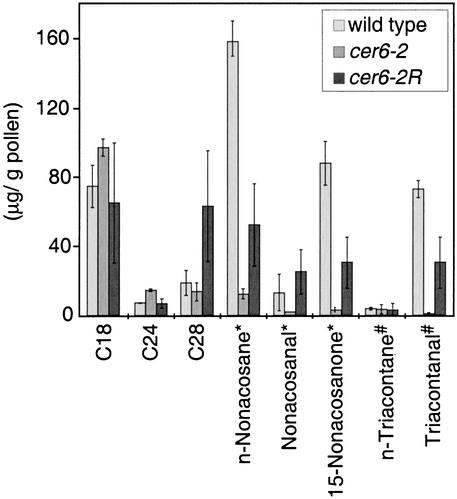
Lipid Contents in the Pollen Coats of Wild-Type, cer6-2, and cer6-2R Pollen. Chloroform-extracted lipids were analyzed by gas chromatography/mass spectrometry. Lipids constituting >1% of wild-type pollen coat lipids are reported. Quantities were normalized to an internal control. All classes of lipids for a given carbon chain length—18, 24, or 28—were pooled for that length. Error bars indicate standard deviation; for the wild type (derived from Landsberg and Columbia), formula image; for cer6-2, formula image; and for cer6-2R, formula image. (*), C29 lipids; (#), C30 lipids.
Figure 5.
Figure 5.
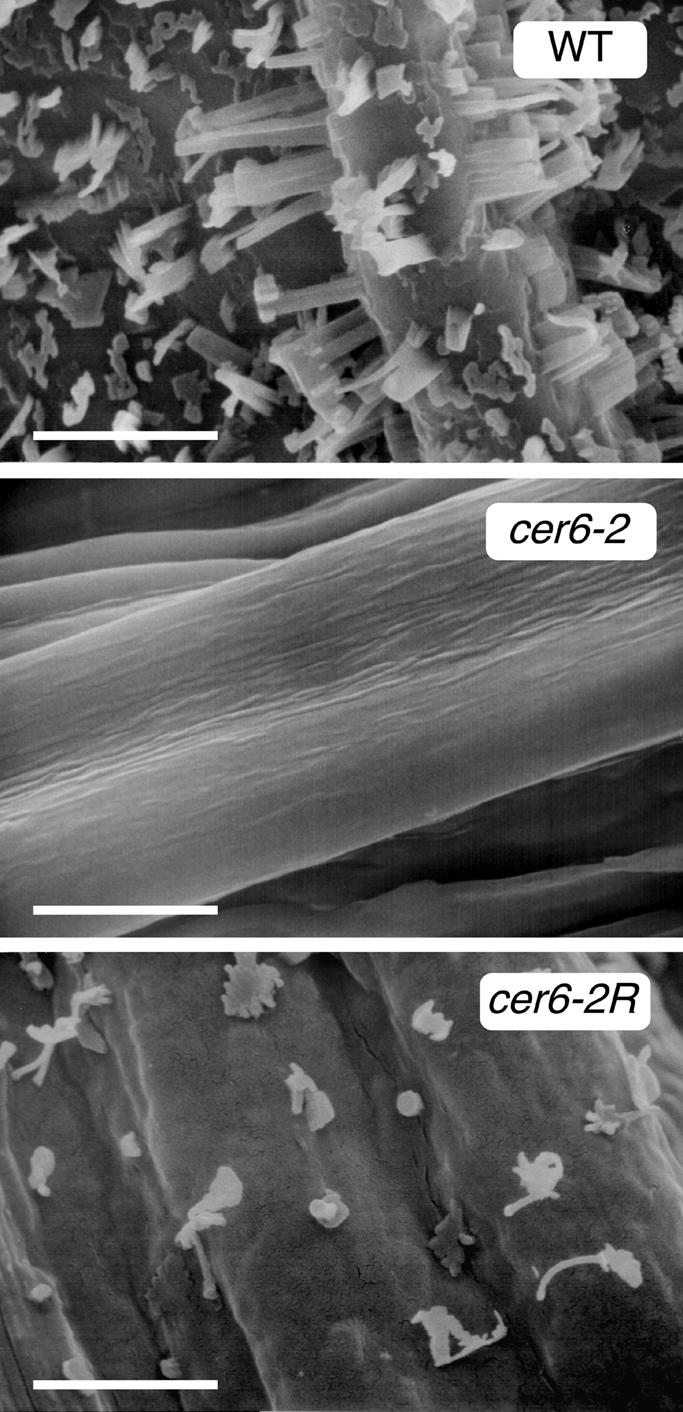
Presence of Lipid Crystals on cer6-2R Stems. Scanning electron microscopy of wild-type (WT), cer6-2, and cer6-2R stems shows fewer crystals on cer6-2R stems than on those of the wild type. formula image.

References

    1. Aarts, M.G., Keijzer, C.J., Stiekema, W.J., and Pereira, A. (1995). Molecular characterization of the CER1 gene of Arabidopsis involved in epicuticular wax biosynthesis and pollen fertility. Plant Cell 7, 2115–2127. - PMC - PubMed
    1. Bechtold, N., and Pelletier, G. (1998). In planta Agrobacterium-mediated transformation of adult Arabidopsis thaliana plants by vacuum infiltration. Methods Mol. Biol. 82, 259–266. - PubMed
    1. Bell, C.J., and Ecker, J.R. (1994). Assignment of 30 microsatellite loci to the linkage map of Arabidopsis. Genomics 19, 137–143. - PubMed
    1. Copenhaver, G.P., Browne, W.E., and Preuss, D. (1998). Assaying genome-wide recombination and centromere functions with Arabidopsis tetrads. Proc. Natl. Acad. Sci. USA 95, 247–252. - PMC - PubMed
    1. Hannoufa, A., McNevin, J.P., and Lemieux, B. (1993). Epicuticular wax of Arabidopsis thaliana eceriferum (cer) mutants. Phytochemistry 33, 851–855. - PubMed

Publication types