. 2000 Nov;74(22):10737-44.
doi: 10.1128/jvi.74.22.10737-10744.2000.

Establishment of a rescue system for canine distemper virus

Affiliations

Establishment of a rescue system for canine distemper virus

U Gassen et al. J Virol. 2000 Nov.

Abstract

Canine distemper virus (CDV) has been rescued from a full-length cDNA clone. Besides Measles virus (MV) and Rinderpest virus, a third morbillivirus is now available for genetic analysis using reverse genetics. A plasmid p(+)CDV was constructed by sequential cloning using the Onderstepoort vaccine strain large-plaque-forming variant. The presence of a T7 promoter allowed transcription of full-length antigenomic RNA by a T7 RNA polymerase, which was provided by a host range mutant of vaccinia virus (MVA-T7). Plasmids expressing the nucleocapsid protein, the phosphoprotein, and the viral RNA-dependent RNA polymerase, also under control of a T7 promoter, have been generated. Infection of HeLa cells with MVA-T7 and subsequent transfection of p(+)CDV plus the helper plasmids led to syncytium formation and release of infectious recombinant (r) CDV. Comparison of the rescued virus with the parental virus revealed no major differences in the progression of infection or in the shape and size of syncytia. A genetic tag, consisting of two nucleotide changes within the coding region of the L protein, has been identified in the rCDV genome. Expression by rCDV of all the major viral structural proteins has been demonstrated by immunofluorescence.


Figures

FIG. 1
FIG. 1
Schematic representation of p(+)CDV: cloning procedure and full-length cDNA clone. (A) The multiple cloning sites of pBS SK II and adjacent T3/T7 promoters were excised from the plasmid with BssHII. The remaining plasmid then served as backbone for construction of p(+)CDV. The first cDNA coding for the T7 promoter, viral leader sequence, and mainly the N protein was ligated into the vector. The restriction enzyme MluI was used to block one BssHII recognition site during the cloning procedure (see panel C). (B) BssHII was used throughout the construction of p(+)CDV to cut at the 3′ ends. (C) The full-length clone of 18,743 nt was generated in 12 separate cloning steps. The restriction sites used for cloning are indicated. As the genetic tag, a Csp45I site was introduced into the coding sequence of the L protein. The δ ribozyme and T7 terminator sequences were required for generation of RNAs of exact length. The representation is not to scale.
FIG. 2
FIG. 2
Recombinant N and P proteins visualized by immunofluorescence. Vero cells (105) were transfected with 1.2 μg of pEMC-N or pEMC-P, acetone fixed at 24 h p.i. and subjected to immunofluorescence. (A) N protein was indirectly visualized with SSPE antiserum and FITC-labeled mouse anti-human secondary antibody. (B) Phosphoprotein expression was examined using an anti-PDV P primary and FITC-labeled rabbit anti-mouse secondary antibody. Nuclei were counterstained with propidium iodide (red). Photographs were taken with a confocal laser microscope (magnification, ×160).
FIG. 3
FIG. 3
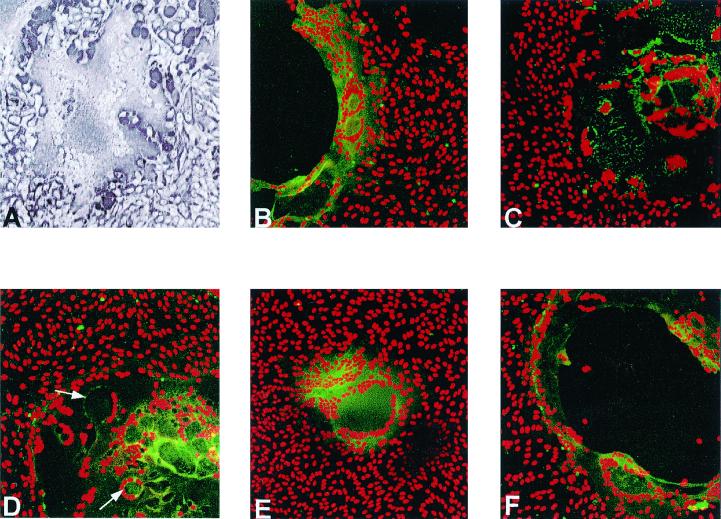
Immunofluorescence of rCDV. Vero cells were infected with rCDV at an MOI of 0.1 and acetone fixed at 24 h p.i. when CPEs of different stages of progression were visible. Expression of viral proteins was detected with specific MAbs, and nuclei were counterstained with propidium iodide. Staining for the N (B), P (C), M (D), F (E), and H (F) proteins is shown by the green fluorescence of FITC-labeled rabbit anti-mouse antibodies. (A) Light-microscopic photograph of a syncytium in an infected native monolayer of Vero cells stained with methylene blue (magnification, ×160).
FIG. 4
FIG. 4
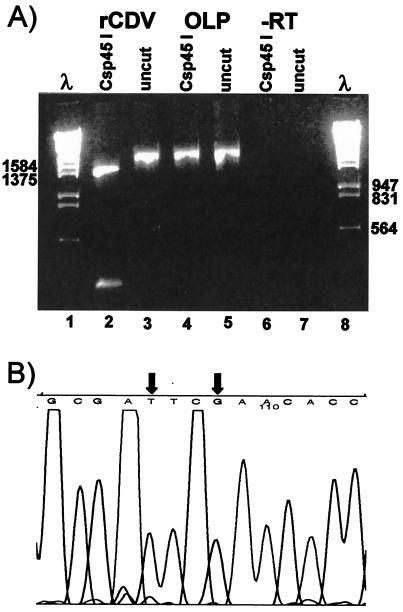
Characterization of rCDV. Vero cells were infected with passage-four rCDV and harvested for RNA isolation when the monolayer was fused. First-strand cDNA was synthesized with AMV-RT and used either for sequencing or for PCR amplification of the area containing the genetic tag. (A) Shown is a photograph of a 1.5% agarose gel with separated PCR products either cut with endonuclease Csp45I or undigested. In lanes 1 and 8, molecular weight markers have been separated (λ EcoRI/HindIII). The cDNA of rCDV was digested with Csp45I (lane 2) or untreated (lane 3). RNA of CDV Onderstepoort was used for PCR amplification and separated either after treatment with Csp45I (lane 4) or after no treatment (lane 5). For lanes 6 and 7, RNA of rCDV was subjected to PCR without the RT step as a control for plasmid contaminations. Shown is a chromatogram of the sequence analysis of the area containing the genetic tag (B). Arrows indicate the two nt changes.
FIG. 5
FIG. 5
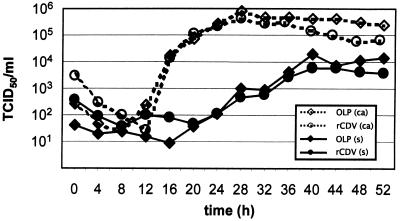
Growth analysis of rCDV and CDV Onderstepoort separated into cell-associated virus and virus in supernatant. Vero cells were infected at an MOI of 0.1, and virus was collected every 4 h over a period of 52 h. Shown are the mean values of three separate 50% tissue culture-infective doses for CDV Onderstepoort and rCDV as virus in supernatant(s) and cell-associated virus (ca).

References

    1. Alexander K A, Appel M J. African wild dogs (Lyacon pictus) endangered by a canine distemper epizootic among domestic dogs near the Masai Mara National Reserve, Kenya. J Wildl Dis. 1994;30:481–485. - PubMed
    1. Appel M J G, Reggiardo C, Summers B A, Pearce-Kelling S, Maré C J, Noon T H, Reed R E, Shively J N, Örvell C. Canine distemper virus infection and encephalitis in javelinas (collared peccaries) Arch Virol. 1991;119:147–152. - PubMed
    1. Baron M D, Barrett T. Rescue of rinderpest virus from cloned cDNA. J Virol. 1997;71:1265–1271. - PMC - PubMed
    1. Barrett T, Clarke D K, Evans S A, Rima B K. The nucleotide sequence of the gene encoding the F protein of canine distemper virus: a comparison of the deduced amino acid sequence with other paramyxoviruses. Virus Res. 1987;8:373–386. - PubMed
    1. Barrett T, Shrimpton S B, Russell S E. Nucleotide sequence of the entire protein coding region of canine distemper virus polymerase-associated (P) protein mRNA. Virus Res. 1985;4:367–372. - PubMed

Publication types

MeSH terms

Associated data

LinkOut - more resources