


doi: 10.1379/1466-1268(2000)005<0328:tghaad>2.0.co;2.
Toxoplasma gondii Hsp70 as a danger signal in toxoplasma gondii-infected mice
Affiliations
- PMID: 11048655
- PMCID: PMC312862
- DOI: 10.1379/1466-1268(2000)005<0328:tghaad>2.0.co;2
Item in Clipboard
Toxoplasma gondii Hsp70 as a danger signal in toxoplasma gondii-infected mice
Cell Stress Chaperones.
2000 Oct.
Abstract
Toxoplasma gondii Hsp70, T gondii Hsp30/bag1, and surface antigen 1 messenger RNAs were shown to be useful in analyzing stage conversion of T gondii between bradyzoites and tachyzoites. The high-level expression of T gondii Hsp70 was correlated with mortality in interferon-gamma knockout mice infected with T gondii. Tgondii Hsp70 inhibited the induction of nitric oxide release by peritoneal macrophages of T gondii-infected mice. These findings identify T gondii Hsp70 as a danger signal during lethal, acute T gondii infection.
Figures
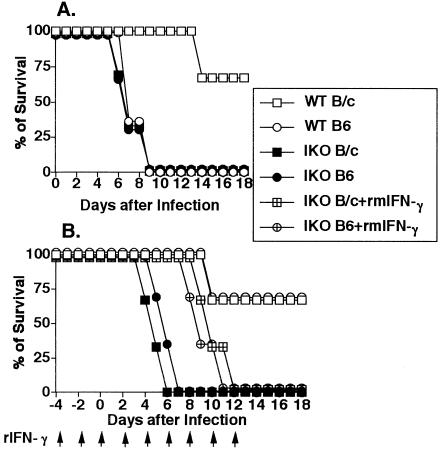
IFN-γ-dependent resistance to lethal T gondii challenge. Mice were perorally (A) or intraperitoneally (B) challenged with 200 cysts of T gondii, and survival was monitored. Twelve mice were used for each experimental group, and the experiment was repeated at least 2 times. Arrows indicate the date of rmIFN-γ treatment of rmIFN-γ-treated IKO mice
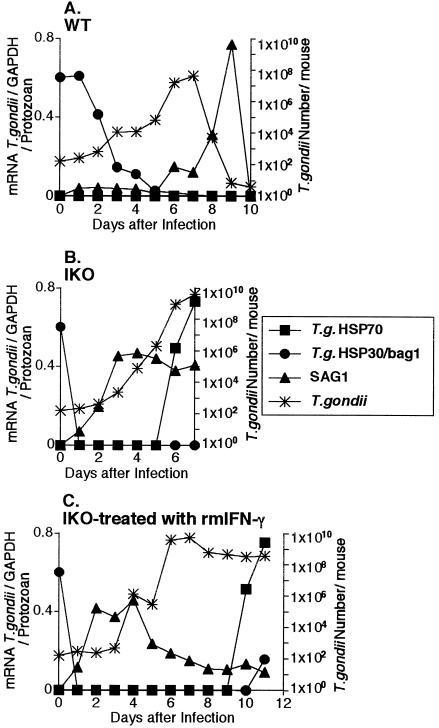
Time course of the expression of T gondii Hsp70, T gondii Hsp30/bag1 and SAG1 mRNAs per protozoan and the number of T gondii after infection intraperitoneally with 200 cysts of T gondii. The expression of T gondii Hsp70, T gondii Hsp30/bagl (as a market of bradyzoites) and SAG1 (as a market of tachyzoites) mRNAs per protozoan and the number of T gondii were investigated in PECs of WT (A), IKO (B) and IKO treated with rmIFN-γ (C). The results are expressed as the ratio between the optical density (OD) value of the RT-PCR product of each molecule and the OD value of the RT-PCR product of GAPDH, relative to the number of T gondii estimated by QC-PCR, according to the following formula: {(OD of molecule/OD of GAPDH)/T gondii number × 10 000. There mice were used for each experimental group and the experiment was repeated at least 2 times
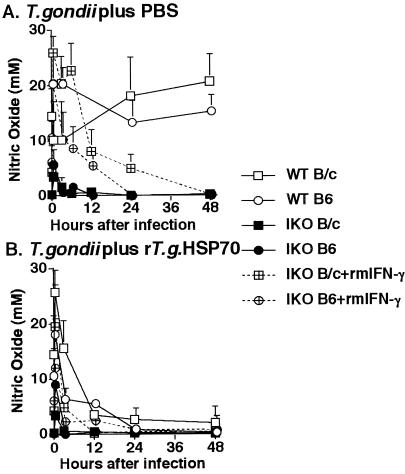
Influence of IFN-γ defect and T gondii Hsp70 on NO release. Age/sex-matched WT B/C, IKO B/C and IKO B/C treated with rmIFN-γ were i.p. infected with 200 cysts of T gondii plus PBS (A) or 200 cysts of T gondii plus 100 μg of rT gondii Hsp70 (B). At 0, 3, 6, 12, 24 and 48 h postinfection, the ascites of the mice was assayed for NO2− by the Griess reaction. There mice were used for each experimental group and the experiment was repeated at least 2 times
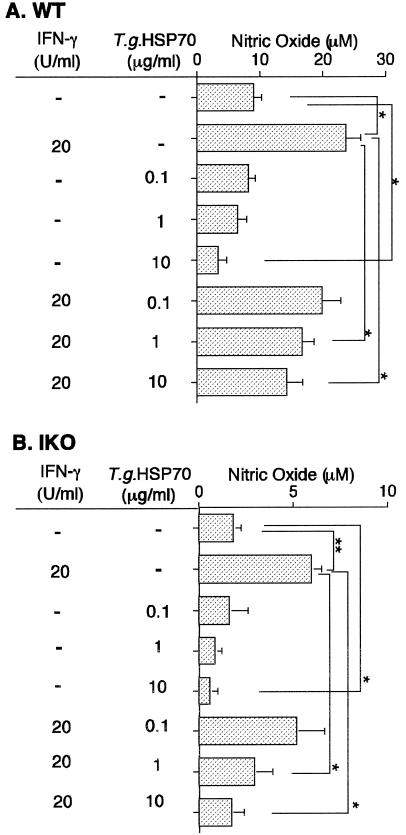
Influence of T gondii HSP70 on NO release. Age/sex-matched WT B6 (A) and IKO B6 (B) were i.p. infected with 200 cysts of T gondii. At 3 h P.I., PECs from mice were harvested and highly purified peritoneal macrophages were obtained by adhering to plastic plates. For further handling, the peritoneal macrophages were cultured at a concentration of 2 × 10⁵ cells per well in a 96-well microtiter plates. Recombinant mIFN-γ and rT gondii HSP70 were added simultaneously with peritoneal macrophages and were present in culture medium for the entire cultivation time of 12 h. NO2− was measured 12 h post treatment by the Griess reaction. The levels of NO release of non-stimulated peritoneal macrophages from non-infected WT and IKO B6 mice were 2.2 and 0.8, respectively. *,P<0.05; **, P <0.005. Three mice were used for each experimental group and the experiment was repeated at least 2 times
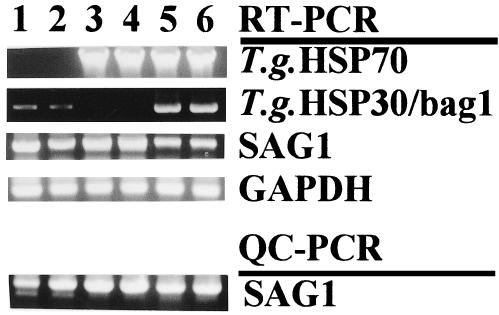
The expression of T gondii Hsp70, T gondii Hsp30/bag1 and SAG1 and the number of T gondii after infection i.p. with 200 cysts of T gondii. (A) Representative data of RT-PCR to assess the expression of T gondii Hsp70, T gondii Hsp30/bag1 and SAG1, and QC-PCR for measuring the number of T gondii in PECs of the mice infected with cysts of T gondii i.p. Lane 1, day 7 of WT B/c; lane 2, day 7 of WT B6; lane 3, day 6 of IKO B/c; lane 4, day 7 of IKO B6; lane 5, day 12 of IKO B/c treated with rmIFN-γ lane 6, day 11 of IKO B6 treated with rmIFN-γ. The reaction product was visualized by electrophoresis using 10 μl of the reaction mixture at 100 V in a
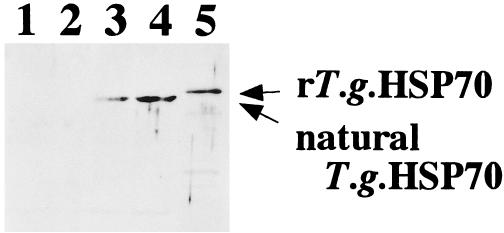
Continued.1% agarose gel containing ethidium bromide (1 μg/ml). The gels were then examined on a UV light box and photographed. GAPDH was the positive transcription control. (B) Western blotting with T gondii Hsp70-specific mAb (T gondii NCR A5) of lysates of PECs infected with T gondii. Lane 1, day 1 of IKO B/c; lane 2, day 1 of IKO B6; lane 3, day 6 of IKO B/c; lane 4, day 7 of IKO B6; lane 5, rT gondii Hsp70. Molecular weights of natural T gondii Hsp70 and rT gondii Hsp70 were 72 kDa and 74 kDa, respectively. Three mice were used for each experimental group and the experiment was repeated at least 2 times
References
-
- Bohne W, Gross U, Ferguson DJ, Heesemann J. Cloning and characterization of a bradyzoite-specifically expressed gene (Hsp30/bag1) of Toxoplasma gondii related to genes encoding small heat-shock proteins of plants. Mol Microbiol. 1995;16:1221–1230. - PubMed
-
- Burg JL, Perelman D, Kasper LH, Ware PL, Boothroyd JC. Molecular analysis of the gene encoding the major surface antigen of Toxoplasma gondii. J Immunol. 1988;141:3584–3591. - PubMed
-
- Chen W, Syldath U, Bellmann K, Burkart V, Kolb H. Human 60-kDa heat-shock protein: a danger signal to the innate immune system. J Immunol. 1999;162:3212–3219. - PubMed
Publication types
MeSH terms
Substances
LinkOut - more resources
Full Text Sources