


Cloning and characterization of two splice variants of human phosphodiesterase 11A
- PMID: 11050148
- PMCID: PMC18860
- DOI: 10.1073/pnas.200355397
Cloning and characterization of two splice variants of human phosphodiesterase 11A
Abstract
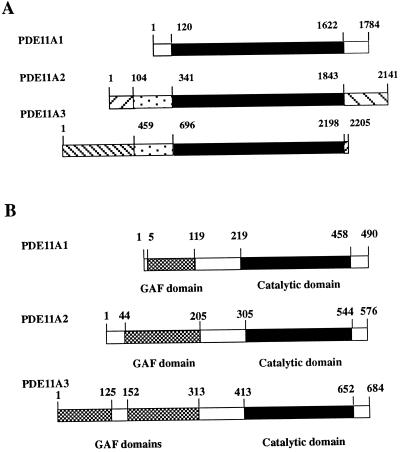
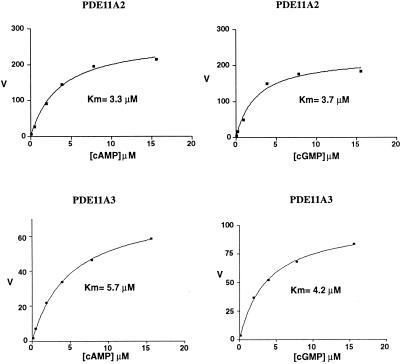
Phosphodiesterase 11A (PDE11A) is a recently identified family of cAMP and cGMP hydrolyzing enzymes. Thus far, a single splice variant designated as PDE11A1 has been reported. In this study, we identify and characterize two additional splice variants of PDE11A, PDE11A2 and PDE11A3. The full-length cDNAs are 2,141 bp for PDE11A2 and 2205 bp for PDE11A3. The ORF of PDE11A2 predicts a protein of 576 aa with a molecular mass of 65.8 kDa. The ORF of PDE11A3 predicts a protein of 684 aa with a molecular mass of 78.1 kDa. Comparison of the PDE11A2 sequence with that of PDE11A1 indicates an additional 86 aa at the N terminus of PDE11A2. Part of this sequence extends the potential cGMP binding region (GAF domain) present in PDE11A1. Compared with PDE11A2, PDE11A3 has an additional 108 N-terminal amino acids. Sequence analysis of PDE11A3 indicates the presence of another GAF domain in this region. This diversification of regulatory sequences in the N-terminal region of PDE11A splice variants suggests the interesting possibility of differential regulation of these enzymes. Recombinant PDE11A2 and -A3 proteins expressed in the Baculovirus expression system have the ability to hydrolyze both cAMP and cGMP. The K(m) values for cAMP hydrolysis are 3.3 microM and 5.7 microM for PDE11A2 and PDE11A3, respectively. The K(m) values for cGMP hydrolysis are 3.7 microM and 4.2 microM for PDE11A2 and PDE11A3, respectively. Both PDEs showed a V(max) ratio for cAMP/cGMP of approximately 1.0. PDE11A2 is sensitive to dipyridamole, with an IC(50) of 1.8 microM, and to zaprinast, with an IC(50) of 28 microM. PDE11A3 demonstrated similar pattern of inhibitor sensitivity with IC(50) values of 0.82 and 5 microM for dipyridamole and zaprinast, respectively.
Figures

References
-
- Li L, Yee C, Beavo J A. Science. 1999;283:848–851. - PubMed
-
- Dousa T P. Kidney Int. 1999;55:29–62. - PubMed
-
- Pfister C, Bennett N, Bruckert F, Catty P, Clerc A, Pages F, Deterre P. Cell Signaling. 1993;5:235–241. - PubMed
-
- Torphy T J, Zhou H L, Foley J J, Sarau H M, Manning C D, Barnette M S. J Biol Chem. 1995;270:23598–23604. - PubMed
Publication types
MeSH terms
Substances
Associated data
- Actions
- Actions
Grants and funding
LinkOut - more resources
Full Text Sources
Other Literature Sources
Molecular Biology Databases
