. 2000 Oct 24;97(22):11722-9.
doi: 10.1073/pnas.97.22.11722.

Hair cell recovery in mitotically blocked cultures of the bullfrog saccule

Affiliations

Hair cell recovery in mitotically blocked cultures of the bullfrog saccule

R A Baird et al. Proc Natl Acad Sci U S A. .

Erratum in

  • Proc Natl Acad Sci U S A. 2000 Dec 19;97(26):14831. Lysakowski, A [added]

Abstract

Hair cells in many nonmammalian vertebrates are regenerated by the mitotic division of supporting cell progenitors and the differentiation of the resulting progeny into new hair cells and supporting cells. Recent studies have shown that nonmitotic hair cell recovery after aminoglycoside-induced damage can also occur in the vestibular organs. Using hair cell and supporting cell immunocytochemical markers, we have used confocal and electron microscopy to examine the fate of damaged hair cells and the origin of immature hair cells after gentamicin treatment in mitotically blocked cultures of the bullfrog saccule. Extruding and fragmenting hair cells, which undergo apoptotic cell death, are replaced by scar formations. After losing their bundles, sublethally damaged hair cells remain in the sensory epithelium for prolonged periods, acquiring supporting cell-like morphology and immunoreactivity. These modes of damage appear to be mutually exclusive, implying that sublethally damaged hair cells repair their bundles. Transitional cells, coexpressing hair cell and supporting cell markers, are seen near scar formations created by the expansion of neighboring supporting cells. Most of these cells have morphology and immunoreactivity similar to that of sublethally damaged hair cells. Ultrastructural analysis also reveals that most immature hair cells had autophagic vacuoles, implying that they originated from damaged hair cells rather than supporting cells. Some transitional cells are supporting cells participating in scar formations. Supporting cells also decrease in number during hair cell recovery, supporting the conclusion that some supporting cells undergo phenotypic conversion into hair cells without an intervening mitotic event.


Figures
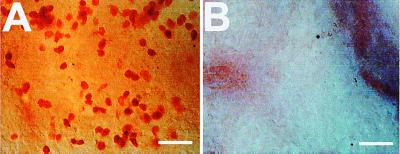
Figure 1
Figure 1
Micrographs of GT (A) and MBGT (B) cultures incubated for 7 days in modified Wolfe–Quimby culture medium supplemented with 1 μM BrdUrd. Cultures were fixed for 2 h in 4% paraformaldehyde, permeabilized for 30 min in 1 M HCl containing 0.2% Triton X-100, and blocked for 30 min in PBS containing 10% normal horse serum, 2.5% BSA, and 0.2% Triton X-100. They were then incubated overnight at 4°C with anti-BrdUrd antisera (Caltag, South San Francisco, CA; IU-4) (1:2000), 1 h in biotinylated horse anti-mouse IgG (1:500), and 1 h in avidin-biotin peroxidase complex (1:500). BrdUrd-labeled nuclei were detected with standard diaminobenzidine (DAB) histochemistry. Note the presence of BrdUrd-labeled nuclei in GT (A) and absence of such nuclei in MBGT cultures (B). Bars = 25 μm.
Figure 2
Figure 2
Lumenal surface (A) and mid-epithelium (B) of myosin (red), cytokeratin (green), and Hoechst (blue) labeling a 9-day MBC culture, illustrating sequentially acquired with a confocal laser scanning microscope (Bio-Rad, Radiance 2000). In the central saccule (Bottom, A and B), HCs and SCs are immunolabeled, respectively, with myosin (red) and cytokeratin (green) immunoreactivity. Immature HCs on the macular margin are immunolabeled with both markers (right arrows, A and B), with cytokeratin immunoreactivity in the cytoplasm and perinuclear bodies (left arrows, A and B). Bars = 25 μm.
Figure 3
Figure 3
Transmission electron micrographs (A and B) of apical (top arrows) and basal (filled arrows) remnants of fragmenting HCs in a 7-day MBGT culture. In B, the basal remnant is trapped inside a scar formation formed by the expansion of the apical processes of neighboring SCs. Bars = 10 μm.
Figure 4
Figure 4
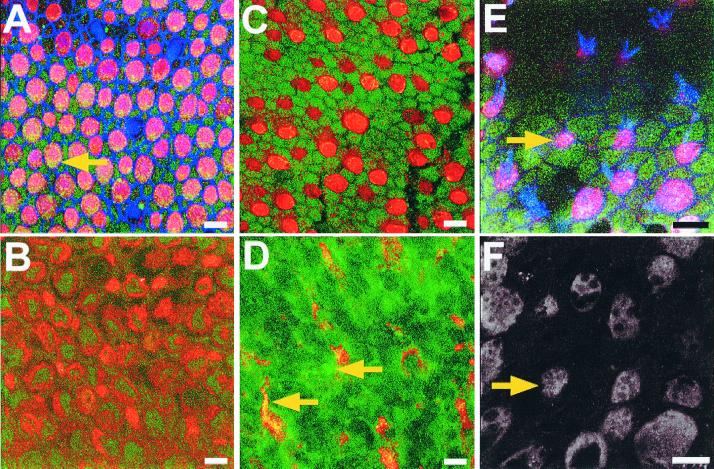
Lumenal surface (A, C, and E) and mid-epithelium (B, D, and F) of 3-day (A and B) and 5-day (CF) MBGT cultures, illustrating immunolabeling of sublethally damaged HCs. With the exception of their missing bundles, sublethally damaged HCs in 3-day cultures had normal morphology. They also retained their myosin immunoreactivity and, unlike undamaged HCs, had cytokeratin immunoreactivity around their basal bodies and cuticular plates (arrow, A). In 5-day cultures, these cells had degenerating cuticular plates (C), as well as elongated cell bodies, basal nuclei, and basal pseudopodia ending at or near the basement membrane (D). They also had cytokeratin immunoreactivity in their cytoplasm (left arrow, D) and perinuclear bodies (right arrow, D). Sublethally damaged HCs also had enlarged mitochondria and numerous autophagic vacuoles (arrows, E and F). Bars = 10 μm.
Figure 5
Figure 5
(Top) Undamaged bundle density (●) and SC density (▾) in MBC (open symbols) and MBGT (filled symbols) cultures plotted vs. survival time. (Middle) Density of mature (blue bars), damaged (red bars), and immature (yellow bars) bundles in 3-day MBC cultures (Left) and MBGT cultures (Right) plotted vs. survival time. (Bottom) Density of repairing (blue bars) and nonrepairing (red bars) scars in 3-day MBC cultures (Left) and MBGT cultures (Right) plotted vs. survival time.
Figure 6
Figure 6
Luminal surface (A and D), mid-epithelium (B and E), and cut-away views (C and F) of 5-day MBGT cultures, illustrating morphology and immunolabeling of TCs in repairing scar formations. Note round or triangular apical surface (arrows, A and D), elongated cell body (arrows, B and E), and basal nucleus (arrows, C and F). Bars = 10 μm.
Figure 7
Figure 7
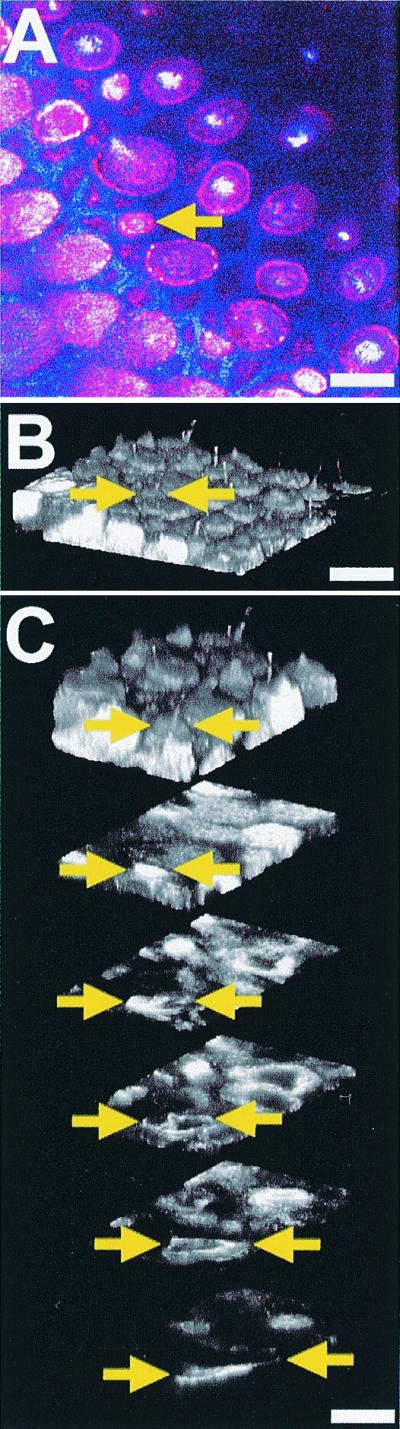
Lumenal surface (A) and cut-away views (B and C) of 9-day MBGT culture, illustrating morphology and immunolabeling of immature HC. Note absence of cytokeratin immunolabeling, round apical surface (arrow, A), kinocilium and immature bundle (arrow, B and C), elongated cell body, basal nucleus (asterisks, B and C), and basal pseudopodia (pointer, C). Bars = 10 μm.

References

    1. Hudspeth A J. Nature (London) 1989;341:397–404. - PubMed
    1. Hudspeth A J. Neuron. 1997;19:947–950. - PubMed
    1. Corwin J T, Warchol M E. Annu Rev Neurosci. 1991;14:301–333. - PubMed
    1. Corwin J T, Warchol M E, Kelley M T. Curr Opin Neurobiol. 1993;3:32–37. - PubMed
    1. Staecker H, Van De Water T. Curr Opin Neurobiol. 1998;8:480–487. - PubMed

Publication types

LinkOut - more resources