


Pharmacological examination of contractile responses of the guinea-pig isolated ileum produced by mu-opioid receptor antagonists in the presence of, and following exposure to, morphine
- PMID: 11053208
- PMCID: PMC1572416
- DOI: 10.1038/sj.bjp.0703659
Pharmacological examination of contractile responses of the guinea-pig isolated ileum produced by mu-opioid receptor antagonists in the presence of, and following exposure to, morphine
Abstract
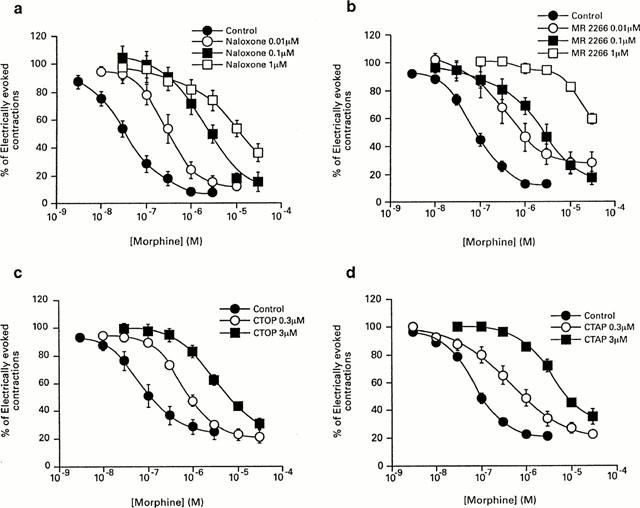
We have assessed the potential of several mu-opioid receptor antagonists to elicit a response in the guinea-pig isolated ileum in the presence of, and following overnight exposure to, morphine. Naloxone, D-Phe-Cys-Tyr-D-Trp-Orn-Thr-Pen-Thr-NH(2) (CTOP), (-)-5, 9alpha-diethyl-2-(3-furyl-methyl)-2'-hydroxy-6,7-benzomorphan (MR2266), but not D-Phe-Cys-Tyr-D-Trp-Arg-Thr-Pen-Thr-NH(2) (CTAP), produced a transient inhibition of electrically-evoked contractions of the guinea-pig ileum. The effect of 1 microM CTOP, but not that to MR2266, was inhibited by 1 microM somatostatin. Naloxone (0.3 microM), CTOP (3 microM), CTAP (3 microM) and MR2266 (0.3 microM) antagonized the inhibitory effect of morphine on electrically-evoked contractions of the guinea-pig to a similar degree and, following 60 min exposure to morphine, produced non-sustained contractions. The response to 3 microM CTOP was significantly smaller than that to 3 microM CTAP. None of the antagonists produced a response in the absence of morphine. Following overnight exposure of the ileum to 0.3 microM morphine (4 degrees C), and repeated washing to remove the agonist, all four antagonists elicited non-sustained contractions. However, the responses to 3 microM CTOP and 0.3 microM MR2266 were significantly smaller than those elicited by 0.3 microM naloxone and 3 microM CTAP. Somatostatin (1 microM) significantly reduced naloxone-induced contractions, but not those to CTAP. While all four mu-opioid antagonists elicited contractions in the presence of, and following prolonged exposure to, morphine, differences between them were noted which may be a consequence of non-opioid actions.
Figures




References
-
- AMMER H., SCHULZ R. Chronic morphine treatment increases stimulatory Beta-2 adrenoceptor signaling in A431 cells stably expressing the Mu opioid receptor. J. Pharmacol., Exp. Ther. 1997;280:512–520. - PubMed
-
- AVIDOR-REISS T., BAYEWITCH M., LEVY R., MATUS-LEIBOVITCH N., NEVO I., VOGEL Z. Adenylyl cyclase supersensitization in μ-opioid receptor-transfected Chinese Hamster Ovary cells following chronic opioid treatment. J. Biol. Chem. 1995;270:29732–29738. - PubMed
-
- BILSKY E.J., BERNSTEIN R.N., WANG Z., SADEE W., PORRECA F. Effects of naloxone and D-Phe-Cys-Tyr-D-Trp-Arg-Thr-Pen-Thr-NH2 and the protein kinase inhibitors H7 and H8 on acute morphine dependence and antinociceptive tolerance in mice. J. Pharmacol. Exp. Ther. 1996;277:484–490. - PubMed
Publication types
MeSH terms
Substances
LinkOut - more resources
Full Text Sources
Research Materials
