


An evaluation of potassium ions as endothelium-derived hyperpolarizing factor in porcine coronary arteries
- PMID: 11053218
- PMCID: PMC1572415
- DOI: 10.1038/sj.bjp.0703658
An evaluation of potassium ions as endothelium-derived hyperpolarizing factor in porcine coronary arteries
Abstract
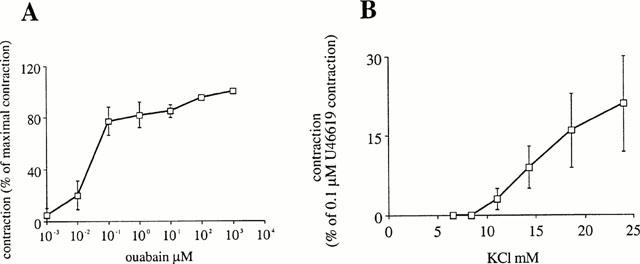
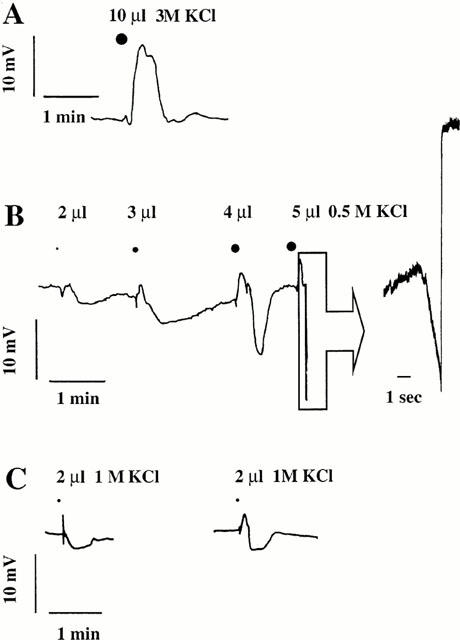
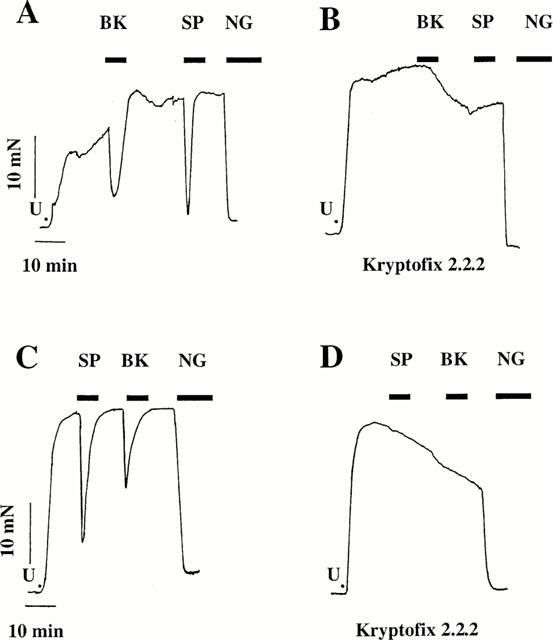
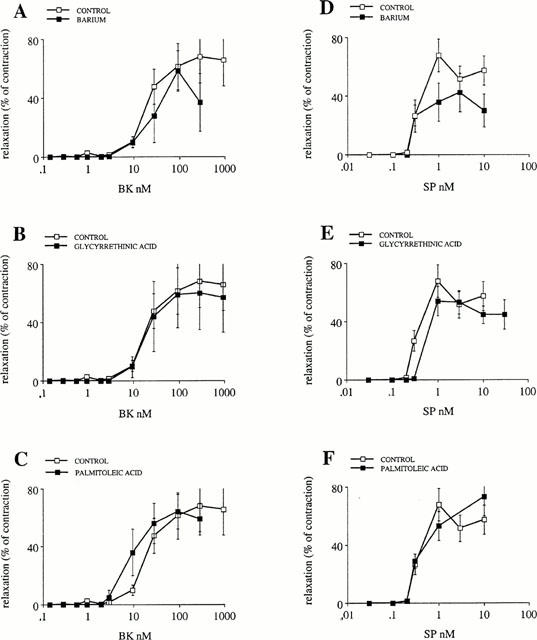
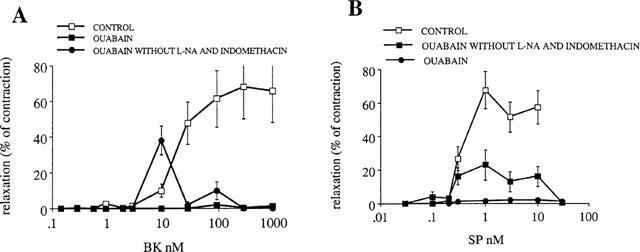
In the rat hepatic artery, the endothelium-derived hyperpolarizing factor (EDHF) was identified as potassium. Potassium hyperpolarizes the smooth muscles by gating inward rectified potassium channels and by activating the sodium-potassium adenosine triphosphatase (Na(+)-K(+)ATPase). Our goal was to examine whether potassium could explain the EDHF in porcine coronary arteries. On coronary strips, the inhibition of calcium-dependent potassium channels with 100 nM apamin plus 100 microM charibdotoxin inhibited the endothelium-dependent relaxations, produced by 10 nM substance P and 300 nM bradykinin and resistant to nitro-L-arginine and indomethacin. The scavenging of potassium with 2 mM Kryptofix 2.2.2 abolished the endothelium-dependent relaxations produced by the kinins and resistant to nitro-L-arginine and indomethacin. Forty microM 18alpha glycyrrethinic acid or 50 microM palmitoleic acid, both uncoupling agents, did not inhibit these kinin relaxations. Therefore, EDHF does not result from an electrotonic spreading of an endothelial hyperpolarization. Barium (0.3 nM) did not inhibit the kinin relaxations resistant to nitro-L-arginine and indomethacin. Therefore, EDHF does not result from the activation of inward rectified potassium channels. Five hundred nM ouabain abolished the endothelium-dependent relaxations resistant to nitro-L-arginine and indomethacin without inhibiting the endothelium-derived NO relaxation. The perifusion of a medium supplemented with potassium depolarized and contracted a coronary strip; however, the short application of potassium hyperpolarized the smooth muscles. These results are compatible with the concept that, in porcine coronary artery, the EDHF is potassium released by the endothelial cells and that this ion hyperpolarizes and relaxes the smooth muscles by activating the Na(+)-K(+)ATPase.
Figures
References
-
- BÉNY J.-L. Endothelial and smooth muscle cells hyperpolarized by bradykinin are not dye coupled. Am. J. Physiol. 1990a;258:H836–H841. - PubMed
-
- BÉNY J.-L. Effect of substance P on the membrane potential of coronary arterial endothelial cells in situ. Agents and Actions. 1990b;31:317–320. - PubMed
-
- BÉNY J.-L., BRUNET P.C. Neither nitric oxyde nor nitroglycerin accounts for all the characteristics of the endothelially mediated vasodilatation of pig coronary arteries. Blood Vessels. 1988;25:308–311. - PubMed
Publication types
MeSH terms
Substances
LinkOut - more resources
Full Text Sources
Medical
