. 2000 Nov;66(11):4625-33.
doi: 10.1128/AEM.66.11.4625-4633.2000.

Persistence of selected Spartina alterniflora rhizoplane diazotrophs exposed to natural and manipulated environmental variability

Affiliations

Persistence of selected Spartina alterniflora rhizoplane diazotrophs exposed to natural and manipulated environmental variability

C E Bagwell et al. Appl Environ Microbiol. 2000 Nov.

Abstract

Rhizoplane-rhizosphere nitrogen-fixing microorganisms (diazotrophs) are thought to provide a major source of biologically available nitrogen in salt marshes dominated by Spartina alterniflora. Compositional and functional stability has been demonstrated for this important functional group; however, the quantitative responses of specific diazotroph populations to environmental variability have not been assessed. Changes in the relative abundances of selected rhizoplane diazotrophs in response to long-term fertilization were monitored quantitatively by reverse sample genome probing. Fertilization stimulated Spartina, with plant height nearly tripling after 1 year. Fertilization also resulted in significant changes in interstitial porewater parameters. Diazotrophic activity (acetylene reduction assay) was sensitive to the fertilization treatments and was inhibited in some plots on several sampling dates. However, inhibition was never consistent across all of the replicates within a treatment and activity always recovered. The rhizoplane diazotrophs were quite responsive to environmental variability and to experimental treatments, but none were displaced by either environmental variability or experimental treatments. All strains were detected consistently throughout this study, and extensive spatial heterogeneity in the distribution patterns of these organisms was observed. The physiological traits that differentiate the diazotroph populations presumably support competitiveness and niche specialization, resulting in the observed resilience of the diazotroph populations in the rhizosphere.


Figures

FIG. 1
FIG. 1
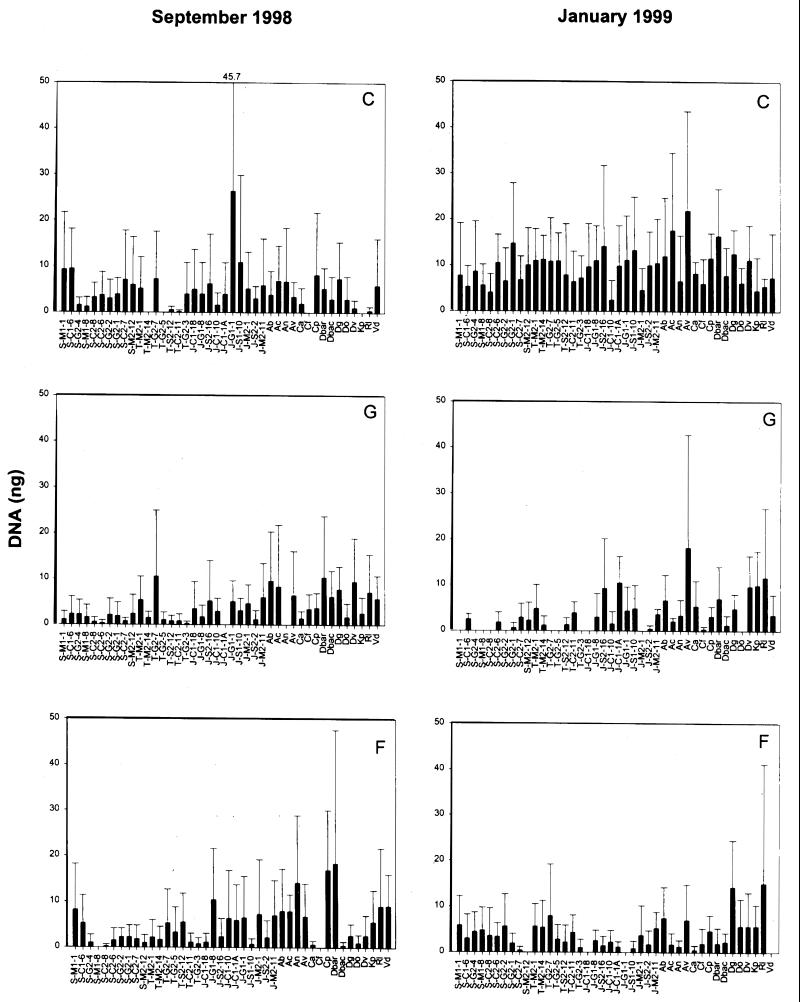
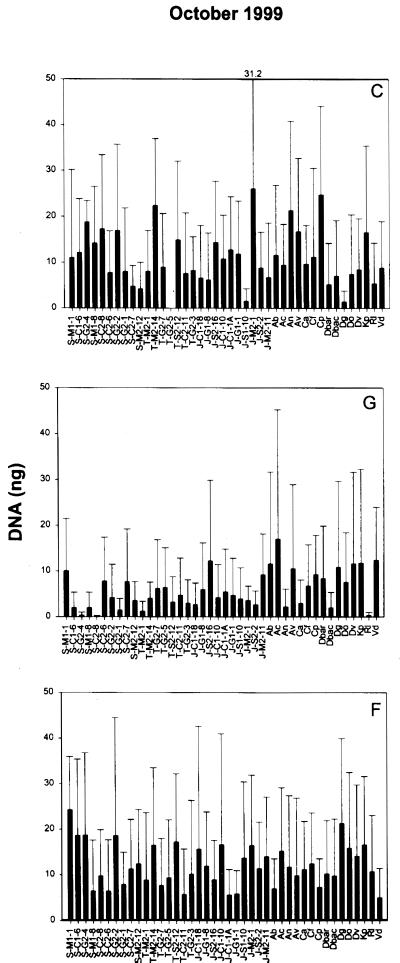
RSGP profiles for each sample date by treatment (n = 3). In July, n = 2 for the foliar spray treatment profile. Values are mean nanograms of DNA ± the standard deviation for each rhizoplane diazotroph and reference strain. Standard deviations exceeding the y-axis scale are provided across the top of each panel. Strains are designated by the host plant origin (S, short-form Spartina; T, tall-form Spartina; J, Juncus), the carbon source used for isolation (C, citrate; M, malate; S, sucrose; G, glucose), the pH of the isolation medium (1, pH 7.0; 2, pH 7.5), and the strain number. Reference strains are abbreviated as follows: Ab, Azospirillum brasilense; Ac, Azotobacter chroococcum; An, Arcobacter nitrofigilis; Av, Azotobacter vinelandii; Ca, Clostridium acidiurici; Cf, Clostridium formicoaceticum; Cp, Clostridium perfringens; Dbar, Desulfovibrio baarsii; Dbac, Desulfovibrio bacculatus; Dg, Desulfovibrio gigas; Do, Desulfotomaculum orientis; Dv, Desulfovibrio vulgaris; Kp, Klebsiella pneumoniae; Rl, Rhizobium leguminosarum; Vd, Vibrio diazotrophicus. C, control; G, ground treatment; F, foliar spray treatment.
FIG. 1
FIG. 1
RSGP profiles for each sample date by treatment (n = 3). In July, n = 2 for the foliar spray treatment profile. Values are mean nanograms of DNA ± the standard deviation for each rhizoplane diazotroph and reference strain. Standard deviations exceeding the y-axis scale are provided across the top of each panel. Strains are designated by the host plant origin (S, short-form Spartina; T, tall-form Spartina; J, Juncus), the carbon source used for isolation (C, citrate; M, malate; S, sucrose; G, glucose), the pH of the isolation medium (1, pH 7.0; 2, pH 7.5), and the strain number. Reference strains are abbreviated as follows: Ab, Azospirillum brasilense; Ac, Azotobacter chroococcum; An, Arcobacter nitrofigilis; Av, Azotobacter vinelandii; Ca, Clostridium acidiurici; Cf, Clostridium formicoaceticum; Cp, Clostridium perfringens; Dbar, Desulfovibrio baarsii; Dbac, Desulfovibrio bacculatus; Dg, Desulfovibrio gigas; Do, Desulfotomaculum orientis; Dv, Desulfovibrio vulgaris; Kp, Klebsiella pneumoniae; Rl, Rhizobium leguminosarum; Vd, Vibrio diazotrophicus. C, control; G, ground treatment; F, foliar spray treatment.
FIG. 1
FIG. 1
RSGP profiles for each sample date by treatment (n = 3). In July, n = 2 for the foliar spray treatment profile. Values are mean nanograms of DNA ± the standard deviation for each rhizoplane diazotroph and reference strain. Standard deviations exceeding the y-axis scale are provided across the top of each panel. Strains are designated by the host plant origin (S, short-form Spartina; T, tall-form Spartina; J, Juncus), the carbon source used for isolation (C, citrate; M, malate; S, sucrose; G, glucose), the pH of the isolation medium (1, pH 7.0; 2, pH 7.5), and the strain number. Reference strains are abbreviated as follows: Ab, Azospirillum brasilense; Ac, Azotobacter chroococcum; An, Arcobacter nitrofigilis; Av, Azotobacter vinelandii; Ca, Clostridium acidiurici; Cf, Clostridium formicoaceticum; Cp, Clostridium perfringens; Dbar, Desulfovibrio baarsii; Dbac, Desulfovibrio bacculatus; Dg, Desulfovibrio gigas; Do, Desulfotomaculum orientis; Dv, Desulfovibrio vulgaris; Kp, Klebsiella pneumoniae; Rl, Rhizobium leguminosarum; Vd, Vibrio diazotrophicus. C, control; G, ground treatment; F, foliar spray treatment.

References

    1. Amann R I, Ludwig W, Schleifer K H. Phylogenetic identification and in situ detection of individual microbial cells without cultivation. Microbiol Rev. 1995;59:143–169. - PMC - PubMed
    1. Bagwell C E, Lovell C R. Microdiversity of culturable diazotrophs from the rhizoplanes of the salt marsh grasses Spartina alterniflora and Juncus roemerianus. Microb Ecol. 2000;39:128–136. - PubMed
    1. Bagwell C E, Piceno Y M, Ashburne-Lucas A, Lovell C R. Physiological diversity of the rhizosphere diazotroph assemblages of selected salt marsh grasses. Appl Environ Microbiol. 1998;64:4276–4282. - PMC - PubMed
    1. Balasubramanian A, Rangaswami G. Studies on the influence of foliar nutrient sprays on the root exudation pattern in four crop plants. Plant Soil. 1969;30:210–220.
    1. Balasubramanian A, Rangaswami G. Influence of foliar application of chemicals on the root exudations and rhizosphere microflora of Sorghum vulgare and Crotalaria juncea. Folia Microbiol. 1973;18:492–498. - PubMed

Publication types

LinkOut - more resources