


Do steroids prevent reintubation in children with laryngotracheobronchitis?
- PMID: 11056758
- PMCID: PMC29049
- DOI: 10.1186/cc714
Do steroids prevent reintubation in children with laryngotracheobronchitis?
Abstract
Background: Classic laryngotrachoebronchitis (LTB) is an inflammatory process, with oedema and secretions that involve the entire laryngotracheobronchial tree. The severity of lower airway disease in African children with LTB has previously been documented. The aim of the present study was to determine whether steroids prevent reintubation in African children with classic LTB.
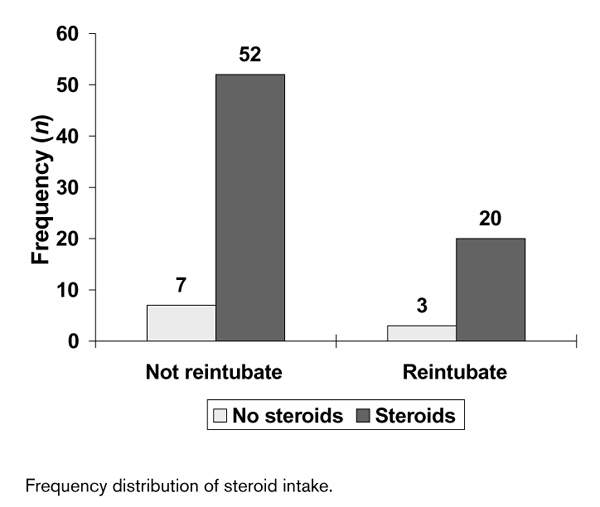
Method and results: The study was a retrospective analysis from January 1993 to December 1996. Eighty-two black children with LTB were mechanically ventilated in the intensive care unit (ICU). By univariate regression, the estimated B coefficients for variables such as age, pneumonia, days of intubation, arterial partial oxygen tension (PaO2) : fractional inspired oxygen (FIO2) ratio, atelectasis and antibiotic use were not statistically significant (P > 0.05) as predictors for reintubation. Using multiple regression (all independent variables in combination), none of the variables acted as predictors of reintubation (P = 0.25). Steroids were shown to have no effect alone or in association with other variables in altering reintubation rates. An increase in the days of intubation showed a tendency towards reintubation (P = 0.06) in the univariate analysis (odds ratio 1.00-1.14), but showed no statistically significant difference in multivariate analysis. Of the variables used as predictors of reintubation, none acted either as a preventive factor or as a risk factor.
Conclusion: The present results suggest that steroids should not be recommended at any stage in treatment of intubated patients with classic LTB. Prospective studies should evaluate the major risk factors for reintubation: duration of intubation, trauma to the airway at intubation and during ICU stay, and dose and timing of steroids. They should also evaluate whether upper airway disease is present alone or in association with lower airway disease.
Figures
References
-
- Dansky R, Buchanan N, Cane RD. The ICU treatment of acute laryngotracheobronchitis in a developing country. Intensive Care Med. 1978;4:51–53. - PubMed
-
- Cherry JD. The treatment of croup: continued controversy due to failure of recognition of historic, ecologic, etiologic and clinical perspectives. J Pediatr. 1979;94:352–354. - PubMed
-
- Freezer N, Butt W, Phelani P. Steroids in croup: do they increase the incidence of successful extubation? Anaesth Intensive Care . 1990;18:224–228. - PubMed
-
- Tunnessen WW, Feinstein AR. The steroid-croup controversy: an analytic review of methodologic problems. J Pediatr. 1980;96:751–756. - PubMed
-
- Tellez DW, Galvis AG, Storgion SA, Amer HN, Hoseyni M, Deakers TW. Dexamethasone in the prevention of postextubation stridor in children. J Pediatr. 1991;118:289–294. - PubMed
MeSH terms
Substances
LinkOut - more resources
Full Text Sources
Medical
