


Induction of cyclin E-cdk2 kinase activity, E2F-dependent transcription and cell growth by Myc are genetically separable events
- PMID: 11060032
- PMCID: PMC305784
- DOI: 10.1093/emboj/19.21.5813
Induction of cyclin E-cdk2 kinase activity, E2F-dependent transcription and cell growth by Myc are genetically separable events
Abstract
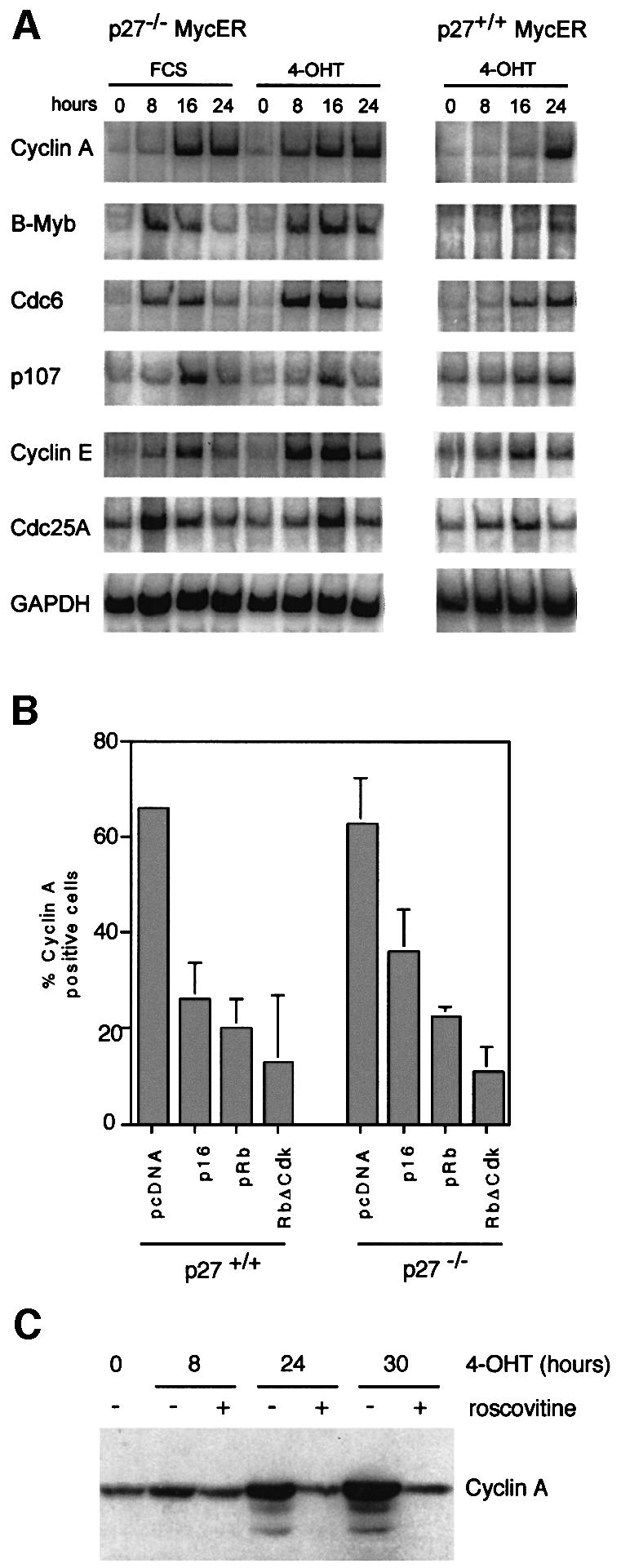
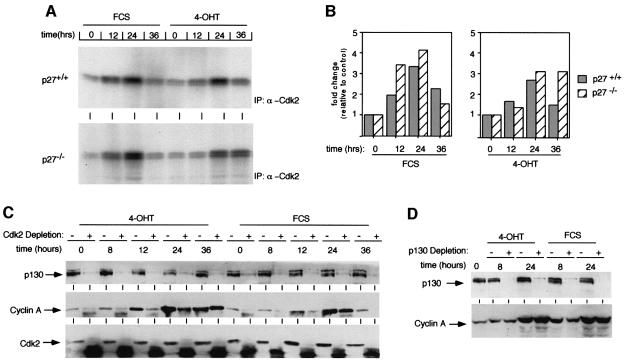
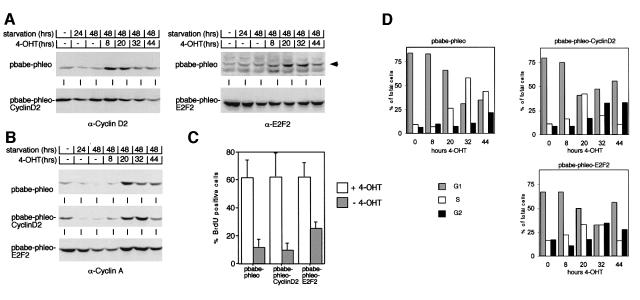
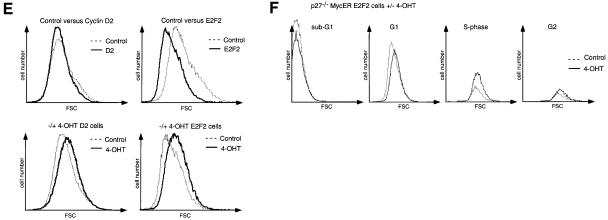
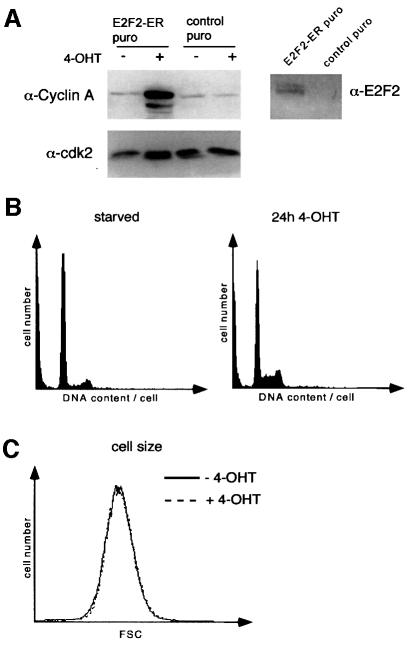
The c-myc gene has been implicated in three distinct genetic programs regulating cell proliferation: control of cyclin E-cdk2 kinase activity, E2F-dependent transcription and cell growth. We have now used p27(-/-) fibroblasts to dissect these downstream signalling pathways. In these cells, activation of Myc stimulates transcription of E2F target genes, S-phase entry and cell growth without affecting cyclin E-cdk2 kinase activity. Both cyclin D2 and E2F2, potential direct target genes of Myc, are induced in p27(-/-) MycER cells. Ectopic expression of E2F2, but not of cyclin D2, induces S-phase entry, but, in contrast to Myc, does not stimulate cell growth. Our results show that stimulation of cyclin E-cdk2 kinase, of E2F-dependent transcription and of cell growth by Myc can be genetically separated from each other.
Figures
References
-
- Alessi F., Quarta,S., Savio,M., Riva,F., Rossi,L., Stivala,L.A., Scovassi,A.I., Meijer,L. and Prosperi,E. (1998) The cyclin-dependent kinase inhibitors olomoucine and roscovitine arrest human fibroblasts in G1 phase by specific inhibition of CDK2 kinase activity. Exp. Cell Res., 245, 8–18. - PubMed
-
- Amati B., Alevizopoulos,K. and Vlach,J. (1998) Myc and the cell cycle. Front. Biosci., 15, D250–D268. - PubMed
-
- Berns K., Hijmans,E.M. and Bernards,R. (1997) Repression of c-Myc responsive genes in cycling cells causes G1 arrest through reduction of cyclin E/CDK2 kinase activity. Oncogene, 15, 1347–1356. - PubMed
Publication types
MeSH terms
Substances
LinkOut - more resources
Full Text Sources
