. 2000 Oct 30;151(3):731-8.
doi: 10.1083/jcb.151.3.731.

Recycling of the yeast a-factor receptor

Affiliations

Recycling of the yeast a-factor receptor

L Chen et al. J Cell Biol. .

Abstract

The yeast a-factor receptor (Ste3p) is subject to two mechanistically distinct modes of endocytosis: a constitutive, ligand-independent pathway and a ligand-dependent uptake pathway. Whereas the constitutive pathway leads to degradation of the receptor in the vacuole, the present work finds that receptor internalized via the ligand-dependent pathway recycles. With the a-factor ligand continuously present in the culture medium, trafficking of the receptor achieves an equilibrium in which continuing uptake to endosomal compartments is balanced by its recycling return to the plasma membrane. Withdrawal of ligand from the medium leads to a net return of the internalized receptor back to the plasma membrane. Although recycling is demonstrated for receptors that lack the signal for constitutive endocytosis, evidence is provided indicating a participation of recycling in wild-type Ste3p trafficking as well: a-factor treatment both slows wild-type receptor turnover and results in receptor redistribution to intracellular endosomal compartments. Apparently, a-factor acts as a switch, diverting receptor from vacuole-directed endocytosis and degradation, to recycling. A model is presented for how the two Ste3p endocytic modes may collaborate to generate the polarized receptor distribution characteristic of mating cells.


Figures

Figure 1
Figure 1
Ligand-dependent endocytosis of Ste3Δ365p. 30 min after a 90-min period of galactose-induced receptor expression, cultures of GAL1-STE3Δ365 MATα cells were treated with a-factor and receptor internalization (B) or turnover (C) were monitored. (A) Ste3p schematic showing positions (indicated by amino acid residue numbers) within the receptor CTD of the PEST-like signal for constitutive endocytosis (the three redundant lysyl acceptor sites for ubiquitin attachment are indicated with K) and the NPFSTD sequence required for ligand-dependent uptake. Residues removed by the Δ365 mutation are indicated above. (B) Ligand-induced internalization of Ste3Δ365p. To eliminate the vacuolar turnover of the receptor that accompanies endocytosis, the pep4Δ prb1Δ NDY1027 strain was used. At the times indicated after the addition of a-factor, aliquots were removed from culture and the intact cells were treated with proteases (+) or were mock-treated (−) in parallel (see Materials and Methods). Extracts prepared from these cells were subjected to SDS-PAGE and Western blot analysis with Ste3p-specific antibodies. (C) Ligand-induced turnover of Ste3Δ365p. Cultures of strain NDY349, isogenic to NDY1027 except for being PEP4 + and PRB1 + were treated with a-factor or were mock treated in parallel. Extracts were prepared from culture aliquots at the indicated times after a-factor addition, and were then subjected to SDS-PAGE and Western blot analysis as described for B. (D) Rates of Ste3Δ365p internalization and turnover. Receptor abundunce was quantitated for the samples of the B and C experiments (Materials and Methods) and percent internalization and percent turnover are reported at each timepoint.
Figure 2
Figure 2
Internalized Δ365 receptor localizes to intracellular endosomal compartments. Cells of the MATα GAL1-STE3Δ365(3xHA) strain NDY1181 were cultured and treated with a-factor as described for Fig. 1. Culture aliquots were removed for indirect immunofluorescence analysis just before the addition of a-factor and 45 min after a-factor addition. In addition, as control for the specificity of the HA.11 mAb an aliquot of a culture of the MATα ste3Δ::LEU2 strain NDY343 was processed in parallel (no HA). Cells were fixed and processed for indirect immunofluorescence analysis as described (Materials and Methods). The top row shows the fluorescent signal (red) that corresponds to HA-tagged Δ365 receptor. In addition to showing the receptor signal (red) from the same cells, the middle panel also shows the fluorescent signal (green) deriving from detection of the vacuolar membrane protein alkaline phosphatase. In the bottom row, displaying Nomarski images of the same cells, the vacuole appears as an apparent depression in the cell surface.
Figure 3
Figure 3
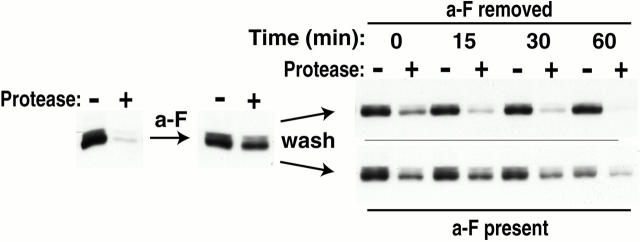
Internalized Δ365 receptor returns to the cell surface after removal of a-factor ligand from the culture medium. Cells of the MATα GAL1-STE3Δ365 strain NDY349 were cultured and treated for 45 min with a-factor as described for Fig. 1. After the a-factor treatment, cells were washed and resuspended in fresh medium, either lacking or containing a-factor (see Materials and Methods). Culture aliquots were removed before the initial treatment with a-factor, after the a-factor treatment, and at the indicated times after the restoration of the cells to culture, either in the presence or absence of a-factor. To assess the surface localization of the receptor at these timepoints, intact cells were treated with extracellular proteases and extracts were prepared as described (Materials and Methods). Finally, extracts were subjected to SDS-PAGE and Western analysis with Ste3p-specific antibodies.
Figure 5
Figure 5
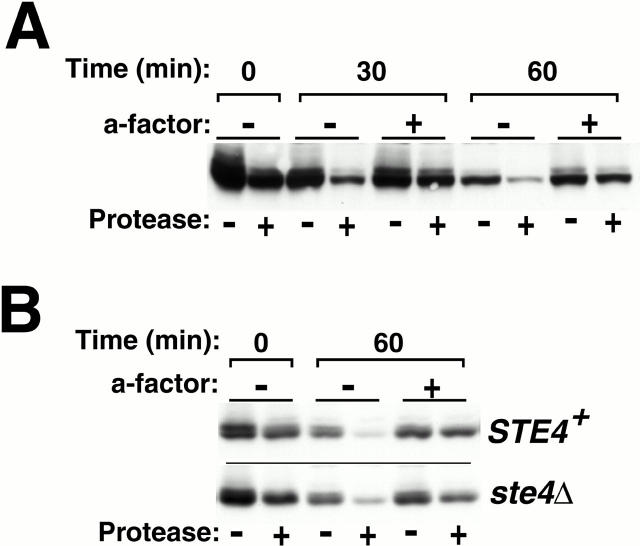
a-factor produces effects on wild-type Ste3p consistent with induced recycling. After a 90-min period of galactose-induced receptor expression, cultures of GAL1-STE3 MATα cells were treated with glucose (3%) to repress further synthesis and simultaneously treated either with a-factor, or mock-treated in parallel. At the indicated times thereafter, aliquots removed from the culture at the indicated times were subjected to the intact cell protease-shaving protocol (see Materials and Methods). Finally, protein extracts were subjected to SDS-PAGE and then Western analysis with Ste3p-specific antibodies. (A) Effects of a-factor on Ste3p turnover and distribution. Cells of the wild-type GAL1-STE3 MATα strain NDY341 were treated as described above. (B) The effects of a-factor on Ste3p turnover and distribution are not secondary to induced pheromone signaling. Wild-type (NDY341) and ste4Δ (NDY1206) cells were treated as described above.
Figure 4
Figure 4
Cell surface return of internalized Δ365 and 3K→R receptors. (A) Energy-dependent recycling of Ste3Δ365p. MATα GAL1-STE3Δ365 cells of strain NDY349 were cultured and treated with a-factor as described for Fig. 1. After the 45-min a-factor treatment, cells were collected and the intact cells were preparatively digested with extracellular proteases in the presence of energy poisons (10 mM sodium azide and 10 mM potassium fluoride). The shaved cells were then collected by centrifugation and restored to culture in fresh medium either lacking or containing the energy poisons. Culture aliquots were removed either before the initial treatment with a-factor, after the a-factor treatment, and at the indicated times after the restoration of the shaved cells to culture. Surface localization of the receptor at these timepoints was assessed via the intact cell proteolysis protocol (Materials and Methods). Finally, extracts were subjected to SDS-PAGE and Western analysis with Ste3p-specific antibodies. (B) Energy-dependent recycling of Ste3(3K→R)p. Cells of the MATα GAL1-STE3(3KR) strain NDY841were cultured, treated with a-factor, and processed as described for A.

References

    1. Bonifacino J.S., Weissman A.M. Ubiquitin and the control of protein fate in the secretory and endocytic pathways. Annu. Rev. Cell Dev. Biol. 1998;14:19–57. - PMC - PubMed
    1. Brizzio V., Gammie A.E., Nijbroek G., Michaelis S., Rose M.D. Cell fusion during yeast mating requires high levels of a-factor mating pheromone. J. Cell Biol. 1996;135:1727–1739. - PMC - PubMed
    1. Chuang J.S., Schekman R.W. Differential trafficking and timed localization of two chitin synthase proteins, Chs2p and Chs3p. J. Cell Biol. 1996;135:597–610. - PMC - PubMed
    1. Ciechanover A., Schwartz A.L., Lodish H.F. Sorting and recycling of cell surface receptors and endocytosed ligandsthe asialoglycoprotein and transferrin receptors. J. Cell Biochem. 1983;23:107–130. - PubMed
    1. Davis N.G., Horecka J.L., Sprague G.F., Jr. Cis- and trans-acting functions required for endocytosis of the yeast pheromone receptors. J. Cell Biol. 1993;122:53–65. - PMC - PubMed

Publication types

MeSH terms