. 2000 Nov 21;97(24):13239-44.
doi: 10.1073/pnas.230438397.

Y chromosomal fertility factors kl-2 and kl-3 of Drosophila melanogaster encode dynein heavy chain polypeptides

Affiliations

Y chromosomal fertility factors kl-2 and kl-3 of Drosophila melanogaster encode dynein heavy chain polypeptides

A B Carvalho et al. Proc Natl Acad Sci U S A. .

Abstract

The molecular identity and function of the Drosophila melanogaster Y-linked fertility factors have long eluded researchers. Although the D. melanogaster genome sequence was recently completed, the fertility factors still were not identified, in part because of low cloning efficiency of heterochromatic Y sequences. Here we report a method for iterative blast searching to assemble heterochromatic genes from shotgun assemblies, and we successfully identify kl-2 and kl-3 as 1beta- and gamma-dynein heavy chains, respectively. Our conclusions are supported by formal genetics with X-Y translocation lines. Reverse transcription-PCR was successful in linking together unmapped sequence fragments from the whole-genome shotgun assembly, although some sequences were missing altogether from the shotgun effort and had to be generated de novo. We also found a previously undescribed Y gene, polycystine-related (PRY). The closest paralogs of kl-2, kl-3, and PRY (and also of kl-5) are autosomal and not X-linked, suggesting that the evolution of the Drosophila Y chromosome has been driven by an accumulation of male-related genes arising de novo from the autosomes.


Figures

Figure 1
Figure 1
Appearance of the results of a blastn search with the D. melanogaster kl-5 cDNA sequence (AF210453) as a query against the unmapped portion of the Drosophila whole genome sequence (armU). Note the staggered appearance of the hits. The numbers above the bars are the abridged accession numbers of the unmapped scaffolds (AE002627 was abridged to 2627 and so on).
Figure 2
Figure 2
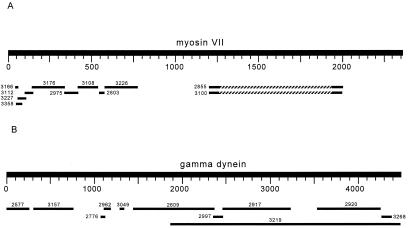
(A) tblastn search of D. discoideum myosin VII (AAF06035) against armU. As was the case for kl-5, this search yielded a staggered pattern. PCR with primers designed from several of these fragments showed that they are not male-specific, and are thus not Y-linked. This finding implies that autosomal heterochromatic genes also show a staggered pattern in such a blast search. Hatched segments represent intervening regions of no alignment. The amino acid sequence of this putative gene is different from the previously identified myosin VII homolog crinkled (AAF44915). (B) A tblastn search with the C. reinhardtii γ-dynein (Q39575) against the armU database reveals a large number of fragments, many of which were shown by PCR to be male-specific. From this pattern, scaffold-specific PCRs were done on DNA from Y deficiency males to associate genomic fragments with fertility factor regions. RT-PCR was then done to fill the sequence gaps.
Figure 3
Figure 3
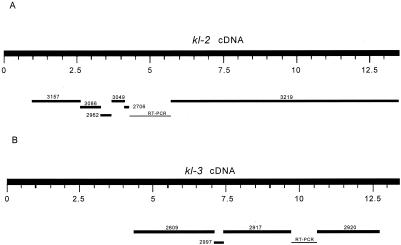
Assembly of the kl-2 and kl-3 dyneins. Some additional scaffolds were found in armU by blasting partial sequence of the RT-PCR products against armU once again. The fragments in kl-2 and kl-3 labeled RT-PCR had no armU match and were sequenced de novo. We recovered 93% of kl-2 and 63% of kl-3 (the N terminus of kl-2 and the N and C termini of kl-3 are still missing), assuming that these genes have the typical size of dynein heavy chains (≈4,500 amino acids; ≈13,500-bp mRNA). Only one of the coding regions was previously identified (CG17629 in the AE002917 scaffold).
Figure 4
Figure 4
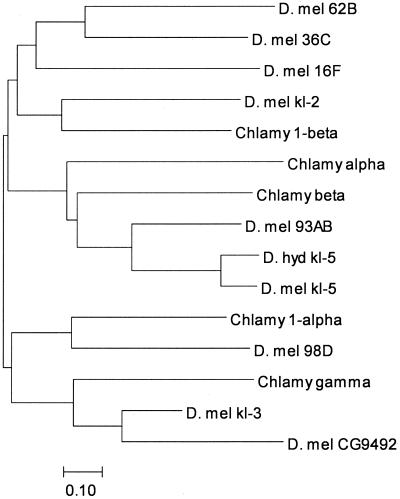
Dynein neighbor-joining tree. Inferred amino acid sequences were aligned with clustalw (33), and the MEGA2 package (34) was used to construct this neighbor-joining tree. The clustering of kl-3 with Chlamydomonas γ-dynein and the autosomal paralog CG9492 is clear, as is the clustering of kl-5 with Chlamydomonas β-dynein. The autosomal paralog Dhc 93AB. kl-2 clusters with the Chlamydomonas inner arm dynein 1β. Because of its short length, CG9068 (the autosomal paralog of kl-2) could not be included in the phylogeny, but both proteins are closely related, having an amino acid identity of 53%. Accession numbers: kl-5, AAF21041; D. hydei kl-5, AAC35745; Dhc93AB, AAF55834; Dhc16F, AAF48792; Dhc62B, AAF47564; Dhc98D, AAF56793; CG9492, AAF54422; CG9068, AAF58022; Dhc36C, AAF53626; Chlamydomonas β, T08030; Chlamydomonas γ, T08044; Chlamydomonas α, AAA57316; Chlamydomonas 1a, CAB56598; Chlamydomonas 1β, CAB99316. The bar indicates the number of amino acids substitutions per site. D. mel, D. melanogaster; Chlamy, Chlamydomonas; D. hyd, D. hydei.

References

    1. Morgan T H. Science. 1910;32:120–122. - PubMed
    1. Stern C. Z Indukt Abstamm Vererbungsl. 1929;51:253–353.
    1. Brosseau G E. Genetics. 1960;45:257–274. - PMC - PubMed
    1. Kennison J A. Genetics. 1981;98:529–548. - PMC - PubMed
    1. Hardy R W, Tokuyasu K T, Lindsley D L. Chromosoma. 1981;83:593–617. - PubMed

Publication types

LinkOut - more resources