


Disruption of virion host shutoff activity improves the immunogenicity and protective capacity of a replication-incompetent herpes simplex virus type 1 vaccine strain
- PMID: 11070010
- PMCID: PMC113198
- DOI: 10.1128/jvi.74.23.11137-11144.2000
Disruption of virion host shutoff activity improves the immunogenicity and protective capacity of a replication-incompetent herpes simplex virus type 1 vaccine strain
Abstract
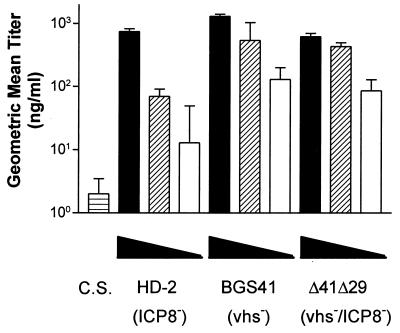
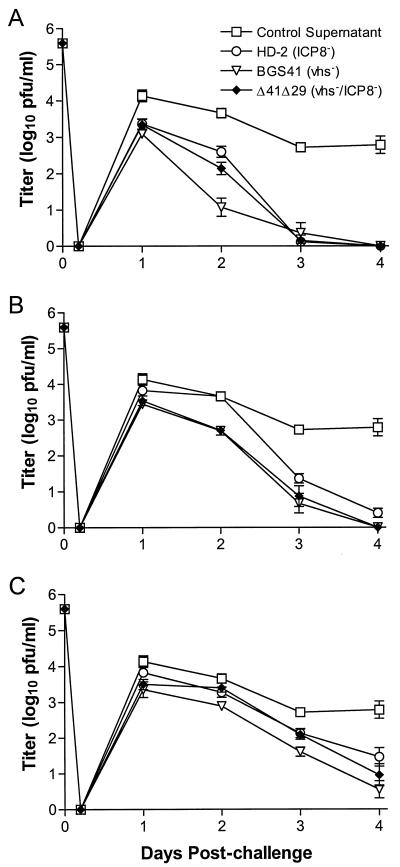
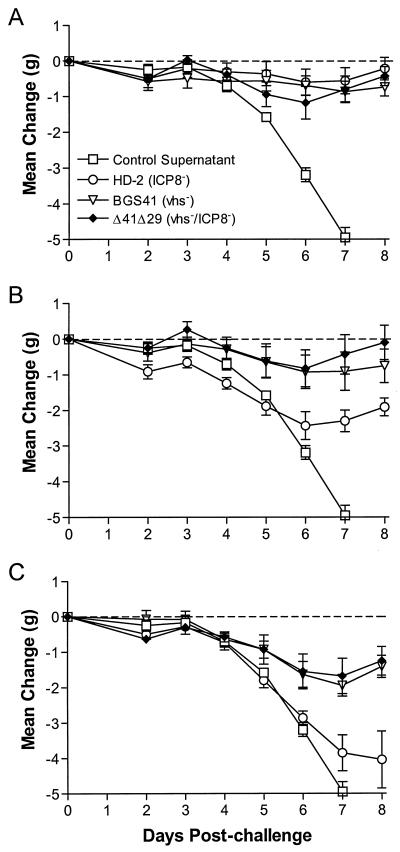
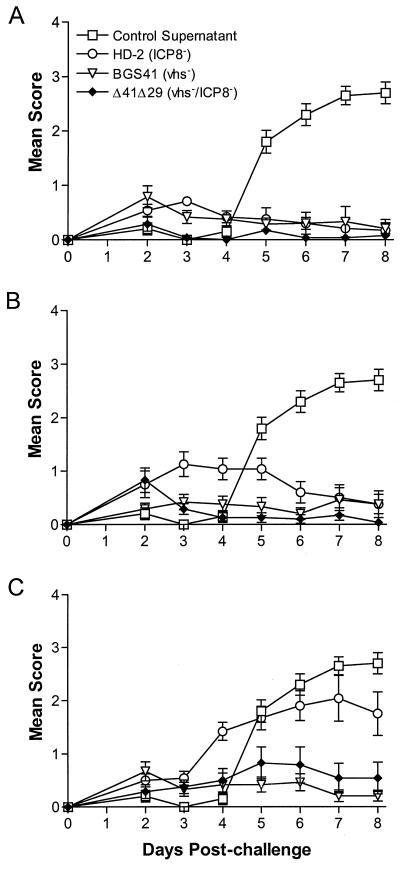
The virion host shutoff (vhs) protein encoded by herpes simplex virus type 1 (HSV-1) destabilizes both viral and host mRNAs. An HSV-1 strain with a mutation in vhs is attenuated in virulence and induces immune responses in mice that are protective against corneal infection with virulent HSV-1, but it has the capacity to establish latency. Similarly, a replication-incompetent HSV-1 strain with a mutation in ICP8 elicits an immune response protective against corneal challenge, but it may be limited in viral antigen production. We hypothesized therefore that inactivation of vhs in an ICP8(-) virus would yield a replication-incompetent mutant with enhanced immunogenicity and protective capacity. In this study, a vhs(-)/ICP8(-) HSV-1 mutant was engineered. BALB/c mice were immunized with incremental doses of the vhs(-)/ICP8(-) double mutant or vhs(-) or ICP8(-) single mutants, or the mice were mock immunized, and protective immunity against corneal challenge with virulent HSV-1 was assessed. Mice immunized with the vhs(-)/ICP8(-) mutant showed prechallenge serum immunoglobulin G titers comparable to those immunized with replication-competent vhs(-) virus and exceed those of mice immunized with the ICP8(-) single mutant. Following corneal challenge, the degrees of protection against ocular disease, weight loss, encephalitis, and establishment of latency were similar for vhs(-)/ICP8(-) and vhs(-) virus-vaccinated mice. Moreover, the double deleted vhs(-)/ICP8(-) virus protected mice better in all respects than the single deleted ICP8(-) mutant virus. The data indicate that inactivation of vhs in a replication-incompetent virus significantly enhances its protective efficacy while retaining its safety for potential human vaccination. Possible mechanisms of enhanced immunogenicity are discussed.
Figures
References
-
- Anonymous. Guide for the care and use of laboratory animals. DHHS publication 85-23 (NIH). Bethesda, Md: Committee on Care and Use of Laboratory Animals, National Institutes of Health; 1985.
-
- Brandt C R. Susceptibility of +/+ +/nu and nu/nu BALB/c mice to ocular herpes simplex virus infection. Ophthalmic Res. 1992;24:332–337. - PubMed
-
- Brubaker J O, Thompson C M, Morrison L A, Knipe D M, Siber G R, Finberg R W. Induction of Th1-associated immune responses to beta-galactosidase expressed by a replication-defective mutant of herpes simplex virus 1. J Immunol. 1996;157:1598–1604. - PubMed
-
- Coen D M, Irmiere A F, Jacobson J G, Kerns K M. Low levels of herpes simplex virus thymidine-thymidylate kinase are not limiting for sensitivity to certain antiviral drugs or for latency in a mouse model. Virology. 1989;168:221–231. - PubMed
Publication types
MeSH terms
Substances
Grants and funding
LinkOut - more resources
Full Text Sources
Other Literature Sources
