. 2000 Dec;74(23):11201-9.
doi: 10.1128/jvi.74.23.11201-11209.2000.

Efficient and specific initiation of subgenomic RNA synthesis by cucumber mosaic virus replicase in vitro requires an upstream RNA stem-loop

Affiliations

Efficient and specific initiation of subgenomic RNA synthesis by cucumber mosaic virus replicase in vitro requires an upstream RNA stem-loop

M H Chen et al. J Virol. 2000 Dec.

Abstract

We defined the minimal core promoter sequences responsible for efficient and accurate initiation of cucumber mosaic virus (CMV) subgenomic RNA4. The necessary sequence maps to positions -28 to +15 relative to the initiation cytidylate used to initiate RNA synthesis in vivo. Positions -28 to -5 contain a 9-bp stem and a 6-nucleotide purine-rich loop. Considerable changes in the stem and the loop are tolerated for RNA synthesis, including replacement with a different stem-loop. In a template competition assay, the stem-loop and the initiation cytidylate are sufficient to interact with the CMV replicase. Thus, the mechanism of core promoter recognition by the CMV replicase appears to be less specific in comparison to the minimal subgenomic core promoter of the closely related brome mosaic virus.


Figures
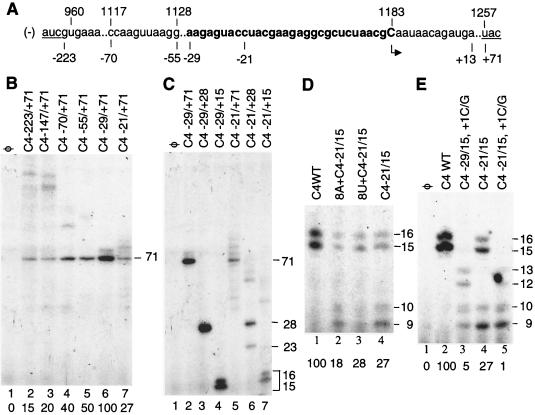
FIG. 1
FIG. 1
Sequences required to direct the initiation of CMV subgenomic RNA synthesis. (A) Partial sequence containing the complement to the intercistronic region of minus-strand CMV RNA3. Numbers correspond to the nucleotide positions of CMV strain Fny RNA3. The underlined sequences at the left and right correspond to the complement of the termination and initiation codons of the CMV 3a and capsid proteins, respectively. The sequence in bold contains the 29 nt 3′ of the initiation cytidylate. The sequence between positions 1117 and 1128 corresponds to the complement of the B-box sequence, a motif demonstrated to be important in BMV RNA replication (9, 23). The arrow identifies the initiation cytidylate for the initiation of CMV subgenomic RNA synthesis used in vivo (4). (B) Effects of deletion of the sequence 3′ of the initiation cytidylate. Proscripts used in the reactions are indicated at the top. “φ” indicates that no template was in the reaction. The expected 71-nt product is denoted to the right of the autoradiograph from a 7 M urea–10% polyacrylamide gel. (C) Effects of deletion of the sequence 5′ of the initiation cytidylate. Since the deletions decrease the template lengths, the products of RNA synthesis are of different lengths. The gel was of two densities; the bottom portion contained 20% acrylamide, and the top contained 10% acrylamide. The border of the two gel densities lies slightly above the 71-nt band. (D) Examination of the length 3′ of the initiation cytidylate required for accurate and efficient RNA synthesis in a 7 M urea–20% polyacrylamide gel. The expected products should be 15- and 16-nt. The 9- and 10-nt products were incorrectly initiated. (E) The +1C used in the initiation of RNA synthesis, and the effects of the 3′ sequence.
FIG. 2
FIG. 2
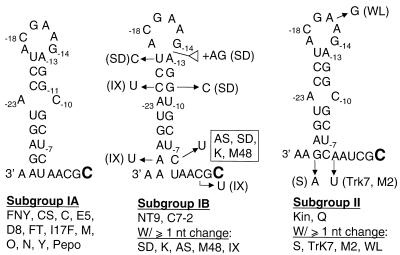
Comparison of predicted RNA secondary structures for the sequence 3′ of the initiation cytidylate in three CMV subgroups. The initiation cytidylate used in vivo in strains Fny (subgroup I) and Kin (subgroup II) and the corresponding cytidylates in other CMV strains are in bold letters (4, 22). The CMV isolates used to generate the prototype structure are indicated directly under the viral subgroups, and strains that vary from the prototype are listed under the heading “W/≥ 1 nt change.” Nucleotides that diverged from the prototype in each subgroup are indicated with an arrow. The white triangle in the middle structure denotes the insertion of two nucleotides in strain SD.
FIG. 3
FIG. 3
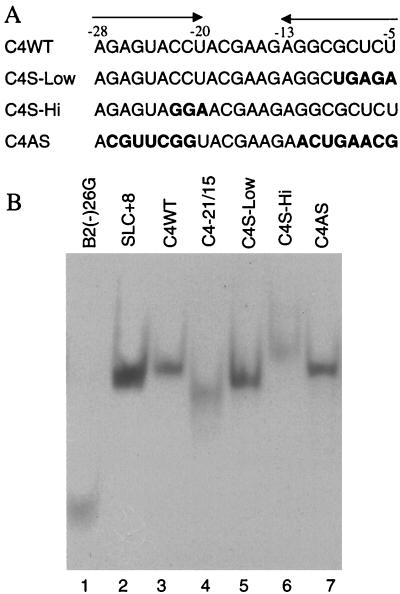
Analysis of RNA structure using native gel electrophoresis. (A) Sequences of the RNAs tested. Each of the RNAs tested is 44 nt in length, spanning from positions −29 to +15. However, only the portions relevant to formation of the stem-loop are shown, with the nucleotides that form the stem indicated by arrows. Nucleotide changes that affect the stem are shown in bold letters. C4AS contains a sequence from the stem of the BMV SLC, whose structure has been solved by nuclear magnetic resonance spectroscopy (Kim and Kao, submitted). (B) RNAs stained with toluidine blue after PAGE in a 10% nondenaturing gel. B2(−)26G is a 27-nt RNA whose secondary structure was reported by Sivakumaran et al. (30). SLC+8 is a 45-nt RNA whose structure was reported by Kim and Kao (submitted).
FIG. 4
FIG. 4
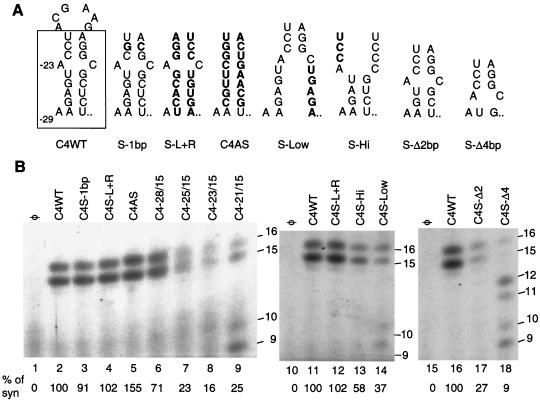
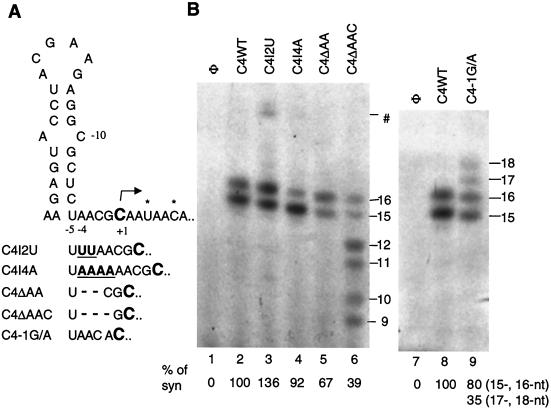
Effects of changes in the stem in the CMV subgenomic core promoter on the level and accuracy of RNA synthesis. (A) Summary of most of the RNA constructs tested for the ability to direct RNA synthesis. Nucleotides changed from the prototype C4WT are indicated in bold letters. The predicted RNA secondary structures that resulted from the changes are also shown. (B) Autoradiograph of the results from RNA synthesis assays from several proscripts. The proscripts tested are indicated above the lanes, and sizes of the products are indicated in nucleotides at the left. “% of syn” indicates the percentage of the CMV replicase products made from the specified template relative to C4WT tested in the same set of reactions; “φ” indicates that no template was added to the reaction. A 7 M urea–20% polyacrylamide gel was used for analysis of the 15- and 16-nt products shown in this and subsequent figures.
FIG. 5
FIG. 5
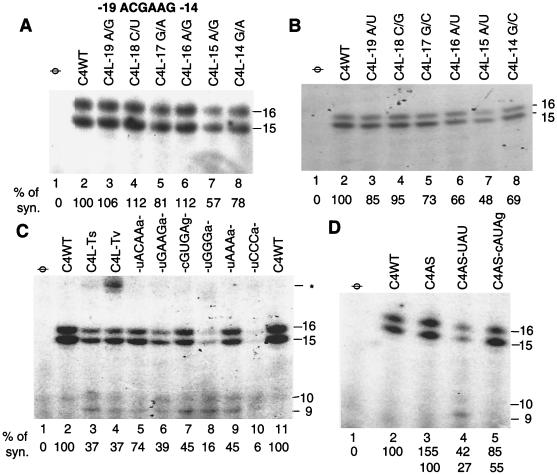
Effects of changes in the hexanucleotide loop within the CMV core promoter. (A) Effects of single-base W-C transversions of the six loop nucleotides. The sequence of the wild-type loop from positions −19 to −14 is in bold. The constructs used are named so as to indicate the identity of the original base before the slash and the nucleotide of the substitution after the slash. Positions of the 15- and 16-nt replicase products are shown at the right. “% of syn” indicates the percentage of the CMV replicase products made from the specified template relative to C4WT tested in the same set of reactions; “φ” indicates that no template was added to the RNA synthesis reaction. (B) Effects of single-base W-C transversions of the six loop nucleotides. (C) Effects of multiple nucleotide substitutions and deletions in the loop. C4-Ts has all of the loop nucleotides changed to 3′ GUAGGA 5′; C4-Tv has all of the loop nucleotides changed to 3′ UGUUUC 5′. Changes in the other constructs are indicated according to the final sequence of the loop. The putative closing base pairs are in lowercase letters. Products of the RNA synthesis reaction are indicated at the left. The asterisk denotes a misinitiation product of ca. 25 nt. (D) Effects of changes in both the stem and the loop nucleotides. C4AS contains an alternative stem sequence shown in Fig. 4. The nucleotides in the loop are identified in the names of the proscripts. Where changed, the identities of the closing nucleotides are indicated in lowercase letters.
FIG. 6
FIG. 6
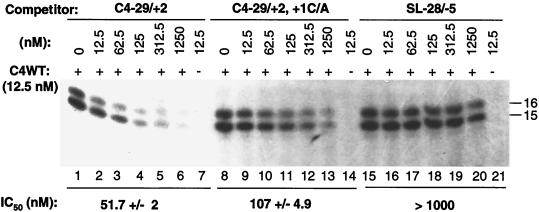
Minimal proscript sequence required to interact with the CMV replicase, as identified by a template competition assay. The reaction measures the synthesis from C4WT as affected by the three competitor RNAs listed at the top. The IC50s were calculated from three independent experiments, and 1 standard deviation from the mean is listed after the mean. For SL-28/+5, reduction of synthesis to 50% was never obtained in three independent experiments.
FIG. 7
FIG. 7
Effects of changing the spacing between the stem-loop and the initiation cytidylate. (A) Schematic of the region affected by insertions and deletions. The initiation cytidylate is in bold and a larger font. Asterisks identify potential alternative initiation sites. Underlined bold letters indicate insertions; nucleotides deleted are indicated by dashes. (B) RNA synthesis from the mutant proscripts identified in panel A. Sizes of the initiation products are indicated in nucleotides at the right. The symbol ⋕ identifies a longer product in the reaction with C4I2U.

References

    1. Adkins S, Siegel R, Sun J H, Kao C C. Minimal templates directing accurate initiation of subgenomic RNA synthesis in vitro by the brome mosaic virus RNA-dependent RNA polymerase. RNA. 1997;3:634–647. - PMC - PubMed
    1. Adkins S, Stawicki S S, Faurote G, Siegel R, Kao C C. Mechanistic analysis of RNA synthesis by RNA-dependent RNA polymerase from two promoters reveals similarities to DNA-dependent RNA polymerase. RNA. 1998;4:455–470. - PMC - PubMed
    1. Adkins S, Kao C C. Subgenomic RNA promoters dictate the mode of recognition by bromoviral RNA-dependent RNA polymerases. Virology. 1998;252:1–8. - PubMed
    1. Boccard F, Baulcombe D. Mutational analysis of cis-acting sequences and gene function in RNA3 of cucumber mosaic virus. Virology. 1993;193:563–578. - PubMed
    1. Buck K W. Comparison of the replication of positive-strand RNA viruses of plants and animals. Adv Virus Res. 1996;47:159–251. - PMC - PubMed

Publication types

LinkOut - more resources