. 2000 Nov 15;28(22):E97.
doi: 10.1093/nar/28.22.e97.

A rapid method for efficient gene replacement in the filamentous fungus Aspergillus nidulans

Affiliations

A rapid method for efficient gene replacement in the filamentous fungus Aspergillus nidulans

M K Chaveroche et al. Nucleic Acids Res. .

Abstract

The construction of mutant fungal strains is often limited by the poor efficiency of homologous recombination in these organisms. Higher recombination efficiencies can be obtained by increasing the length of homologous DNA flanking the transformation marker, although this is a tedious process when standard molecular biology techniques are used for the construction of gene replacement cassettes. Here, we present a two-step technology which takes advantage of an Escherichia coli strain expressing the phage lambda Red(gam, bet, exo) functions and involves (i) the construction in this strain of a recombinant cosmid by in vivo recombination between a cosmid carrying a genomic region of interest and a PCR-generated transformation marker flanked by 50 bp regions of homology with the target DNA and (ii) genetic exchange in the fungus itself between the chromosomal locus and the circular or linearized recombinant cosmid. This strategy enables the rapid establishment of mutant strains carrying gene knock-outs with efficiencies >50%. It should also be appropriate for the construction of fungal strains with gene fusions or promoter replacements.


Figures
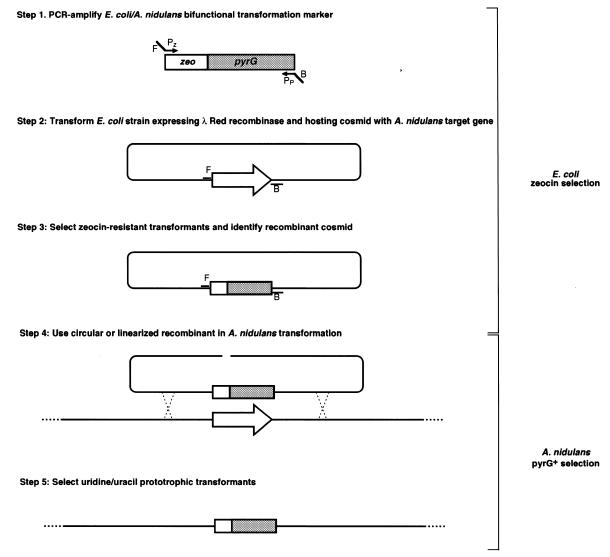
Figure 1
Figure 1
A two-step methodology for allelic exchange in A.nidulans. F and B refer to the homology extensions corresponding to regions flanking the target gene (open arrow). PZ and PP refer to priming sites on the bi-functional zeo/pyrG transformation marker.
Figure 2
Figure 2
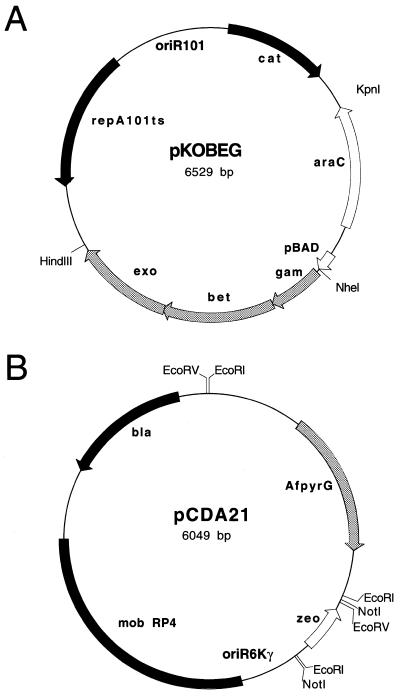
Maps of recombination plasmid pKOBEG (A) and plasmid pCDA21 (B) carrying the zeo/pyrG bi-functional transformation marker.
Figure 3
Figure 3
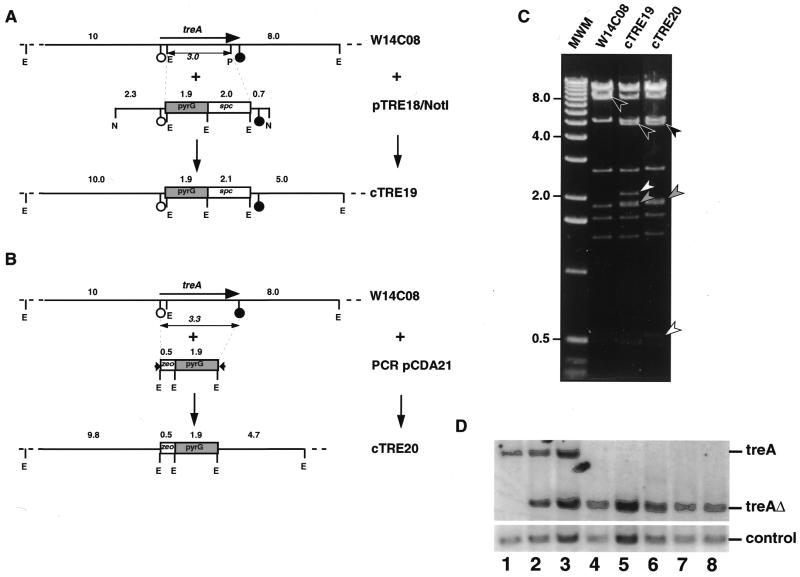
Allelic exchange on cosmid W14C08. (A and B) Replacement using a 7.0 kb NotI fragment derived from pTRE18, yielding cosmid cTRE19 (A) or PCR-amplified pCDA21, yielding cosmid cTRE20 (B). Solid line, A.nidulans DNA; open box, spectinomycin-resistance gene (A) or zeocin-resistance gene (B); gray box, A.fumigatus pyrG gene; E, EcoRI; P, PmlI; N, NotI; arrow, A.nidulans treA coding region; open circle, treA start codon; solid circle, treA stop codon; double-arrow, deletion in the treA coding region resulting from the allelic exchange; arrowheads, 50 bp homology extensions present in the composite primers used to amplify the zeo/pyrG bi-functional transformation marker. The size of the EcoRI restriction fragments in the cosmids, pTRE18/NotI fragment and PCR product are indicated in kb. (C) Ethidium bromide-stained gel of EcoRI-digested W14C08, cTRE19 and cTRE20. The 8.0 kb fragment of W14C08 and the resulting 5.0 and 4.7 kb fragments in cTRE19 and cTRE20, respectively, are indicated by solid arrowheads. The 2.1 and 0.5 kb fragments corresponding to the spc (cTRE19) and zeo (cTRE20) genes, respectively, are indicated by open arrowheads. The 1.9 kb fragment corresponding to the A.fumigatus pyrG gene is indicated by a grey arrowhead. MWM, molecular weight markers, 1 kb ladder (Gibco BRL). Representative molecular weights are indicated in kb. (D) Southern hybridization of EcoRI-digested genomic DNA of A.nidulans FGSC773 (wild-type, lane 1) and of seven transformants: two treA+ transformants with ectopic integrations of pTRE20 (lanes 2 and 3) and five treA transformants with an appropriate gene replacement at the treA locus (lanes 4–8). Genomic DNA was transferred onto nylon membranes and probed for treA (top) or a control single-copy gene (bottom). An 8.0 kb fragment is detected when treA is intact while a 4.7 kb fragment is detected when the treAΔ::(zeo/pyrG) allele is present. Similar intensities of the hybridization signals obtained using the treA and control probes demonstrates that the treAΔ::(zeo/pyrG) allele is present in a single copy.

References

    1. van den Hondel C.A.M.J.J. and Punt,P.J. (1991) In Peberdy,J.F., Caten,C.E., Ogden,J.E. and Bennett,J.W. (eds), Applied Molecular Genetics of Fungi. Cambridge University Press, Cambridge, UK, pp. 1–28.
    1. d’Enfert C., Weidner,G. and Brakhage,A.A. (1999) In Brakhage,A.A., Jahn,B. and Schmidt,A. (eds), Aspergillus fumigatus: Biology, Clinics and Molecular Approaches to Pathogenicity. S. Karger AG, Basel, Switzerland, Vol. 2, pp. 149–166.
    1. Murphy K.C. (1998) J. Bacteriol., 180, 2063–2071. - PMC - PubMed
    1. Zhang Y., Buchholz,F., Muyrers,J.P.P. and Stewart,A.F. (1998) Nature Genet., 20, 123–128. - PubMed
    1. Muyrers J.P.P., Zhang,Y., Testa,G. and Stewart,A.F. (1999) Nucleic Acids Res., 27, 1555–1557. - PMC - PubMed