. 2000 Dec;182(23):6614-21.
doi: 10.1128/JB.182.23.6614-6621.2000.

Developmental aggregation of Myxococcus xanthus requires frgA, an frz-related gene

Affiliations

Developmental aggregation of Myxococcus xanthus requires frgA, an frz-related gene

K Cho et al. J Bacteriol. 2000 Dec.

Abstract

Myxococcus xanthus is a gram-negative bacterium which has a complex life cycle that includes multicellular fruiting body formation. Frizzy mutants are characterized by the formation of tangled filaments instead of hemispherical fruiting bodies on fruiting agar. Mutations in the frz genes have been shown to cause defects in directed motility, which is essential for both vegetative swarming and fruiting body formation. In this paper, we report the discovery of a new gene, called frgA (for frz-related gene), which confers a subset of the frizzy phenotype when mutated. The frgA null mutant showed reduced swarming and the formation of frizzy aggregates on fruiting agar. However, this mutant still displayed directed motility in a spatial chemotaxis assay, whereas the majority of frz mutants fail to show directed movements in this assay. Furthermore, the frizzy phenotype of the frgA mutant could be complemented extracellularly by wild-type cells or strains carrying non-frz mutations. The phenotype of the frgA mutant is similar to that of the abcA mutant and suggests that both of these mutants could be defective in the production or export of extracellular signals required for fruiting body formation rather than in the sensing of such extracellular signals. The frgA gene encodes a large protein of 883 amino acids which lacks homologues in the databases. The frgA gene is part of an operon which includes two additional genes, frgB and frgC. The frgB gene encodes a putative histidine protein kinase, and the frgC gene encodes a putative response regulator. The frgB and frgC null mutants, however, formed wild-type fruiting bodies.


Figures
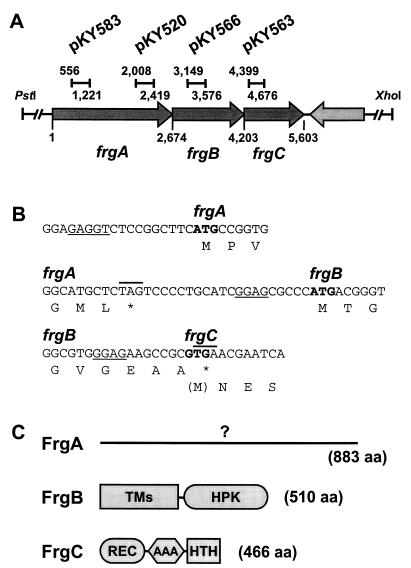
FIG. 1
FIG. 1
Organization of the frgA, frgB, and frgC genes and their protein products. (A) Physical map of the frgABC operon and the plasmids used to create insertion mutants. The numbers indicate the nucleotide position of each site from the translational start site of the frgA gene. The bars indicate the DNA fragment from each gene that was cloned into the respective plasmids and used for mutant construction, as described in the text. (B) Predicted ribosome binding sites (underlined) and termination codons (asterisks and lines above sequence) of the frgA, frgB, and frgC genes. The predicted initiation codons are highlighted in boldface. (C) Domain organization of the deduced products of the frgA, frgB, and frgC genes. FrgA is not similar to any protein in the database. FrgB contains eight predicted transmembrane domains (TMs; from amino acid (aa) residues 1 to 264) and a histidine protein kinase domain (HPK; from amino acid residues 283 to 498). FrgC consists of a receiver domain (REC; from amino acid residues 7 to 118), an ATPase domain (AAA; from amino acid residues 160 to 303), and a helix-turn-helix DNA binding domain (HTH; from amino acid residues 440 to 461).
FIG. 2
FIG. 2
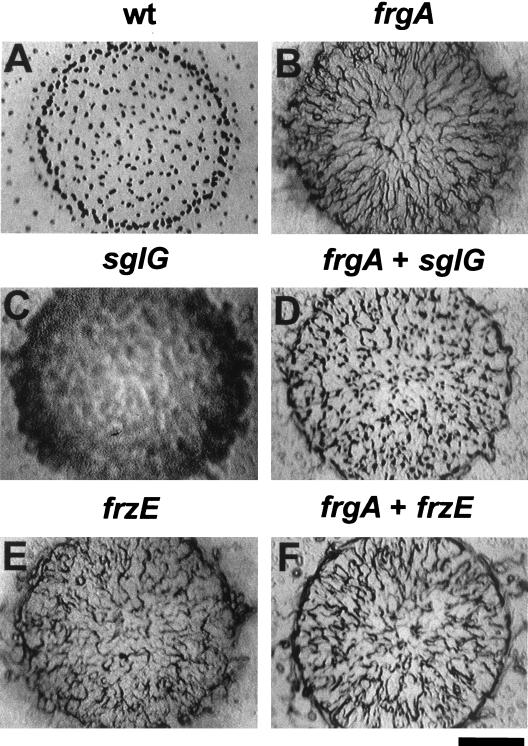
Developmental phenotype and extracellular complementation of the frgA mutant. Cells (10 μl at 2 × 10⁹ cells/ml) were placed on CF agar plates and incubated at 34°C for 3 days and then photographed under a dissecting microscope (bar, 2 mm). (A) M. xanthus DZF1 forms wild-type (wt) fruiting bodies. (B) The frgA mutant (DZF4290) forms frizzy aggregates. (C) The sglG mutant (DK1300) is defective in aggregation. (D) The frgA mutant mixed with the sglG mutant in 4-to-1 ratio. (E) The frzE mutant (DZF3379) forms frizzy aggregates. (F) The frgA mutant mixed with the frzE mutant in 4-to-1 ratio.
FIG. 3
FIG. 3
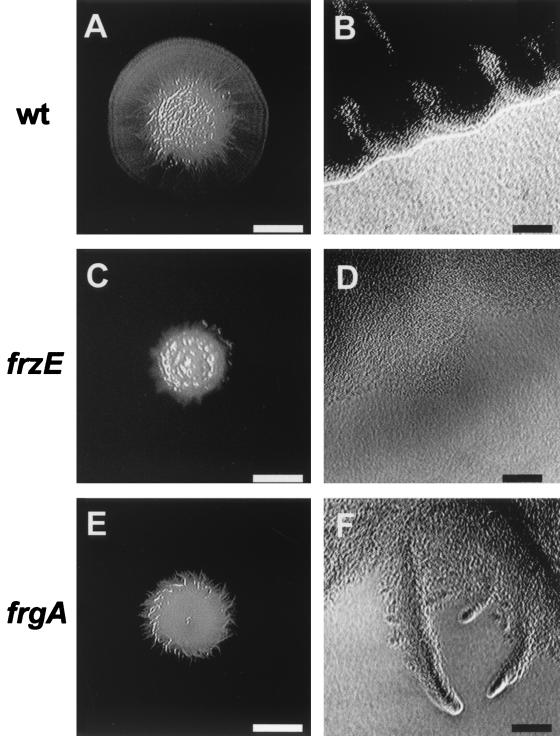
Vegetative swarming of the frgA mutant. M. xanthus DZ2 (wild type [wt]) (A and B), the frzE mutant (DZ4148) (C and D), and the frgA mutant (DZ4291) (E and F) were placed on CYE agar plates (0.3% agar) as described previously (25) and incubated at 34°C for 2 days. (A, C, and E) Overall colony morphology at a low magnification; (B, D, and F) edge of each colony at a higher magnification. White bars, 5 mm; black bars, 50 μm.
FIG. 4
FIG. 4
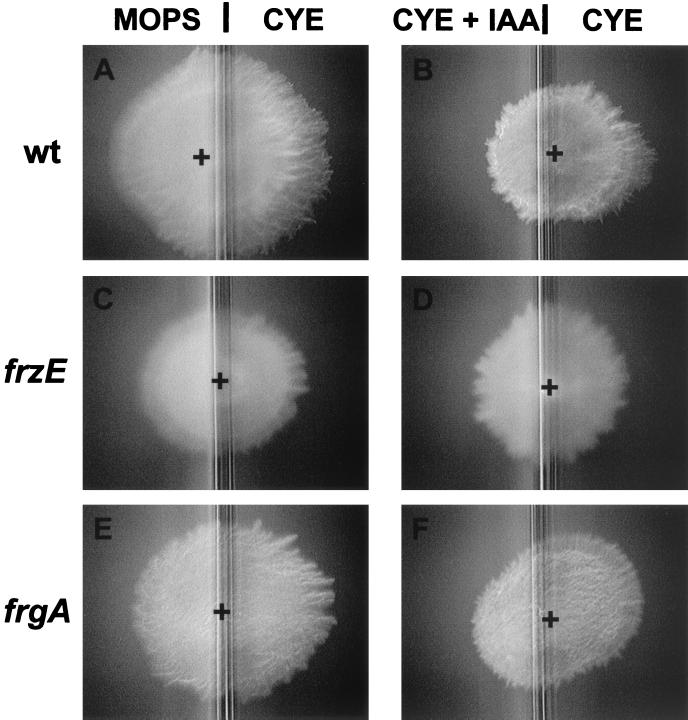
Chemotaxis assay. M. xanthus DZ2 (wild type [wt]) (A and B), the frzE mutant (DZ4148) (C and D), and the frgA mutant (DZ4291) (E and F) were placed on compartmentalized agar plates as described previously (26). MOPS-CYE plates contain 10 mM MOPS buffer in the left side and the CYE medium in the right side. IAA-CYE plates contain 0.1% isoamyl alcohol in the CYE medium in the left side and the CYE medium in the right side. +, center of the original spot of cells.
FIG. 5
FIG. 5
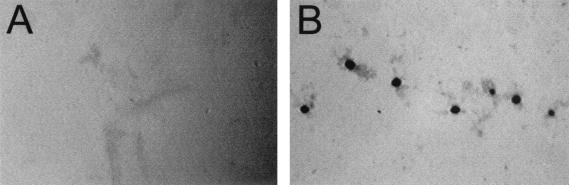
Extracellular complementation of the developmental defect of the frgA mutant in submerged culture by cell-free conditioned medium. The cell-free conditioned medium was from a submerged culture containing DZ2 cells developed in the MMC medium for 14 h at 34°C. Fruiting body development in submerged culture was carried out as described previously (14). (A) frgA mutant (DZF4290) with MMC medium only; (B) frgA mutant (DZF4290) with conditioned medium.

References

    1. Altschul S F, Madden T L, Schaffer A A, Zhang J, Zhang Z, Miller W, Lipman D J. Gapped BLAST and PSI-BLAST: a new generation of protein database search programs. Nucleic Acids Res. 1997;25:3389–3402. - PMC - PubMed
    1. Blackhart B D, Zusman D R. “Frizzy” genes of Myxococcus xanthus are involved in control of frequency of reversal of gliding motility. Proc Natl Acad Sci USA. 1985;82:8767–8770. - PMC - PubMed
    1. Campos J M, Zusman D R. Regulation of development in Myxococcus xanthus: effect of 3′:5′-cyclic AMP, ADP, and nutrition. Proc Natl Acad Sci USA. 1975;72:518–522. - PMC - PubMed
    1. Campos J M, Geisselsoder J, Zusman D R. Isolation of bacteriophage Mx4, a generalized transducing phage for Myxococcus xanthus. J Mol Biol. 1978;119:167–178. - PubMed
    1. Chen Y M, Backman K, Magasanik B. Characterization of a gene, glnL, the product of which is involved in the regulation of nitrogen utilization in Escherichia coli. J Bacteriol. 1982;150:214–220. - PMC - PubMed

Publication types

MeSH terms

Substances

Associated data

LinkOut - more resources