. 2000 Dec;67(6):1382-8.
doi: 10.1086/316915. Epub 2000 Nov 8.

Mutations in FOXC2 (MFH-1), a forkhead family transcription factor, are responsible for the hereditary lymphedema-distichiasis syndrome

Affiliations

Mutations in FOXC2 (MFH-1), a forkhead family transcription factor, are responsible for the hereditary lymphedema-distichiasis syndrome

J Fang et al. Am J Hum Genet. 2000 Dec.

Abstract

Lymphedema-distichiasis (LD) is an autosomal dominant disorder that classically presents as lymphedema of the limbs, with variable age at onset, and double rows of eyelashes (distichiasis). Other complications may include cardiac defects, cleft palate, extradural cysts, and photophobia, suggesting a defect in a gene with pleiotrophic effects acting during development. We previously reported neonatal lymphedema, similar to that in Turner syndrome, associated with a t(Y;16)(q12;q24.3) translocation. A candidate gene was not found on the Y chromosome, and we directed our efforts toward the chromosome 16 breakpoint. Subsequently, a gene for LD was mapped, by linkage studies, to a 16-cM region at 16q24.3. By FISH, we determined that the translocation breakpoint was within this critical region and further narrowed the breakpoint to a 20-kb interval. Because the translocation did not appear to interrupt a gene, we considered candidate genes in the immediate region that might be inactivated by position effect. In two additional unrelated families with LD, we identified inactivating mutations-a nonsense mutation and a frameshift mutation-in the FOXC2 (MFH-1) gene. FOXC2 is a member of the forkhead/winged-helix family of transcription factors, whose members are involved in diverse developmental pathways. FOXC2 knockout mice display cardiovascular, craniofacial, and vertebral abnormalities similar to those seen in LD syndrome. Our findings show that FOXC2 haploinsufficiency results in LD. FOXC2 represents the second known gene to result in hereditary lymphedema, and LD is only the second hereditary disorder known to be caused by a mutation in a forkhead-family gene.


Figures
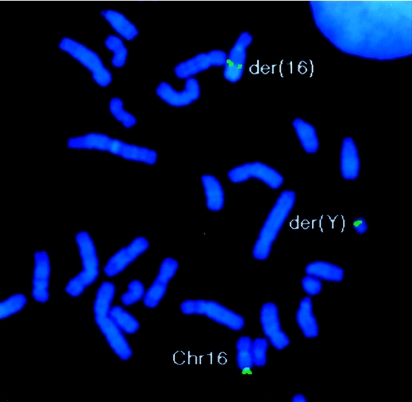
Figure  1
Figure 1
Results of FISH. BAC clone 58A18 (green), which maps to 16q24.3, crosses the t(Y;16)(q11.2;q24.3) translocation breakpoint and hybridizes to the der(Y), der(16), and normal chromosome 16. Metaphase spreads of lymphoblastoid cells from the patient with the t(Y;16) translocation were hybridized with a biotin-labeled BAC 58A18 probe, as described in the Subjects and Methods section.
Figure  2
Figure 2
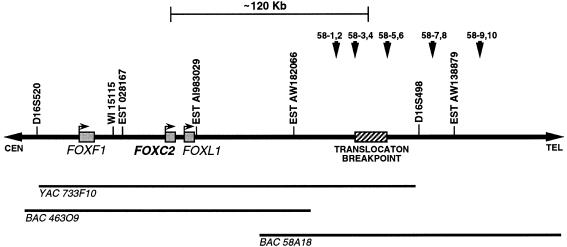
Map of the 16q24.3 region containing the FOXC2 gene. The positions of several sequence-tagged sites and ESTs are indicated. The shaded boxes represent three forkhead genes—FOXF1, FOXC2, and FOXL1. The hatched box indicates the position of the translocation breakpoint identified in the patients with the t(Y;16) translocation and lymphedema. The translocation breakpoint is ∼120 kb distal to the FOXC2 gene. The positions of YAC 733F10, BAC 463O9, and BAC 58A18 are indicated below the map. The arrowheads indicate the positions of five PCR-based FISH probes used to fine-map the translocation breakpoint
Figure  3
Figure 3
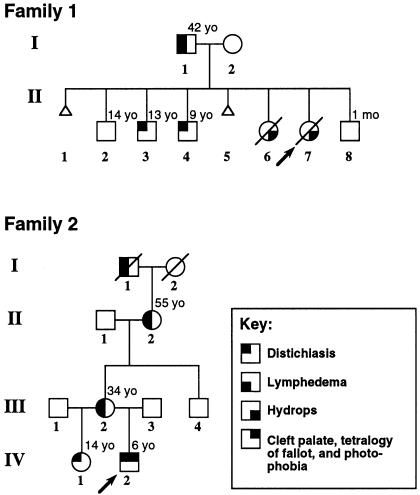
Pedigrees of families with LD. All living members of both families were examined clinically, as were the two fetuses in family 1. The current ages of all relevant family members are indicated (yo = years old). Family 1 was ascertained via fetus II-7, which was electively aborted at 17 wk gestation, because of hydrops fetalis. Pathological examination showed severe nonimmune hydrops. No heart defects were noted. Additional family members presented with either lymphedema-distichiasis or distichiasis alone in younger individuals. Onset of lymphedema in I-1 was at 12 years of age. Fetus II-6 was electively aborted because of cystic hygroma and hydrops. The proband in family 2 was ascertained at age 4 mo, when he presented with cleft palate, cystic hygroma, tetralogy of Fallot, and distichiasis. Additional family members showed either lymphedema-distichiasis or distichiasis alone. No other family members had clinical signs of congenital heart disease, although echocardiography was not performed. Age at onset of lymphedema in individual II-2 was the early 30s, whereas that in individual III-2 was 17 years. Both pedigrees are consistent with an autosomal dominant mode of inheritance.
Figure  4
Figure 4
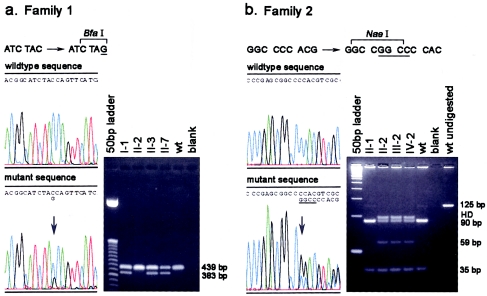
Mutation analysis in two families with hereditary lymphedema. Mutations in the FOXC2 gene were detected by direct sequencing of the PCR-amplified coding region of the gene. Results were confirmed by sequencing the reverse strand and by restriction-enzyme analysis. a, Sequencing revealed a TAC→TAG nonsense mutation (C297G) (arrow, left panel) in the proband (II-7) in family 1, creating a novel BfaI restriction site. The right panel shows the cosegregation of the novel restriction site with the LD phenotype. Fetus II-6 was also shown to have the mutation, by restriction digest analysis (not shown). A 439-bp region of the FOXC2 gene was PCR amplified and digested with BfaI. Products from normal alleles are not cut and remain 439 bp, whereas the mutant allele is cut into 383- and 53-bp fragments (not retained on gel). b, Sequence analysis revealing a 4-bp insertion in the proband (IV-2) in family 2. The GGCC insertion creates a shifted sequence beginning at the arrow (left panel). A novel NaeI restriction site is created by the insertion. The right panel shows the cosegregation of the NaeI fragments with the LD phenotype in family 2. PCR was used to amplify a 125-bp region of the FOXC2 gene (129 bp for the mutant allele). NaeI digestion of the PCR products results in 35- and 90-bp fragments for normal alleles, because of the presence of a naturally occurring NaeI site in the product. In alleles with the insertion, the 129-bp product is cut twice, generating two 35-bp fragments and a 59-bp fragment. Bands labeled “HD” show uncut heteroduplexes.

References

Electronic-Database Information

    1. GenBank Overview, http://www.ncbi.nlm.nih.gov/Genbank/GenbankOverview.html (for FOXC2 [accession number NM_005251] and FOXL1 [accession number AF315075])
    1. Online Mendelian Inheritance in Man (OMIM), http://www.ncbi.nlm.nih.gov/Omim (for Milroy disease [MIM 153100] and LD [MIM 153400])

References

    1. Baskaran N, Kandpal RP, Bhargava AK, Glynn MW, Bale A, Weissman SM (1996) Uniform amplification of a mixture of deoxyribonucleic acids with varying GC content. Genome Res 6:633–638 - PubMed
    1. Corbett CRR, Dale RF, Coltart DJ, Kinmonth JB (1982) Congenital heart disease in patients with primary lymphoedemas. Lymphology 15:85–90 - PubMed
    1. Dagenais SL, Guevara-Fujita M, Loechel R, Burgess AC, Miller DE, Yuzbasiyan-Gurkan V, Brewer GJ, Glover TW (1999) The canine copper toxicosis locus is not syntenic with ATP7B or ATX1 and maps to a region showing homology to human 2p21. Mamm Genome 10:753–756 - PubMed
    1. Erickson RP, Hudgins L, Stone JF, Schmidt S, Wilke C, Glover TW (1995) A “balanced” Y;16 translocation associated with Turner-like neonatal lymphedema suggests the location of a potential anti-Turner gene on the Y chromosome. Cytogenet Cell Genet 71:163–167 - PubMed
    1. Falls HF, Kertesz ED (1964) A new syndrome combining pterygium colli with developmental anomalies of the eyelids and lymphatics of the lower extremities. Trans Am Ophthalmol Soc 62:248–275 - PMC - PubMed

Publication types

MeSH terms

Substances

Associated data