


Production of interleukin-6 in contracting human skeletal muscles can account for the exercise-induced increase in plasma interleukin-6
- PMID: 11080265
- PMCID: PMC2270169
- DOI: 10.1111/j.1469-7793.2000.00237.x
Production of interleukin-6 in contracting human skeletal muscles can account for the exercise-induced increase in plasma interleukin-6
Abstract
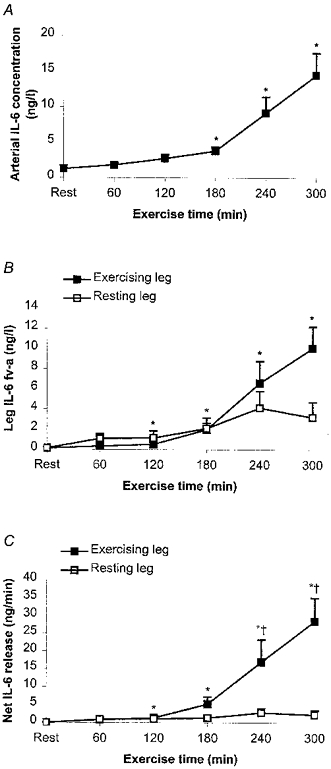
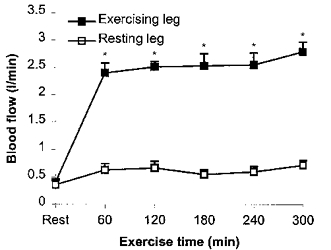
1. Plasma interleukin (IL)-6 concentration is increased with exercise and it has been demonstrated that contracting muscles can produce IL-The question addressed in the present study was whether the IL-6 production by contracting skeletal muscle is of such a magnitude that it can account for the IL-6 accumulating in the blood. 2. This was studied in six healthy males, who performed one-legged dynamic knee extensor exercise for 5 h at 25 W, which represented 40% of peak power output (Wmax). Arterial-femoral venous (a-fv) differences over the exercising and the resting leg were obtained before and every hour during the exercise. Leg blood flow was measured in parallel by the ultrasound Doppler technique. IL-6 was measured by enzyme-linked immunosorbent assay (ELISA). 3. Arterial plasma concentrations for IL-6 increased 19-fold compared to rest. The a-fv difference for IL-6 over the exercising leg followed the same pattern as did the net IL-6 release. Over the resting leg, there was no significant a-fv difference or net IL-6 release. The work was produced by 2.5 kg of active muscle, which means that during the last 2 h of exercise, the median IL-6 production was 6.8 ng min-1 (kg active muscle)-1 (range, 3.96-9.69 ng min-1 kg-1). 4. The net IL-6 release from the muscle over the last 2 h of exercise was 17-fold higher than the elevation in arterial IL-6 concentration and at 5 h of exercise the net release during 1 min was half of the IL-6 content in the plasma. This indicates a very high turnover of IL-6 during muscular exercise. We suggest that IL-6 produced by skeletal contracting muscle contributes to the maintenance of glucose homeostasis during prolonged exercise.
Figures
Comment in
-
Interleukins and exercise.J Physiol. 2000 Nov 15;529 Pt 1(Pt 1):1. doi: 10.1111/j.1469-7793.2000.00001.x. J Physiol. 2000. PMID: 11080244 Free PMC article. No abstract available.
References
-
- Andersen P, Adams RP, Sjogaard G, Thorboe A, Saltin B. Dynamic knee extension as model for study of isolated exercising muscle in humans. Journal of Applied Physiology. 1985;59:1647–1653. - PubMed
-
- Bernéus B, Carlsten A, Holmgren A, Seldinger SI. Percutaneous catheterization of peripheral arteries as a method for blood sampling. Scandinavian Journal of Clinical Laboratory Investigation. 1954;6:217–221. - PubMed
-
- Bruunsgaard H, Skinhoj P, Qvist J, Pedersen BK. Elderly humans show prolonged in vivo inflammatory activity during pneumococcal infections. Journal of Infectious Diseases. 1999;180:551–554. - PubMed
Publication types
MeSH terms
Substances
LinkOut - more resources
Full Text Sources
Other Literature Sources
Medical
Molecular Biology Databases
Miscellaneous
