"Hospital at home" versus hospital care in patients with exacerbations of chronic obstructive pulmonary disease: prospective randomised controlled trial
- PMID: 11082090
- PMCID: PMC27532
- DOI: 10.1136/bmj.321.7271.1265
"Hospital at home" versus hospital care in patients with exacerbations of chronic obstructive pulmonary disease: prospective randomised controlled trial
Abstract
Objectives: To compare "hospital at home" and hospital care as an inpatient in acute exacerbations of chronic obstructive pulmonary disease.
Design: Prospective randomised controlled trial with three months' follow up.
Setting: University teaching hospital offering secondary care service to 350 000 patients.
Patients: Selected patients with an exacerbation of chronic obstructive pulmonary disease where hospital admission had been recommended after medical assessment.
Interventions: Nurse administered home care was provided as an alternative to inpatient admission.
Main outcome measures: Readmission rates at two weeks and three months, changes in forced expiratory volume in one second (FEV(1)) from baseline at these times and mortality.
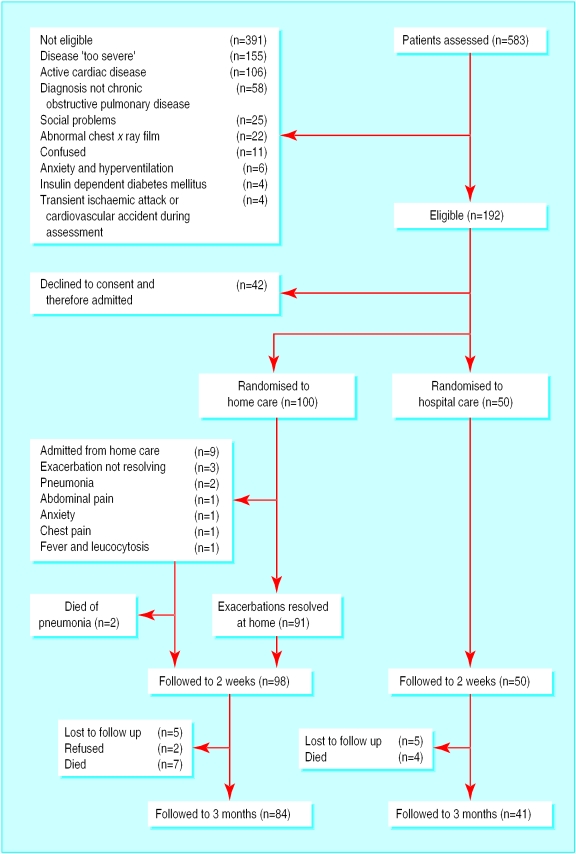
Results: 583 patients with chronic obstructive pulmonary disease referred for admission were assessed. 192 met the criteria for home care, and 42 refused to enter the trial. 100 were randomised to home care and 50 to hospital care. On admission, FEV(1) after use of a bronchodilator was 36.1% (95% confidence interval 2.4% to 69.8%) predicted in home care and 35.1% (6.3% to 63. 9%) predicted in hospital care. No significant difference was found in FEV(1 )after use of a bronchodilator at two weeks (42.6%, 3.4% to 81.8% versus 42.1%, 5.1% to 79.1%) or three months (41.5%, 8.2% to 74.8% versus 41.9%, 6.2% to 77.6%) between the groups. 37% of patients receiving home care and 34% receiving hospital care were readmitted at three months. No significant difference was found in mortality between the groups at three months (9% versus 8%).
Conclusions: Hospital at home care is a practical alternative to emergency admission in selected patients with exacerbations of chronic obstructive pulmonary disease.
References
-
- National Health Service Executive. Burdens of disease: a discussion document. Leeds: Department of Health; 1996.
-
- Seneff MG, Wagner DP, Wagner RP, Zimmerman JE, Knaus WA. Hospital and 1-year survival of patients admitted to intensive care units with acute exacerbation of chronic obstructive pulmonary disease. JAMA. 1995;274:1852–1857. - PubMed
-
- Connors AF, Dawson NV, Thomas C, Harrell FE, Jr, Desbiens N, Fulkerson WJ, et al. Outcomes following acute exacerbation of severe chronic obstructive lung disease. Am J Respir Crit Care Med. 1996;154:959–967. - PubMed
Publication types
MeSH terms
LinkOut - more resources
Full Text Sources
Miscellaneous